All species › Passerines › Chats and flycatchers › Seebohm's Wheatear
Seebohm's Wheatear | Oenanthe seebohmi
Seebohms tapuit | Collalba de Seebohm
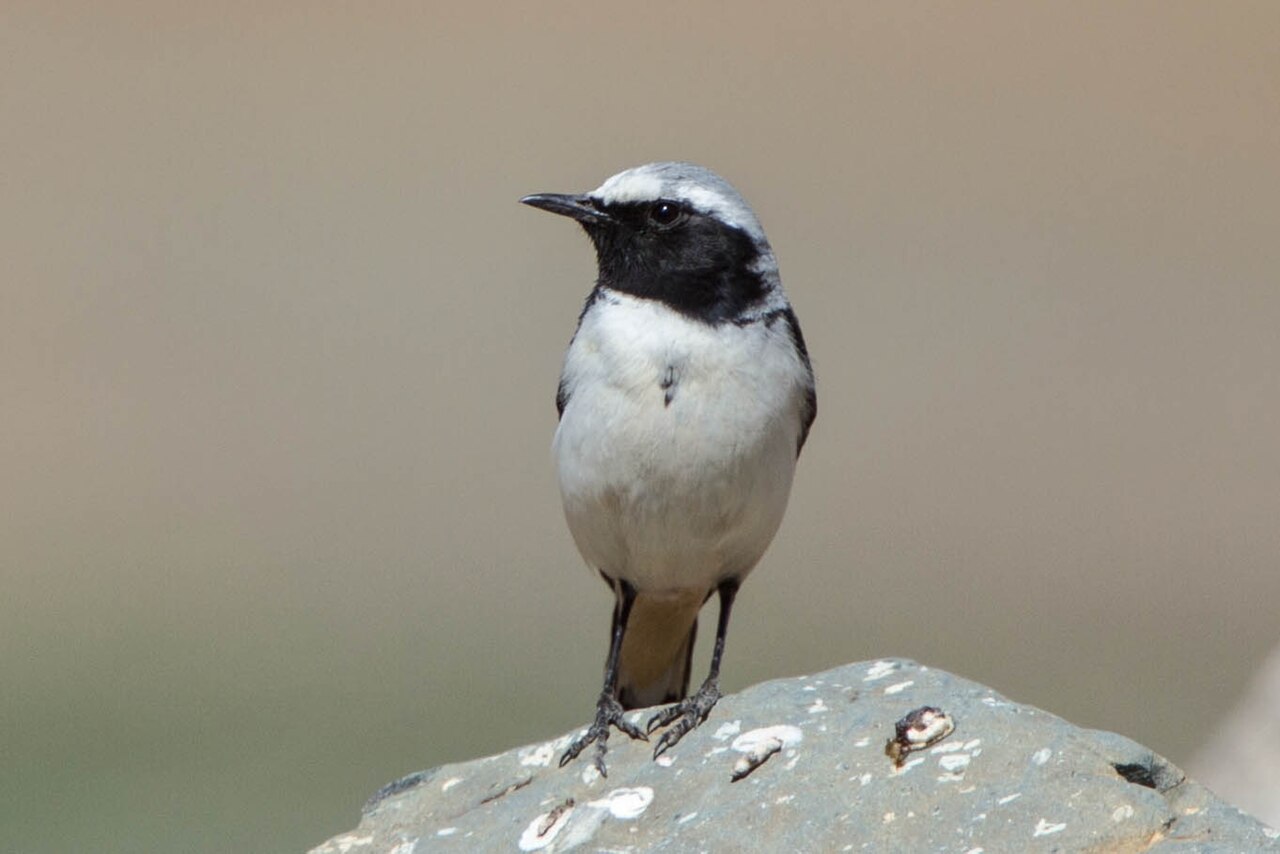
A wheatear with a black throat; other differences from Northern Wheatear are slight. Seebohm's Wheatear breeds only on the high stony plateaux of the Atlas mountains, and since 2021 the world lists have treated it as a species separate from Northern Wheatear. The spring male is recognised at a glance; other plumages usually cannot be identified with certainty in the field.
Voice
The song resembles that of Northern Wheatear but is slower and lower pitched, with better-defined melodious phrases that clearly rise and fall instead of the hurried scratchy rattle of its relative. It sings from a stone or a low bush and sometimes in a brief song flight. The call is the same stony chak and thin rising hweet that the whole family carries. Heard from March into June on the high plateaux.
Recording: Tero Linjama — CC BY-NC-SA 4.0 · Wikimedia Commons
Identification
At first sight a Northern Wheatear: upright, long-legged, short-tailed, with a white rump panel and a black tail band. The breeding male differs on four points. The throat is black, and that black runs from the chin across the cheeks and ear coverts into a solid mask, sometimes reaching the upper breast; on Northern Wheatear the throat is pale. The underparts are clean white to faintly cream, without the warm orange-buff breast of Northern Wheatear. The forehead and supercilium are whiter and broader. And the underwing coverts are almost solidly black, without the pale fringes Northern Wheatear shows there — a character visible only when the bird flies off or lifts a wing. The black terminal band of the tail is narrower than on Northern Wheatear, covering about a third of the outer feather. The bird is also fractionally smaller and shorter-winged, with a shorter primary projection. The female is another matter: many females cannot be separated from a female Northern Wheatear at all. The best of them show greyer upperparts, dark to nearly black lores and ear coverts, a short narrow supercilium, and dark underwing coverts streaked with pale. First-year birds in autumn cannot be identified.
Confusion species
Northern Wheatear is the direct counterpart — see also its own species page. On a spring male the throat decides: black on Seebohm's, pale on Northern — and with it come the clean white rather than orange-buff breast, the narrower black tail band and the black underwing. Outside that plumage the rule reverses: any brown, moulting or young bird is a Northern Wheatear until proved otherwise, and in the field that proof is usually not available. In the Atlas the calendar helps: Northern Wheatear passes through in March and April and again in August and September but breeds nowhere in north-west Africa, so a black-throated male holding territory in May or June is settled. The real local pitfall is not Northern Wheatear but the black-throated morph of Western Black-Eared Wheatear, which is common there; see its own page too. That bird has a creamy-ochre mantle rather than a grey one, and above all a tail that is almost entirely white with a thin black edge, where Seebohm's carries the broad black band of a Northern Wheatear. It is also slimmer and longer-tailed, and its black throat is a patch, not a mask running across the cheek. The same mountains also hold Isabelline Wheatear, larger and plain sandy, with a short tail in which the black band is broad, and no black at all on the head; Desert Wheatear, with a black throat running on to the shoulder and a nearly all-black tail; Black Wheatear, large and wholly black with a white rump; and White-Crowned Wheatear, black with a white crown and an almost entirely white tail. Whinchat has a broad pale supercilium, a streaked back and white patches at the tail base instead of a white rump panel.
Habitat
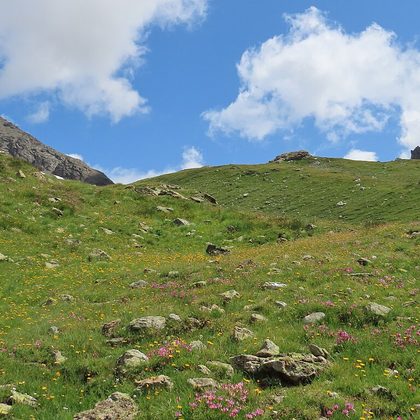
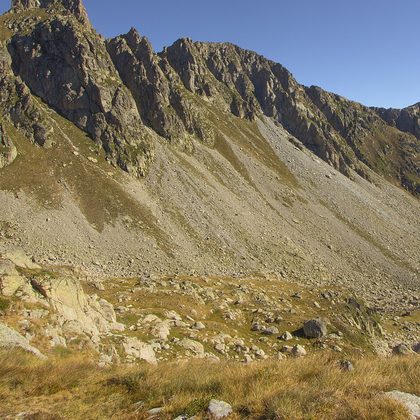
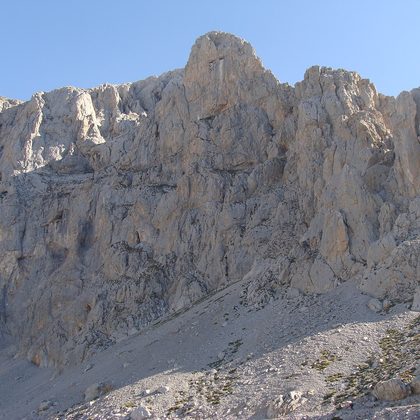
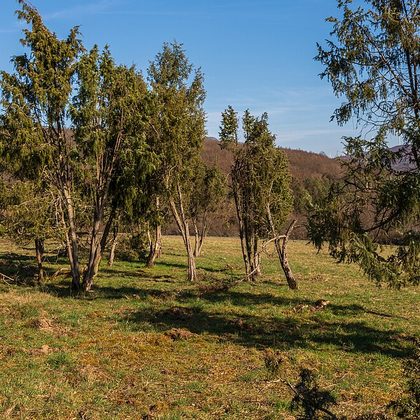
High stony plateaux and short mountain turf above the treeline, with boulders, scree and bare ground. In the western Atlas mainly between 1,700 and 2,300 m, in the eastern Atlas locally far lower, down to about 150 m. The nest goes in a hole in the ground or between rocks. In winter, far outside the area of this guide, it stands on open Sahel savanna with scattered acacias rather than on the bare desert edge.
Where the bird is most at home, classified with EUNIS — the European standard for habitats.
Range and movements
Breeds only in north-west Africa, with a broken range across the Rif, the Middle Atlas, the High Atlas and the central Anti-Atlas in the west and across the Aurès and the Djurdjura further east. Every bird leaves: the winter is spent in the western Sahel, between 15 and 18 degrees north, where an estimated fifty thousand birds gather. Because that lies well outside the map of this guide, within the region it is purely a breeding bird and migrant of the Atlas. Away from north-west Africa it is an exceptional vagrant, with a handful of records in Europe.
- Breeding (summer)
- Passage
- dark = core range, pale = thinly spread
How and when to look
May on the Oukaïmeden plateau or the high ground of the Middle Atlas above Ifrane, shortly after sunrise. Find short stony pasture with grazing stock and watch for males singing from a rock. Look first at the throat, then at the breast, and then flush the bird: the black underwing and the narrow tail band confirm the picture in one movement. Females and brown birds usually cannot be identified in the field.
Conservation status
Least Concern on the Red List, and unlike many recent splits this is an assessment of the species itself rather than of the wider one. The range is small and fragmented and the bird is nowhere abundant, but the high Atlas plateaux change slowly and are hard to bring into cultivation. The pressures sit at the edges: overgrazing that reduces the vegetation to dust, the spread of ski areas and roads, and drought in the Sahel where the entire population spends the winter. Because there is only one mountain system in which it breeds, the species stays sensitive to anything that alters the climate there.
Scientific name
Oenanthe seebohmi | (Dixon, 1882) (GBIF: Oenanthe oenanthe)
Dixon described the species in 1882 as Saxicola seebohmi; because it was later moved to another genus, the author and year stand in brackets. The genus Oenanthe was introduced in 1816 by Vieillot. Oenanthe was used by Aristotle for a bird that can no longer be identified; the word comes from the Greek oinos, oinoē 'wine, vine' and anthos 'flower, bloom'. seebohmi honours the English ornithologist Henry Seebohm (1832–1895), who wrote extensively on Palearctic songbirds. The specimen the first description was based on came from Djebel Mahmel, Algeria.