All species › Passerines › Sylvia warblers › Sardinian Warbler
Sardinian Warbler | Curruca melanocephala
Kleine zwartkop | Curruca cabecinegra
Sardinian Warbler is the noisiest bird of Mediterranean scrub: a small, long-tailed warbler with a jet-black hood, a bright red eye-ring and a rattle that sounds like someone angrily running a stick along a fence. Around the Mediterranean it is everywhere — in the maquis, in the hedges, in the olive grove and in the middle of the village.
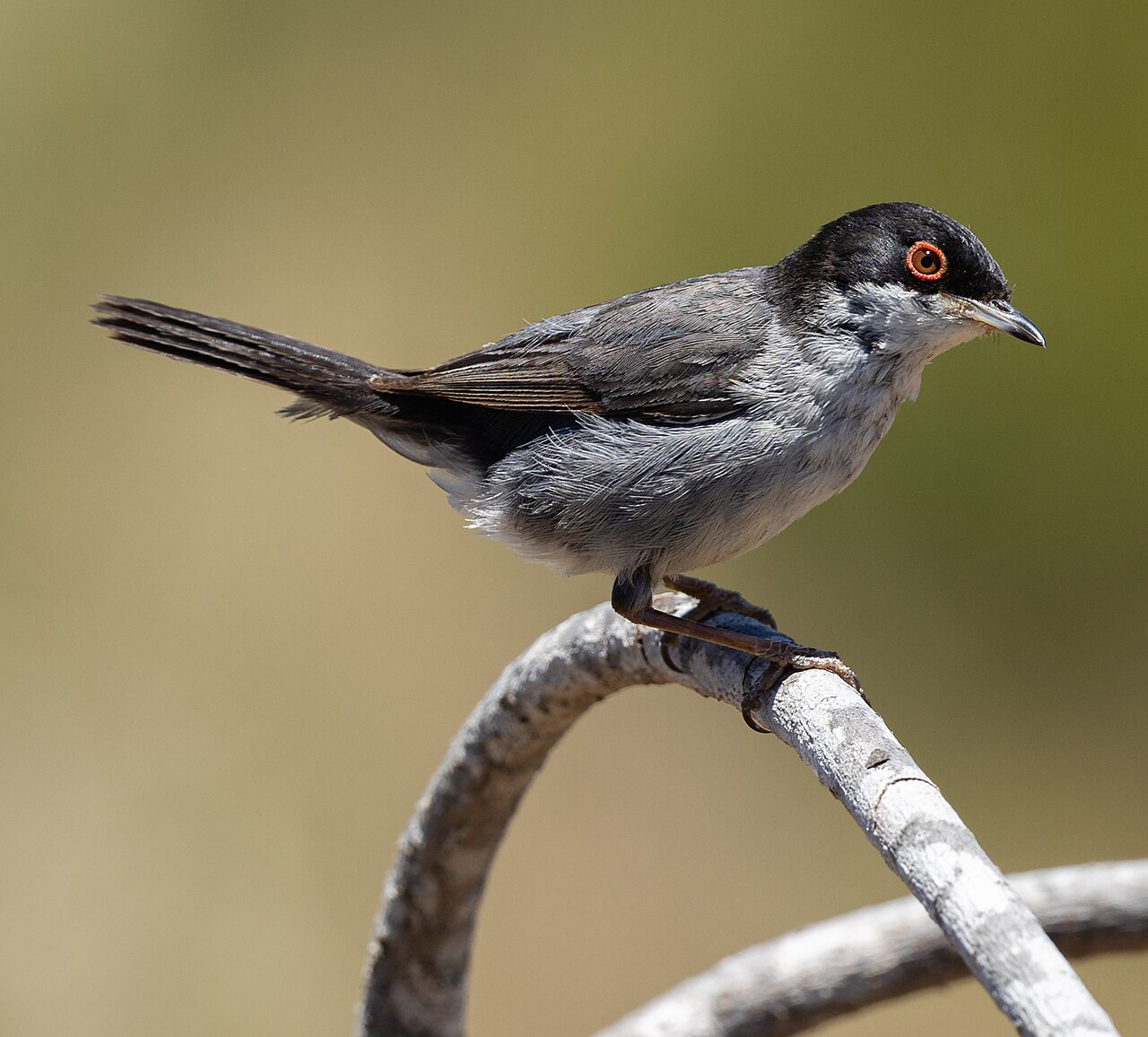
Click a thumbnail to switch the photo above.
Voice
You hear the call before you see the bird: a hard, rattling, angry-sounding tche-tche-tche-tche-tche, fast and on one pitch, like a small ratchet or a stick dragged along railings. It is given all day, all year, and starts the moment you approach a bush. The song is a short, hurried strophe of two to five seconds: a fast, scratchy, grating chatter through which that same rattle keeps falling, with the odd short shrill whistle thrown in. It is delivered from the top of a bush or in a brief bouncing song flight above the scrub, from February into June, and in the far south already in January. Once the rattle is learned, hardly a bush in Iberia seems to lack a Sardinian Warbler.
Recording: Tanguy Loïs — CC BY-SA 4.0 · xeno-canto
Identification
Small, slim and long-tailed, the tail often held up or flicked about nervously. The male has a glossy black hood that does not stop above the eye but runs below it and across the ear-coverts, so that the whole face is black; against it lies a clean white throat that leaps out. A conspicuous red ring surrounds the eye, with a red-brown iris inside it. The mantle is grey, the underparts white to pale grey, the tail black with white outer feathers, and the legs orange-brown to reddish. The female lacks the black: the head is grey to grey-brown, the mantle brown-grey and the underparts a dull cream, but the red eye-ring and the pale legs remain. Juveniles resemble the female, with a duller eye-ring.
Confusion species
For observers from the north Blackcap is the main confusion species, and a single look separates them — see the Blackcap's own species page, where the same difference is set out from the other side. In Blackcap the black cap stops neatly above the eye, there is no eye-ring, the throat is grey rather than clean white and the whole bird is plain grey-brown; the song ends in a rich fluting passage. In Sardinian Warbler the black runs below the eye, a bright red ring surrounds it, the white throat leaps out and the voice consists of rattles and more rattles, without a single clear whistle. Females are harder: a female Blackcap has a rufous cap with a sharp border, while a female Sardinian has a plain grey head, a red eye-ring and pale legs. Further round the Mediterranean there are three neighbours to check. The Subalpine Warblers are smaller and have an orange to brick-red throat and breast with a white moustachial stripe. Rüppell's Warbler, in the southern Balkans and Anatolia, adds a black throat with a white moustachial stripe to the black head. And on Cyprus there is Cyprus Warbler, whose male is spotted black from throat to belly instead of clean white — see its own page.
Habitat
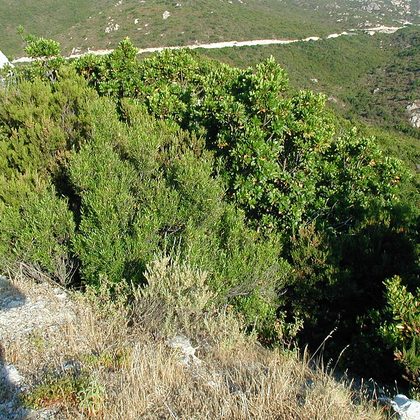
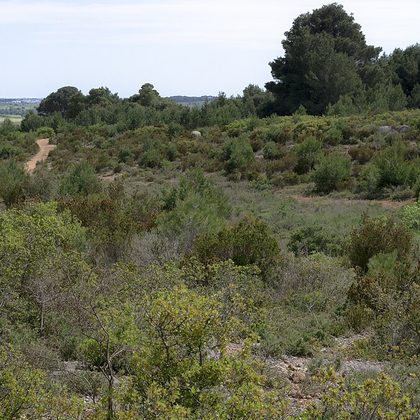
Low, dense, thorny scrub: maquis and garrigue, kermes oak and mastic thickets, broom and cistus, oleander-lined ramblas, hedges and hedgebanks, gardens, parks, cemeteries and the untidy edges of villages and towns. Also olive and almond groves with a dense understorey, and vineyards with hedges. Unlike the Orphean Warblers it wants exactly the low, impenetrable scrub and needs no tall trees; it occurs from sea level to about 1,200 metres.
Where the bird is most at home, classified with EUNIS — the European standard for habitats.



Range and movements
All round the Mediterranean: from Iberia through Languedoc, Provence, the Apennine peninsula and the Balkans to Anatolia and the Levant, and on the African side from the Maghreb to the Nile delta, with its own subspecies in the Canary Islands. A resident that barely moves outside the breeding season. In Iberia it breeds almost everywhere except the highest ground and the wet Atlantic fringe of the north, and is very numerous along the Mediterranean coast, in the Guadalquivir valley and on the Balearics. In the north it has been expanding for decades: it has filled Languedoc and now breeds into Catalonia, Provence and the north of the Apennine peninsula. In north-west Europe it is an exceptional vagrant.
- Resident
- Breeding (summer)
- Winter
- Passage
- dark = core range, pale = thinly spread
How and when to look
Around the Mediterranean at any time of year, but easiest in March and April, when the males are singing. Stand still by a dense bush and wait: the rattle comes of its own accord, and a moment later the bird pops onto the top with its tail cocked. That short moment is enough — look for the red eye-ring and check whether the black runs below the eye. Anyone arriving from the north does well to line the two up deliberately on the first day: first a singing Blackcap in the wood, then a rattling Sardinian Warbler in the scrub beside it.
Conservation status
Not threatened and one of the most numerous songbirds of the Mediterranean, with a population that is stable or increasing across almost the whole range. The species profits from the closing over of abandoned fields and pasture and is spreading north as winters soften. Locally, large fires, the grubbing out of hedges and the tidying of olive groves cost nest sites, and on Cyprus the advance of the Sardinian Warbler is itself a problem for the far rarer Cyprus Warbler.
Scientific name
Curruca melanocephala | (Gmelin, 1789)
Gmelin described the species in 1789 as Motacilla melanocephala; because it was later moved to another genus, the author and year stand in brackets. The genus Curruca was introduced in 1802 by Bechstein. Curruca is Latin, the name of an unidentified small bird mentioned by the Roman poet Juvenal. melanocephala is Greek, from melas 'black' and kephale 'head', after the male's black cap. The specimen the first description was based on came from Sardinia.