All species › Passerines › Chats and flycatchers › Red-Breasted Flycatcher
Red-Breasted Flycatcher | Ficedula parva
Kleine vliegenvanger | Papamoscas papirrojo
The Red-Breasted Flycatcher turns up on the North Sea coast in October: a small, round, robin-shaped bird in a wind-cut hawthorn behind the dunes, cocking its tail and vanishing. There are only a handful each autumn, almost all young birds with no trace of orange, and they are found by people who know the dry rattling call. In the hill forests of the Carpathians it is a common breeder, and there you hear it long before you see it.
Click a thumbnail to switch the photo above.
Voice
The call is what matters here: a dry rattling trrrt strongly recalling a Wren but shorter and softer, often alternating with a short hard hit or chik. Anyone who hears that in a coastal copse in October should stop walking. The song, heard in eastern Europe and occasionally from a spring male singing in an estate wood in north-west Europe, is a short clear whistled run that opens like a Chiffchaff and then falls away like the end of a Willow Warbler's phrase: tsi-tsi-tsi-tyoo-tyoo-tyoo, three to four seconds long and loud for so small a bird. The male sings high in the canopy, throat puffed and tail spread.
Recording: Sonothèque ADVL — CC0 · xeno-canto
Identification
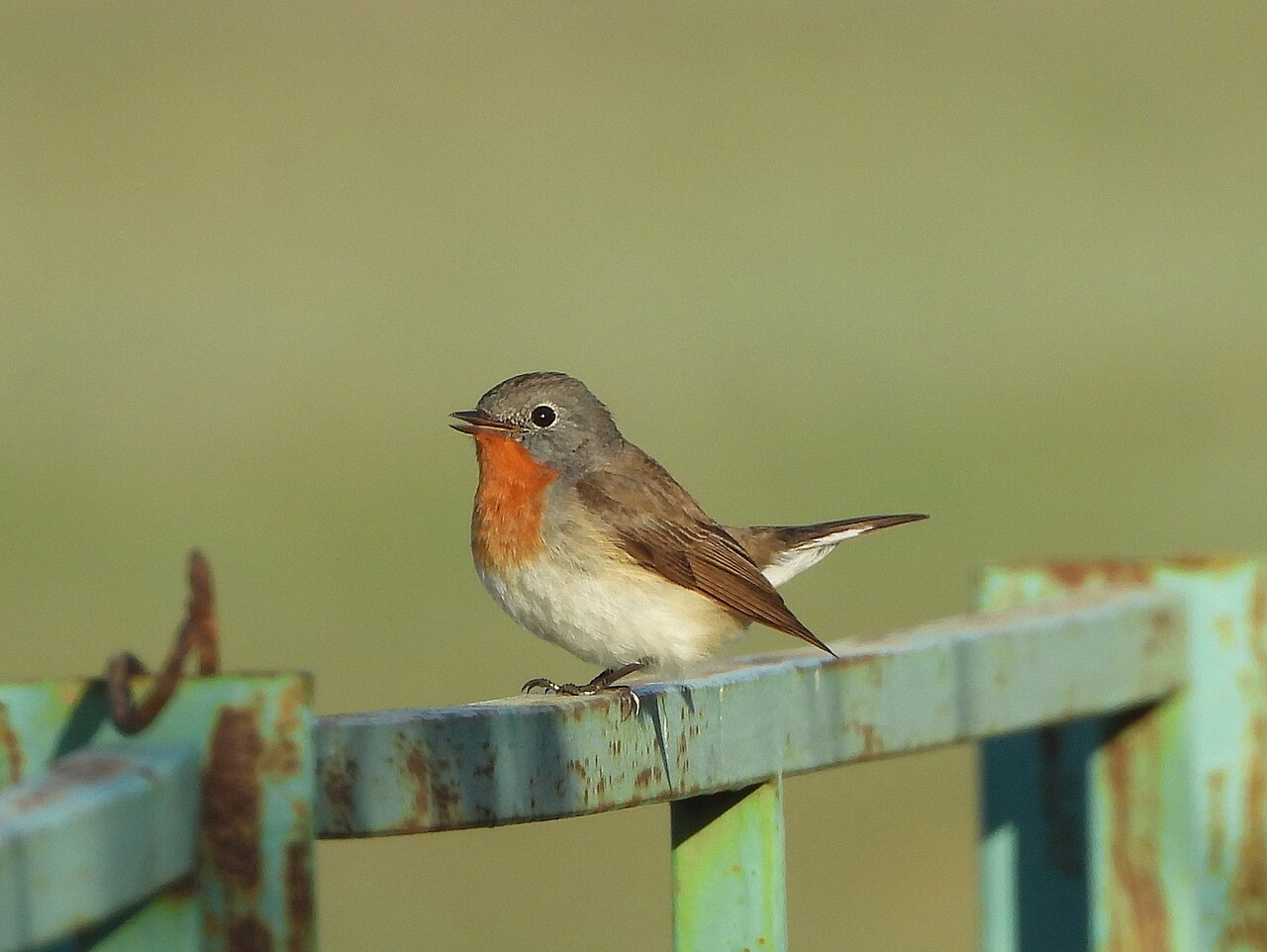
Europe's smallest flycatcher, barely bigger than a Goldcrest with a fat head. The shape is a Robin's: rounded body, big round head, short bill and a large dark eye in a plain flat face, with a conspicuous pale eye-ring that makes the eye look larger still. Grey-brown above, off-white below with a buff wash on the breast sides. The clinching mark is in the tail: black, with a large white patch at the base of the outer feathers, so that every time the bird flies two white flashes light up as though a miniature wheatear were leaving. It also holds the tail cocked, wings drooped, and flicks it briefly down — that alone is a pointer. The old male in spring has an orange-red throat and upper breast blending diffusely into the white, framed by grey head sides; females, young males and every autumn bird lack the orange entirely.
Confusion species
Spotted Flycatcher is the comparison most often needed on the autumn coast — see its own page. That bird is a third bigger, far longer in wing and tail, streaked on crown and breast, and has a plain one-coloured tail with no white; it sits and waits rather than flicking. Pied Flycatcher is more compact, with a big white wing patch and white down the whole length of the tail sides, not just at the base. A Robin is larger, longer-legged and works the ground. That leaves Taiga Flycatcher from Siberia, not covered in this guide but the reason to look carefully: it has black rather than brown uppertail-coverts, an all-dark bill, and in the male a small orange throat patch sharply bounded by grey. Where doubt remains, the call decides it.
Habitat
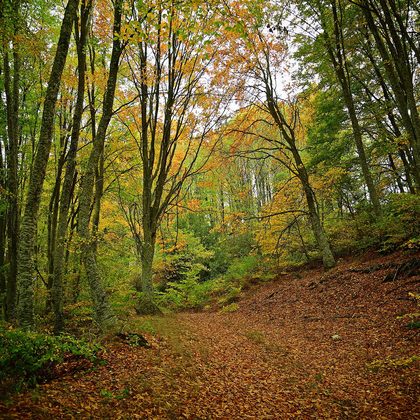
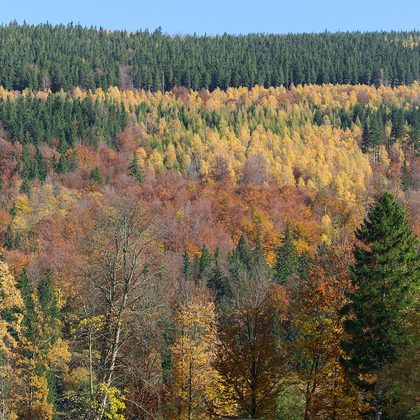
On the breeding grounds tall, mature, shady broadleaved and mixed woodland — beech, hornbeam, oak — with a closed canopy, an open understorey and plenty of thin bare twigs at mid-height to hunt from. It feeds strikingly high, usually above ten metres, and behaves up there more like a leaf warbler than a flycatcher. On migration it is far less particular: coastal copses, hawthorn and elder scrub behind the dunes, gardens, churchyards and dock plantations.
Where the bird is most at home, classified with EUNIS — the European standard for habitats.


Range and movements
A breeder of eastern Europe, from the east of central Europe and the Baltic region east to the Urals, north into central Fennoscandia and south into the Carpathians and the southern Balkans; thin and patchy towards the west. Almost the entire population winters in the Indian subcontinent, travelling by way of the Balkans and Anatolia, a direction hardly any other European songbird takes. Along the North Sea coast it is a scarce but near-annual autumn migrant, best looked for on offshore islands and headlands from mid-September to late October; in Iberia a rarity, mostly from October to December on the Cantabrian coast and in the north-east, where a bird sometimes stays for weeks in the same park or riverside wood. In spring, singing males occasionally hold territory for weeks in mature woodland well west of the breeding range without ever nesting.
- Breeding (summer)
- Winter
- Passage
- dark = core range, pale = thinly spread
How and when to look
Between mid-September and November, on an easterly or north-easterly airflow, on an island or headland on the North Sea or a migration watchpoint on the Cantabrian coast. Walk the inner dune edge and the hawthorn, sea-buckthorn and elder thickets and listen for the dry rattle; only then start looking. If it flies, watch the tail rather than the bird: two white patches at the tail base and the job is done. If it stays put, check the eye-ring, the short bill and the habit of holding the tail up. In May, stand under an old beech wood in the Carpathians and listen for the descending whistle; the bird sits high, and you will not see it until you know where it is.
Conservation status
Least Concern, with a large population running from central Europe deep into Siberia and, at the western edge of the range, increasing rather than falling. The species depends on old, tall woodland with a closed canopy and disappears where such woods are thinned or replanted. It has never bred around the southern North Sea, so the numbers seen there say nothing about how the species is faring and a good deal about how many observers know the call.
Scientific name
Ficedula parva | (Bechstein, 1792)
Bechstein described the species in 1792 as Muscicapa parva; because it was later moved to another genus, the author and year stand in brackets. The genus Ficedula was introduced in 1760 by Brisson. Ficedula is Latin for a small fig-eating bird, from ficus 'fig'; it was believed to turn into the blackcap in winter. parva is the feminine form of Latin parvus 'small'. The specimen the first description was based on came from the Thuringian Forest, Germany.