All species › Passerines › Shrikes › Red-Backed Shrike
Red-Backed Shrike | Lanius collurio
Grauwe klauwier | Alcaudón dorsirrojo
The Red-Backed Shrike is a small songbird with the habits of a raptor: it hunts large insects, lizards and mice from a perch and impales its prey on thorns and barbed wire. Its presence is one of the most reliable indicators of an insect-rich landscape.

Click a thumbnail to switch the photo above.
Voice
The song is soft and chattering with many accurate imitations of other species — usually audible only at close range. The alarm call is more obvious: a hard, chacking tchek-tchek.
Recording: Marie-Lan Taÿ Pamart — CC BY-SA 4.0 · Wikimedia Commons
Identification
Male: blue-grey head with a broad black mask, chestnut mantle and wings, creamy to pinkish underparts and a black-and-white tail. Female and juvenile: warm brown with fine crescent-shaped barring on breast and flanks and a brown mask. All plumages show a strong, slightly hooked bill.
Confusion species
Females and young birds can recall Woodchat Shrike or, among rare visitors, Tiger Shrike. Note tail colour and the extent of the vermiculation. Great Grey Shrike is much larger and longer-tailed, and in north-west Europe is a winter visitor instead.
Habitat
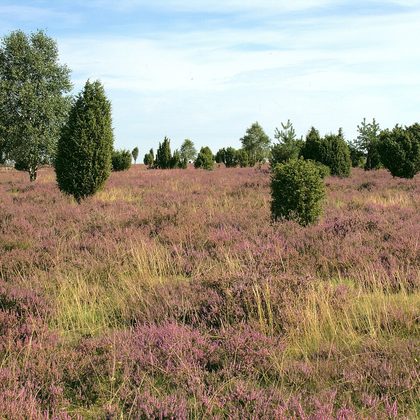
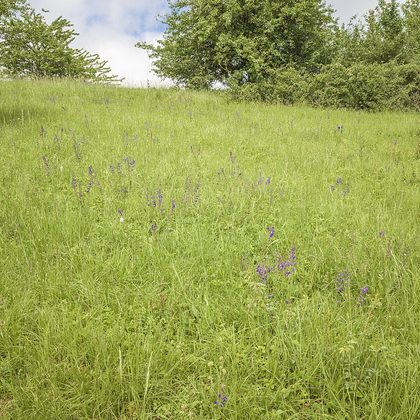
Small-scale, insect-rich landscape with thorny scrub: hawthorn and bramble on heathland, natural transitions between woodland and open ground, extensively managed pasture and hedgerow country. The essential combination is hunting perches, bare ground and large insects.
Where the bird is most at home, classified with EUNIS — the European standard for habitats.


Range and movements
Breeds from Iberia to eastern Europe and on into Anatolia and the Levant; winters in southern Africa, using an eastern migration route over the Levant and north-east Africa. In north-western Europe it is at the edge of its range, with strongholds in the raised bogs and heaths and on the Wadden islands of the Low Countries; in Iberia it breeds mainly in the northern half and in the mountains.
- Breeding (summer)
- Passage
- dark = core range, pale = thinly spread
How and when to look
Mid-May to late July, in the middle of a warm day when insects are active — unlike songbirds, this species rewards a late start. Scan bush tops and barbed wire; anyone who finds a larder with beetles or lizards is almost certainly in an occupied territory.
Conservation status
Not globally threatened (IUCN: Least Concern). Locally, numbers have recovered after a long decline thanks to restoration of heathland with scrub and insect-rich, nutrient-poor margins.
Scientific name
Lanius collurio | Linnaeus, 1758
Linnaeus described the species in 1758 and placed it straight away in the genus where it still stands. He introduced the genus Lanius in that same work. Lanius is Latin for 'butcher', from shrikes' habit of impaling prey on thorns and barbed wire. collurio goes back to Ancient Greek kollurion, a bird mentioned by Aristotle. The specimen the first description was based on came from Sweden.