All species › Passerines › Reed warblers › Marsh Warbler
Marsh Warbler | Acrocephalus palustris
Bosrietzanger | Carricero políglota
An unremarkable brown warbler with an exceptional capacity for imitation: it builds its song out of the voices of dozens of other birds, European and African alike, and pours them out in an unbroken stream. Walk past a nettle bed in June that is full of imitated bird calls and you are listening to a Marsh Warbler.
Voice
The song is a long, continuously rolling stream, more varied in tone than that of any other Acrocephalus: clear whistles, quick rolls and a characteristic nasal tchek-tchek-tchek motif, shot through with accurate imitations of Swallow, Starling, wagtail, House Sparrow, Linnet, Whitethroat and of African species picked up in the winter quarters. An average male imitates some seventy species and switches so fast that the pattern only emerges after a few minutes' listening. It sings from late May to mid July, mostly in the evening, at night and at first light, usually half hidden in vegetation. Call: a short hard tchek and a rattling tcherr.
Recording: Robert Petersen — CC BY-SA 4.0 · Wikimedia Commons
Identification
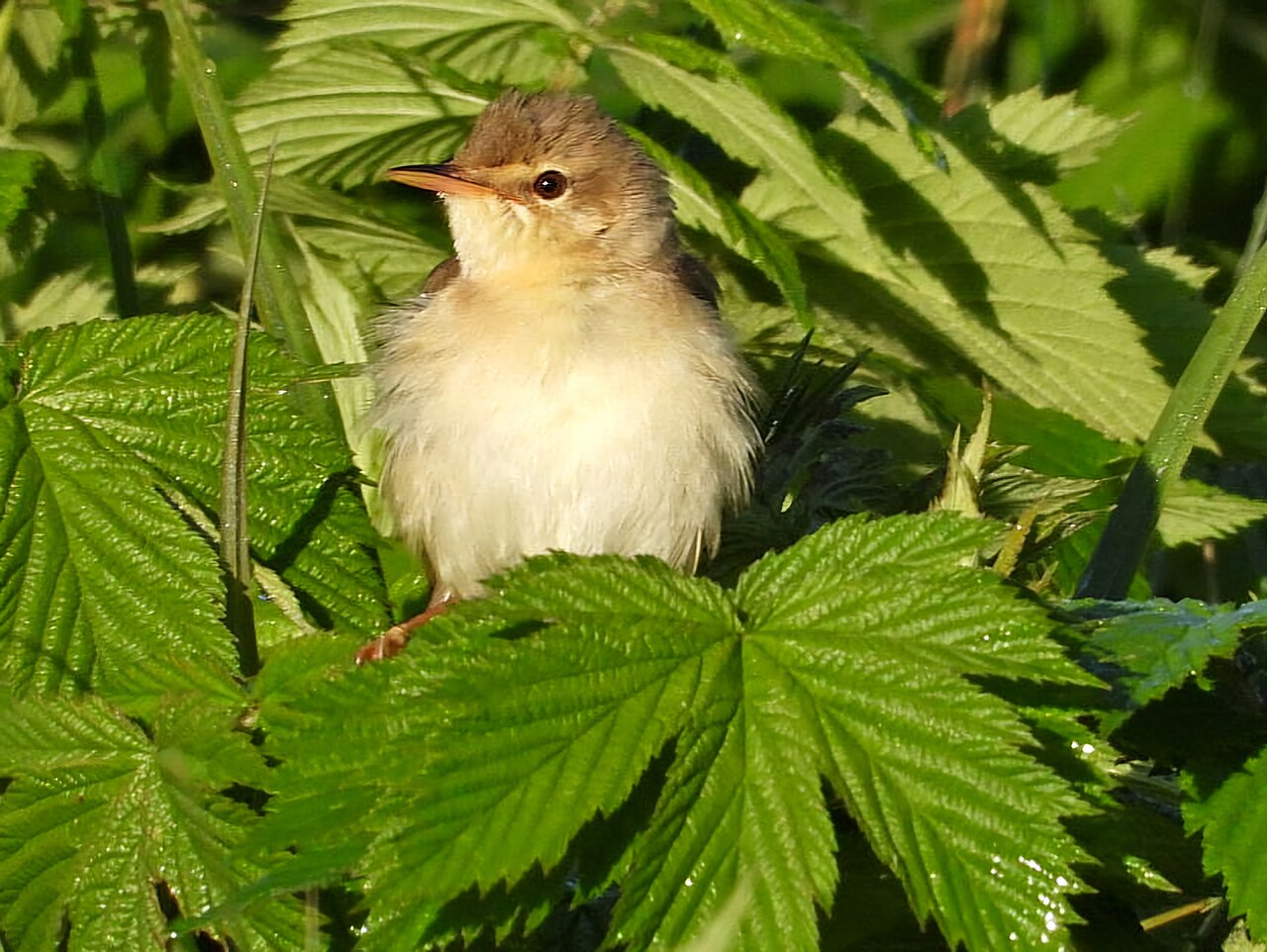
Plain olive-brown above without any streaking, with a cool, faintly olive cast and a dull rump that barely contrasts with the mantle. The head is round with a steep forehead, a short, diffuse pale supercilium that does not extend far behind the eye, and a pale eye-ring. Underparts creamy white with a yellow wash on breast and flanks. Two features settle it: the primary projection is long, about as long as the exposed secondaries, with seven or eight crisply spaced primary tips, and the legs are pale — flesh, yellowish-brown or greyish pink, right out to the toes. The bill is short and broad-based.
Confusion species
Reed Warbler is the species that matters, and the comparison is the whole story. Song decides it fastest: Reed Warbler slow, low and scratchy with endlessly repeated motifs, Marsh Warbler fast, high, musical and packed with mimicry. Beyond that: primary projection long versus short, legs pale flesh versus grey-brown to lead, rump dull olive-brown versus warm rusty, forehead steep versus flat and sloping, and Marsh Warbler in rank herbage and scrub on dry land while Reed Warbler sits in reed standing in water. The scarce Blyth's Reed Warbler is darker and shorter-winged, with a more obvious supercilium in front of the eye and darker legs. Icterine Warbler is bigger and yellower, with an orange lower mandible and a much heavier head.
Habitat
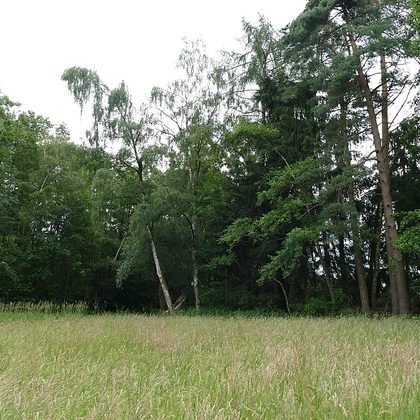
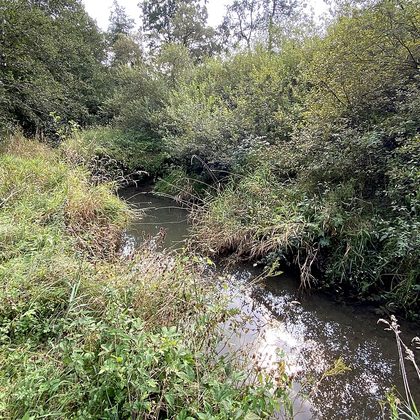
Not reed standing in water, but damp rank vegetation on dry ground: stands of nettle, meadowsweet and cow parsley along ditches and streams, willow scrub, young regrowth, lucerne and oilseed rape, railway embankments, rough field margins and road verges. A single bush or sapling as a song post is often enough. It returns later than any other warbler, because it needs tall herbaceous cover that is not there until mid May.
Where the bird is most at home, classified with EUNIS — the European standard for habitats.


Range and movements
Breeds from north-west Europe east into eastern Europe, with its core in central and eastern Europe; the north-west lies at the western edge yet is densely occupied, in polder herbage, along canals and in the river country. In the Mediterranean very scarce: in Iberia almost only on passage in the north, with a handful of breeding sites in the Pyrenees. An extreme long-distance migrant: it arrives only in mid May, leaves in August and travels via the eastern Mediterranean and the Horn of Africa to south-eastern Africa.
- Breeding (summer)
- Passage
- dark = core range, pale = thinly spread
How and when to look
The first two weeks of June, between midnight and sunrise or in the last hour before dark, along a ditch with nettles and willow scrub. Stand still and let the song run for ten minutes: only then do the imitations separate out one by one. To see the bird, wait until it climbs to the top of a nettle stem, and go straight to the pale legs and the long primary projection. An evening with a Reed Warbler in the reed and a Marsh Warbler in the herbage beside it makes the difference in song directly audible.
Conservation status
Not threatened (LC) and stable to slightly increasing across most of its range. On the breeding grounds the pressures are flail-cutting and early mowing of verges and ditch banks in June, while the nests are still slung in the stems, and the tidying away of rank vegetation in farmland. As an extreme long-distance migrant it also depends on good stopover sites in the Sahel and East Africa.
Scientific name
Acrocephalus palustris | (Bechstein, 1798)
Bechstein described the species in 1798 as Motacilla s. sylvia palustris; because it was later moved to another genus, the author and year stand in brackets. The genus Acrocephalus was introduced in 1811 by Naumann & Naumann. Acrocephalus is Greek, from akros 'topmost, pointed' and kephalē 'head'; the Naumanns, who introduced the genus, called these birds Spitzkopf 'pointed head', so they read akros as 'pointed'. palustris is Latin for 'marshy'. The specimen the first description was based on came from Germany.