All species › Waders, gulls and terns › Plovers and lapwings › Little Ringed Plover
Little Ringed Plover | Thinornis dubius
Kleine plevier | Chorlitejo chico | Flussregenpfeifer | חופמי גדות | Pluvier petit-gravelot
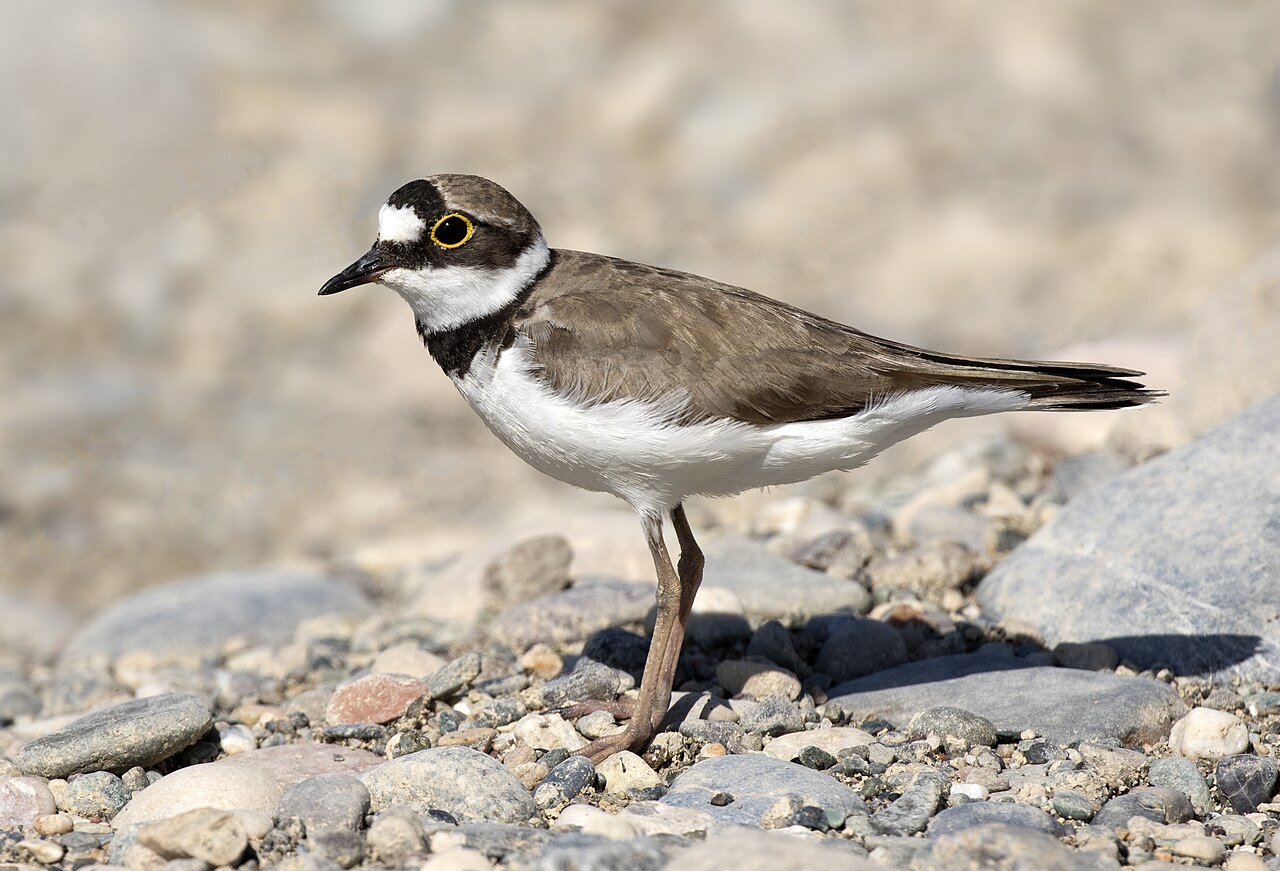
The Little Ringed Plover is the inland plover: bare gravel bars, sand quarries and freshly dug ground. A yellow eye-ring, a dark bill and the fast stop-and-go run over open sand give it away at once.
Click a thumbnail to switch the photo above.
Voice
A sharp, descending and slightly nasal pee-oo, shorter than the two-note whistle of Ringed Plover. In display flight over the gravel, a slowly repeated rattling cree-cree-cree, delivered on slow bat-like wingbeats. Heard mainly from April to June, and at night over river valleys on migration.
Recording: Benoît Van Hecke — CC BY-SA 4.0 · Wikimedia Commons
Identification
Small and slim, with a narrow complete black breast band, a black mask and a yellow eye-ring. The bill is all dark, the legs dull yellow to pinkish. In flight the upperwing is plain, with no white wingbar at all, which is instantly obvious. Juveniles and winter birds are browner, with a dull, often broken breast band and a fainter eye-ring.
Confusion species
Ringed Plover is the only real confusion species, and the wing settles it: Little Ringed shows no white wingbar, Ringed a broad white band. Little Ringed also has a yellow eye-ring, a dark bill and dull yellow legs, where Ringed has an orange bill base, orange legs and a heavier, rounder build.
Habitat
Bare stony or sandy ground without vegetation: river shingle, sand and gravel pits, settling ponds, dredged industrial land and temporary construction sites. It favours pioneer situations and moves on as soon as plants take hold. Feeds on damp mud close to shallow fresh water.
Where the bird is most at home, classified with EUNIS — the European standard for habitats.



Range and movements
Breeds across nearly all of Europe except the far north and winters entirely in sub-Saharan Africa. In north-west and central Europe scattered over river districts, sand extractions and industrial sites; in the Mediterranean on the gravel rivers of the interior and reservoirs with drying margins.
- Resident
- Breeding (summer)
- Winter
- Passage
- dark = core range, pale = thinly spread
How and when to look
Work a fresh sand extraction or a drying river bar in April and May; walk slowly and watch for movement, because a motionless bird vanishes against shingle. The display flight on slow flapping wings is most obvious around sunrise and betrays which sites are occupied.
Conservation status
Not globally threatened (IUCN: Least Concern). It profits from human digging, but occupancy is erratic: a site grows over within two years and is then abandoned. Threats are river canalisation, disturbance by walkers and dogs, and the general loss of dynamic pioneer habitat.
Scientific name
Thinornis dubius | (Scopoli, 1786) (GBIF: Charadrius dubius)
Scopoli described the species in 1786 as Charadrius dubius; because it was later moved to another genus, the author and year stand in brackets. The genus Thinornis was introduced in 1845 by Gray. Thinornis is Greek, from this, thinos 'beach, sandbank' and ornis 'bird'. dubius is Latin for 'doubtful': it was doubted whether the bird was more than a variety of the common ringed plover. The specimen the first description was based on came from Luzon, Philippines.