All species › Woodpeckers and allies › Woodpeckers › Levaillant's Woodpecker
Levaillant's Woodpecker | Picus vaillantii
Levaillants specht | Pito bereber
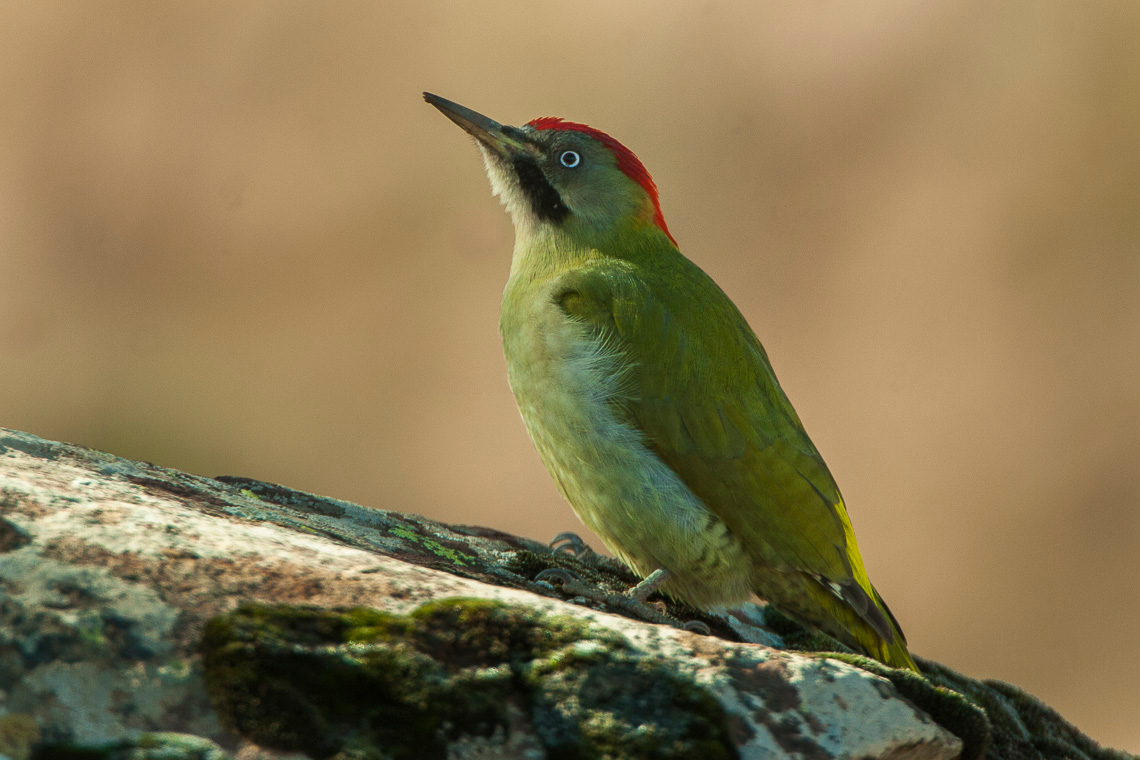
The green woodpecker of the Atlas Mountains: a big olive-green bird that, like its European namesake, feeds mainly on the ground at ant nests. It lives only in the Maghreb, and its laugh carries from the cork oaks near the coast up to the cedar forests at the treeline.
Click a thumbnail to switch the photo above.
Voice
A loud, run-together laugh — rendered plue-plue-plue in the older literature — very like the laugh of European Green Woodpecker but a shade faster and drier. Heard all year and loudest from February to May, when birds call from a dead branch. In flight a short hard kyuk.
Recording: Stanislas Wroza — CC BY-NC-SA 4.0 · Wikimedia Commons
Identification
Large and heavily built, olive green above with a yellow-green rump that flares as it flies off, and off-white to grey-green underparts finely barred on the flanks and undertail coverts. The face is plain grey: there is no black mask around the pale eye and the lores are unmarked. A black moustache runs down from the base of the bill, with a pale border above it. The male's crown is wholly red from forehead to nape; the female's is grey with red confined to the nape. Flight heavy and deeply undulating, usually low from tree to tree.
Confusion species
No other Green Woodpecker occurs in the Maghreb, so confusion in the field is impossible; the differences matter for photographs and for vagrant claims. The key is the moustache: on Levaillant's it is wholly black in both sexes, while the male European Green Woodpecker carries red there inside a broad black surround, and the male Iberian Green Woodpecker has an all but wholly red moustache. Then take the crown: this is the only one of the three in which the female's crown is grey with red confined to the nape. Of the three, the Iberian bird across the strait resembles it most, since it too has a grey face without a black mask.
Habitat
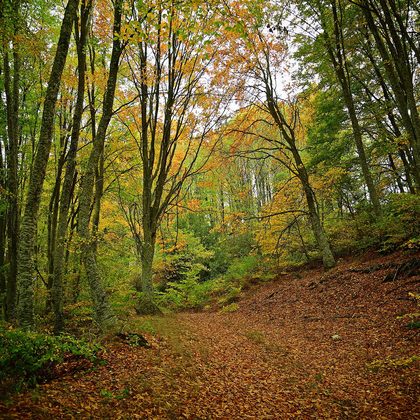
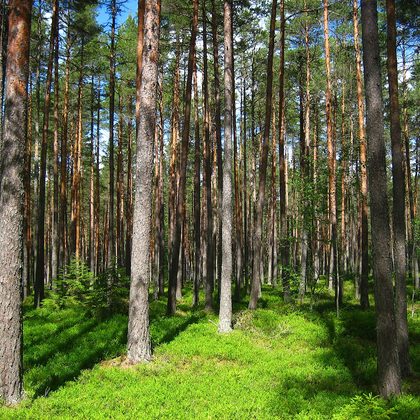
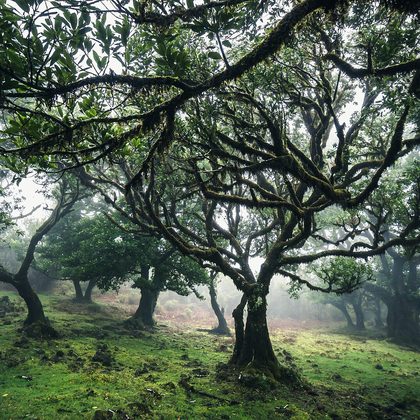
Hill and mountain woodland of the Rif and the Atlas: cork, holm and zeen oak, Atlas cedar, Aleppo pine and juniper, from the coastal hills up to the treeline at about 2000 metres. Also argan woodland, old olive groves, wood pasture and wooded river valleys. Short turf, bare ground or an ant hill must always be within reach: like European Green Woodpecker it takes most of its food off the ground, flicking a long sticky tongue into an ant nest. The nest hole is chopped into an old, soft trunk.
Where the bird is most at home, classified with EUNIS — the European standard for habitats.

Range and movements
North-west Africa only: from the Rif and Middle Atlas to the High Atlas and the edge of the Anti-Atlas, and east across the north of the Maghreb from Kabylie and the Aurès to Kroumirie, where El Feija is the best-known site. It is the only Green Woodpecker in Africa and has never crossed the Strait of Gibraltar. Resident, dropping at most from the highest forest into lower valleys in winter.
- Resident
- Breeding (summer)
- Winter
- Passage
- dark = core range, pale = thinly spread
How and when to look
Oukaïmeden in the High Atlas and the cedar forests of Ifrane and Azrou in the Middle Atlas are the classic places, and March and April give the best chance, when the birds are laughing and drumming. Walk the edge of a cedar stand or an old cork oak pasture, listen first, then scan the open grass between the trunks — you will find it on the ground more often than in a tree. In the east of the range the national park of El Feija is the best bet.
Conservation status
Not threatened and still widespread across the Maghreb, but the quality of its woodland is falling. Felling and thinning of veteran trees, removal of dead wood, overgrazing of the understorey and the dieback of Atlas cedars in the Middle Atlas after years of drought all cost it nest trees and ant-rich ground. Where old trees are left standing it holds on well, including in grazed woodland close to villages.
Scientific name
Picus vaillantii | (Malherbe, 1847)
Malherbe described the species in 1847 as Chloropicus vaillantii; because it was later moved to another genus, the author and year stand in brackets. The genus Picus was introduced in 1758 by Linnaeus. Picus is the Latin word for 'woodpecker' and also the name of Picus, in Roman mythology the first king of Latium, who was turned into a woodpecker by the sorceress Circe. vaillantii honours the French explorer, collector and ornithologist François Levaillant (1753–1824). The specimen the first description was based on came from Algeria.