All species › Gamebirds › Guineafowl › Helmeted Guineafowl
Helmeted Guineafowl | Numida meleagris
Helmparelhoen | Pintada común
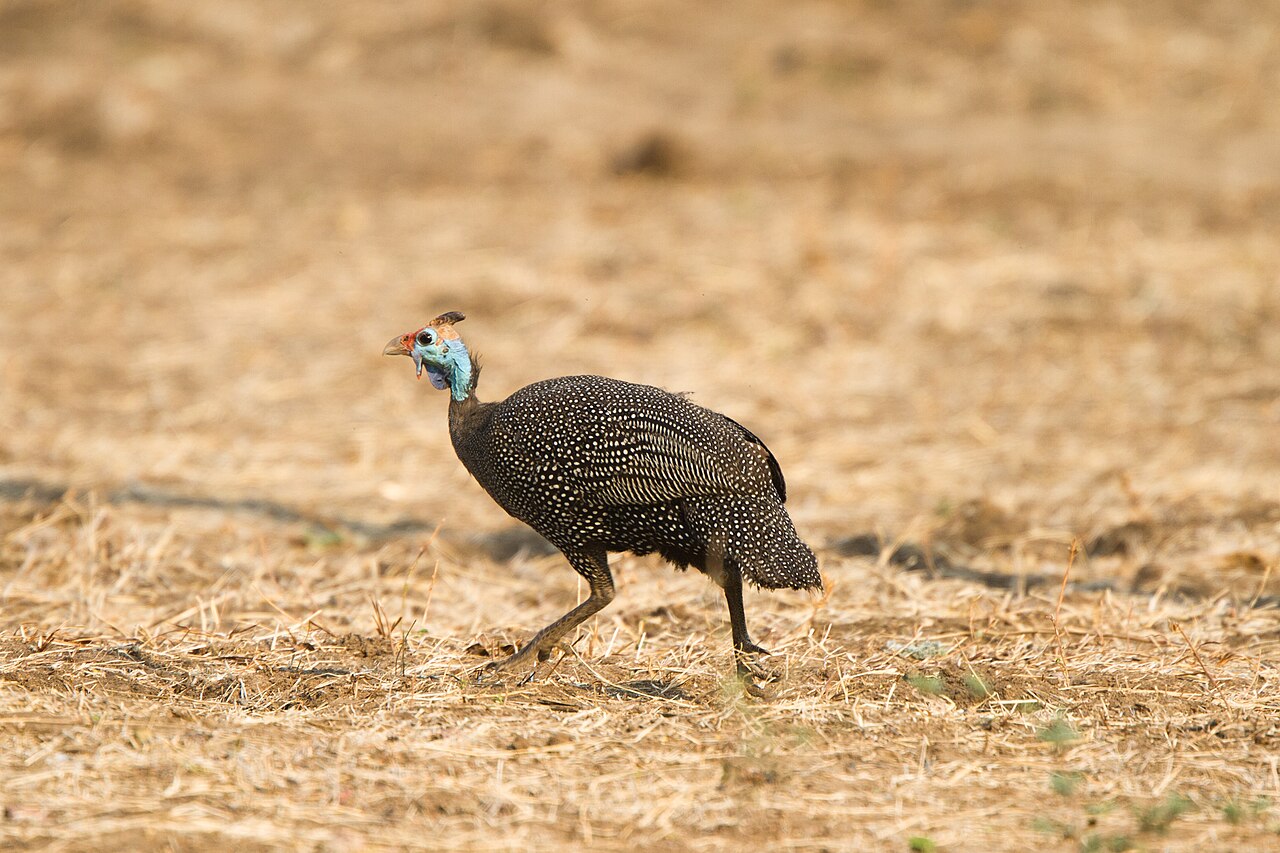
A slate-grey gamebird peppered with white spots, with a bare blue-and-red head and a horny casque on the forehead. Native to the African savannah and kept as poultry around the Mediterranean for centuries. In Europe it walks about half-tame on farms and estates; there is no genuinely wild population anywhere on the continent.
Click a thumbnail to switch the photo above.
Voice
Very loud, and audible for kilometres. Best known is the hen's two-syllable call, a clattering ka-brack, ka-brack, repeated without end; the cock gives a one-syllable, fast rattling chi-chi-chi. Alarmed, the whole covey erupts into a staccato kek-kek-kek-kek-kerrr and then runs rather than flies. Most is heard at first light and just before the group goes up into trees to roost.
Recording: JMK — CC BY-SA 4.0 · Wikimedia Commons
Identification
About the size of a Pheasant hen but far bulkier: a hunched, forward-carried body on long dark grey legs, with a short tail hanging down. The plumage is dark slate grey, spangled with white pearl spots over the whole body, and the wings are short and rounded. The head is unfeathered, sky blue with red around the eye and on the chin, with a red or blue wattle on each side of the bill and a bony buff casque on the forehead. Sexes look alike; the male has a slightly larger casque and heavier wattles.
Confusion species
Confusion in Europe is hardly possible: nothing else on the continent is grey, white-spotted and bare-headed. A Pheasant hen is brown and long-tailed, a Black Grouse black or brown and unspotted. Domestic strains do exist in white or pied plumage with an altered casque, and those belong to the farmyard. At distance a party in dry grass can suggest partridges, but the upright, chicken-like running and the drooping-tailed silhouette settle it at once.
Habitat
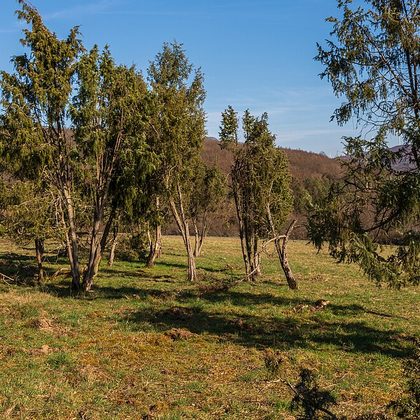
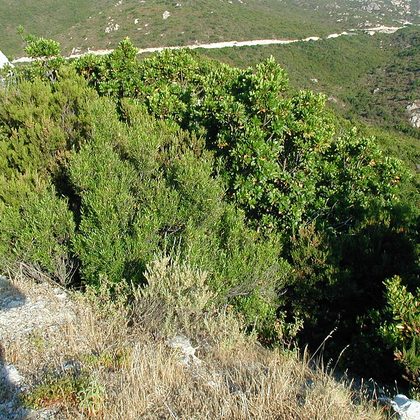
Dry grassland and savannah with scattered bushes, arable fields and stubbles, sparsely wooded grazing and the edges of villages and farmyards. In Europe the birds keep to farms, olive groves and estate tracks, usually within walking distance of the shed they roost in. They feed on the ground all day, come readily to water and dust-bathe at length on bare patches.
Where the bird is most at home, classified with EUNIS — the European standard for habitats.



Range and movements
Native to sub-Saharan Africa from West Africa and the Horn of Africa to southern Africa, over a huge continuous range. Carried worldwide as poultry, with feral and half-tame flocks in the West Indies, North and South America, Australia and Europe. In Europe this amounts to a handful of Mediterranean localities, in Iberia — chiefly on farms and estates in Andalusia and Extremadura — and further on the Apennine peninsula and in the southern Balkans, where birds range freely around farms and estates. No European records committee treats the species as naturalised, and on the British Isles and along the southern North Sea coast every record is an escape.
- Resident
- Breeding (summer)
- Winter
- Passage
- dark = core range, pale = thinly spread
How and when to look
Drive a Mediterranean farm track at first light past olive groves and steadings and follow the noise: the covey always gives itself away by sound first. Look hard at the setting before you claim anything, because nearly every bird belongs to a holding: check for fencing, feed troughs, white or pied domestic birds mixed in, and how far the group strays from buildings. To see the species genuinely wild, go to the savannahs of east and southern Africa, where parties of dozens come down to drink.
Conservation status
Not globally threatened: the range is enormous and the species does well alongside arable farming and cattle water points. In Europe there is nothing to conserve, because no self-supporting population exists; the flocks lean on feed, sheds and farmyard cover and vanish when a holding closes. Chicks survive wet European springs poorly and free-ranging birds are quickly picked off by foxes.
Scientific name
Numida meleagris | (Linnaeus, 1758)
Linnaeus described the species in 1758 as Phasianus meleagris; because it was later moved to another genus, the author and year stand in brackets. The genus Numida was introduced in 1764 by Linnaeus. Numida is Latin for 'Numidian', an inhabitant of North Africa. meleagris is the Greek word for guineafowl. The specimen the first description was based on came from Nubia on the upper Nile.