All species › Passerines › Shrikes › Great Gray Shrike
Great Gray Shrike | Lanius excubitor
Klapekster | Alcaudón norteño
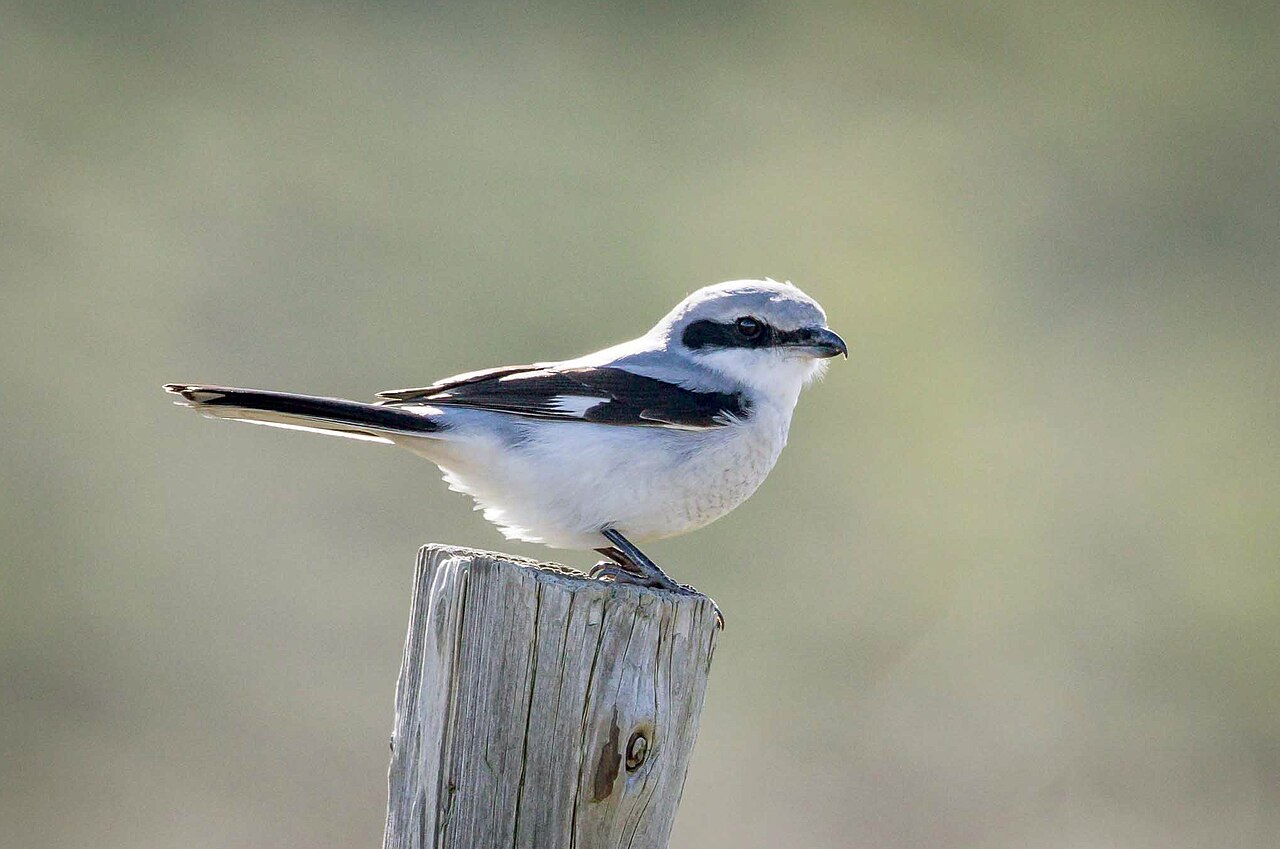
The Great Grey Shrike is a songbird that hunts like a raptor: it sits bolt upright for hours in the top of a birch or on a wire, scanning the heath, and takes voles and small birds that it impales on thorns and barbed wire.
Voice
Usually silent in winter, but when agitated it gives a harsh rattling chek-chek and a hard, nasal waaid. Most remarkable is the soft, sustained song, audible even in the winter quarters on sunny days: a hesitant, slightly grating warble in which it mimics other birds — fragments of Barn Swallow, Starling and Chaffinch, and even the calls of Kestrel or Stock Dove. Those imitations partly serve to lure songbirds within striking range.
Recording: Pascal Christe — CC BY-SA 4.0 · Wikimedia Commons
Identification
A large, long-tailed shrike the size of a Blackbird but slimmer. Clear ash-grey above, dirty white below, with very fine vermiculated barring on the breast in the nominate form if you look closely. A broad black mask runs through the eye and continues across the forehead above the bill, bordered above by a thin white line. The wing is black with one conspicuous white patch at the base of the primaries; in flight the white wing flash and the white outer tail feathers stand out. The bill is heavy and hooked, like a small raptor's. Juveniles are browner grey, with a duller black mask and clearer vermiculation below. The silhouette is characteristic: ramrod straight on a high, exposed lookout, often with the tail swinging, and the flight is low and undulating with a swift rise to the next perch.
Confusion species
Red-Backed Shrike is smaller and shorter-tailed with a warm brown back; the female is brown with crescent-shaped barring and has no white in the wing. Lesser Grey Shrike is more compact and shorter-tailed, with longer wings, a black forehead running right through the mask and a pink wash across the breast; in north-west Europe it is a summer vagrant that barely overlaps in season. In Iberia the resident is Iberian Grey Shrike: darker grey, with a distinctly pink-buff wash below, a broader white supercilium above the mask and usually less white in the wing. A grey shrike in north-west Europe in December, however, is almost always a Great Grey.
Habitat
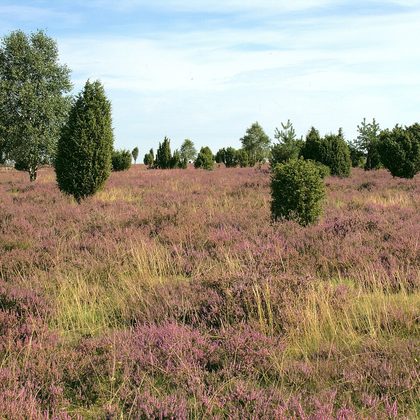
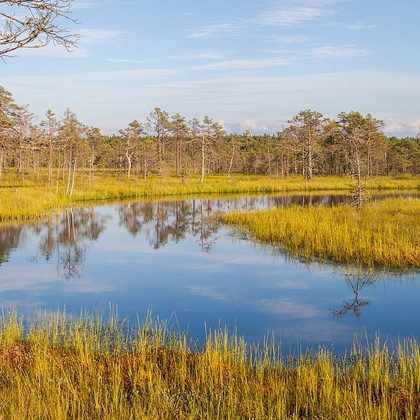
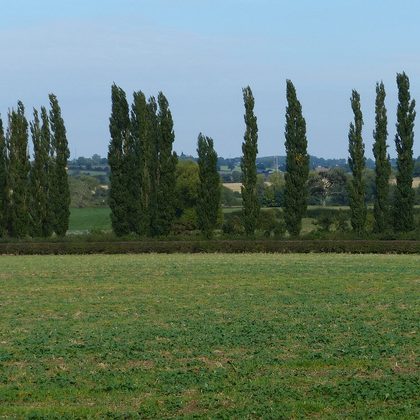
Wide, half-open country with plenty of scattered lookouts and plenty of voles: heathland with young birch and self-sown pine, raised bog, drift sand, young plantations, rough field margins, rewilding sites and tree-studded polders. Each winter a Great Grey Shrike holds a large fixed territory, often many tens of hectares, working a handful of regular lookout trees. Prey is stored impaled on hawthorn, blackthorn or barbed wire.
Where the bird is most at home, classified with EUNIS — the European standard for habitats.


Range and movements
Breeds in northern and eastern Europe, from Scandinavia and the Baltic region east through eastern Europe; the south-western edge of the breeding range retreated far during the twentieth century. In Iberia it is a rare winter visitor in the north-east; the shrike you see on a wire there is almost always Iberian Grey Shrike.
- Resident
- Breeding (summer)
- Winter
- Passage
- dark = core range, pale = thinly spread
How and when to look
November to February, on a clear, windless winter morning. Take a rise beside a large heath or bog and scan every projecting top systematically — pines, birch crowns, fence posts, wires. The bird favours the highest point for miles around and is recognisable at range by its white, upright silhouette. Do not tramp the whole territory: it moves hundreds of metres at a time, so waiting and scanning beats searching.
Conservation status
Not globally threatened (IUCN: Least Concern), but in Europe Lanius excubitor has declined sharply along the western and southern edge of its range, with breeding birds lost around the southern North Sea and in parts of central and western Europe. The causes are nitrogen enrichment and grass encroachment on heathland, the loss or over-tidying of small landscape features, and the decline of large insects and vole-rich rough ground. Note that the former broad species has since been split: the southern forms around the Mediterranean are now treated as separate species, among them Iberian Grey Shrike, which has its own, likewise declining trend in Iberia.
Scientific name
Lanius excubitor | Linnaeus, 1758
Linnaeus described the species in 1758 and placed it straight away in the genus where it still stands. He introduced the genus Lanius in that same work. Lanius is Latin for 'butcher', from shrikes' habit of impaling prey on thorns and barbed wire. excubitor is Latin for 'watchman, sentinel'; the full name means 'sentinel butcher', for the bird watching from a high perch. The specimen the first description was based on came from Sweden.