All species › Kingfishers, bee-eaters and rollers › Bee-eaters › European Bee-Eater
European Bee-Eater | Merops apiaster
Bijeneter | Abejaruco europeo | Bienenfresser | שרקרק מצוי | Guêpier d'Europe
A multicoloured bird: chestnut, gold and turquoise, with a scimitar bill and pointed tail streamers. Colonies announce themselves from far off with rolling calls delivered high overhead.

Click a thumbnail to switch the photo above.
Voice
A liquid, rolling, far-carrying prruip or krroo-krroo, usually coming from an invisible flock passing high overhead. Given almost continuously in flight from late April to September; at the colony there is also a continuous gurgling chatter.
Recording: Pascal Christe — CC BY-SA 4.0 · Wikimedia Commons
Identification
Slim, with long pointed triangular wings, elongated central tail feathers and a long slightly decurved bill. Chestnut crown and mantle grade into golden scapulars, the underparts are turquoise, and a yellow throat is cut off by a narrow black band below a black eye-stripe. Fast beats alternate with long glides; juveniles are greener and lack the streamers.
Confusion species
Roller is also brightly coloured but far bulkier and crow-like, with a straight black bill, sky-blue underparts and no yellow throat, and a heavy flapping flight; it also perches motionless on wires for long spells. High-flying Bee-Eaters are regularly called Swifts or even waders on shape alone, until the voice arrives.
Habitat
Warm open and half-open country with sandy or loamy vertical faces: river banks, sunken lanes, sand pits and erosion gullies, surrounded by flowery grassland, olive groves or extensive arable full of large insects. Hunts bees, wasps and dragonflies high over the land.
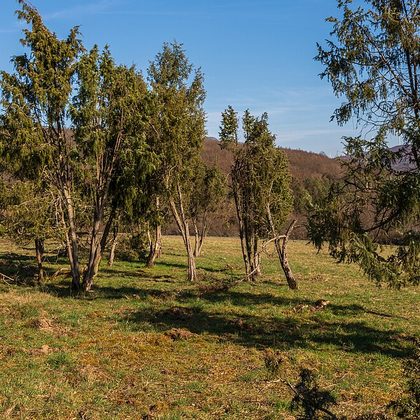
Where the bird is most at home, classified with EUNIS — the European standard for habitats.


Range and movements
Breeds around the Mediterranean and in eastern Europe, east to Anatolia and the Levant and south into North Africa; Iberia is the stronghold, with colonies across almost the whole peninsula. In north-west and central Europe a scarce but increasing colonist of sand pits and quarries, and along the North Sea an annual passage migrant. Winters in West and southern Africa and returns in late April.
- Breeding (summer)
- Passage
- dark = core range, pale = thinly spread
How and when to look
In the Mediterranean, from May to August, work sandy cuttings, gully edges and telegraph wires in river valleys early in the morning, when birds perch low to preen and sun themselves. Further north, on passage in May and August, listen upwards: the rolling call almost always comes before the sighting.
Conservation status
Not globally threatened (IUCN: Least Concern). Numerous in southern Europe and clearly expanding northwards, probably helped by warmer summers. Threats are the levelling or infilling of vertical banks, insecticides that strip out large insects, and local persecution by beekeepers. Working sand pits with steep faces have become essential for the northern colonies.
Scientific name
Merops apiaster | Linnaeus, 1758
Linnaeus described the species in 1758 and placed it straight away in the genus where it still stands. He introduced the genus Merops in that same work. Merops is Greek and means 'bee-eater'. apiaster says the same in Latin, from apis 'bee'; the name thus means 'bee-eater' twice. The specimen the first description was based on came from southern Europe.