All species › Cranes, rails and allies › Rails and crakes › Eurasian Moorhen
Eurasian Moorhen | Gallinula chloropus
Waterhoen | Gallineta común
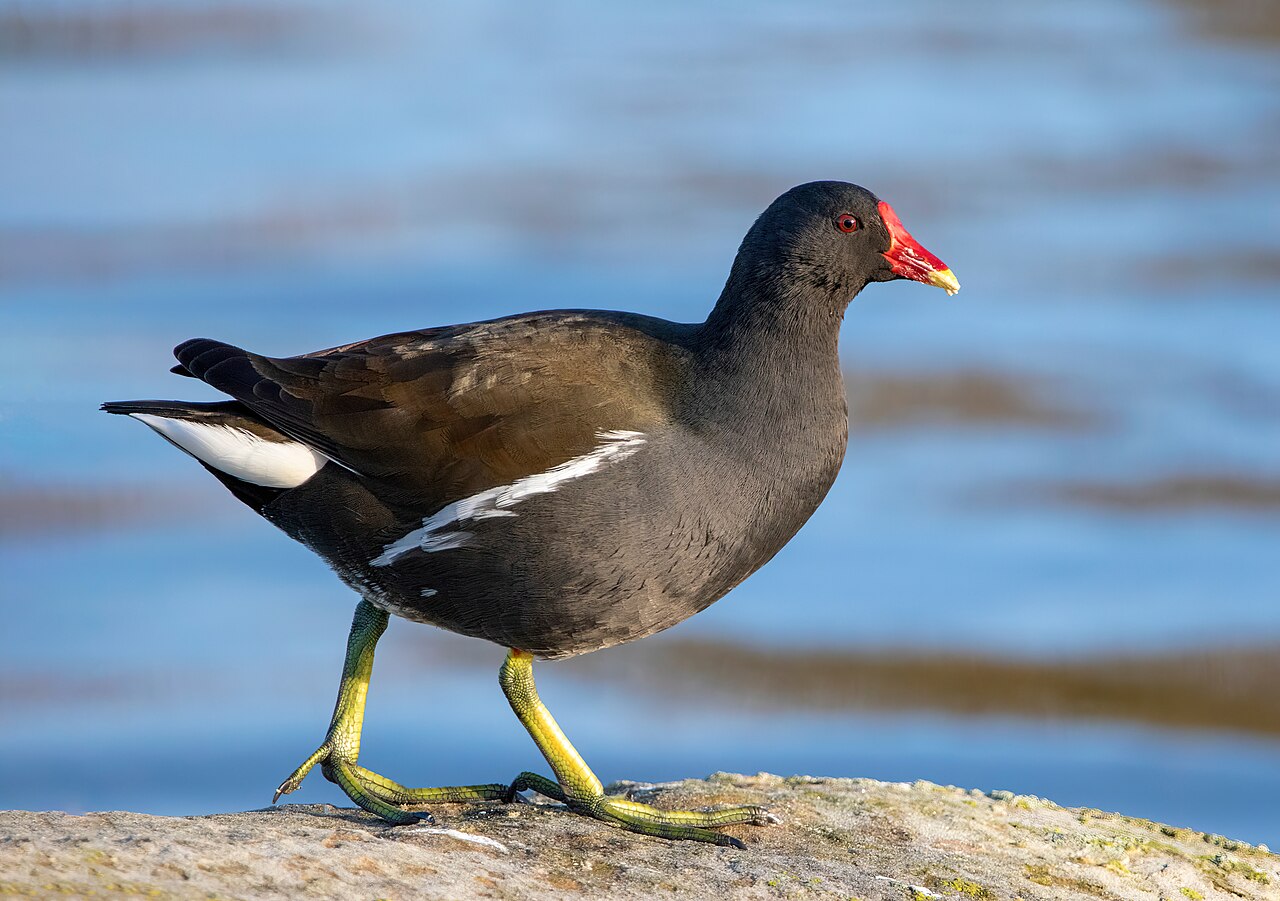
The most everyday rail in Europe and the only one that simply shows itself, on every ditch, town pond and village canal. It swims along the bank with a nodding head and flicks the white undertail when alarmed.
Click a thumbnail to switch the photo above.
Voice
An explosive high kurrk or kittick, like something snapping in the reeds, often followed by a series of lower clucking notes dying away. There is also a bubbling drawn-out krrrrk in territorial disputes. Vocal all year, most of all at dusk and in the first hours of darkness; migrants give a sharp krek on October nights.
Recording: Borja — CC BY-SA 4.0 · Wikimedia Commons
Identification
Slate-blue head, neck and breast, olive-brown mantle, a bright red bill base with a yellow tip, a red frontal shield and long green-yellow legs with huge toes. A broken white line runs along the flanks, and there are two white patches under the tail split by a black centre. Juveniles are dull brown with a pale throat and dark bill.
Confusion species
Coot is bigger, uniformly black with a white shield; Moorhen is browner and shows the white flank line. More awkward is a juvenile Moorhen beside a juvenile Coot: look for the white flank stripe and the yellow bill tip. In reeds a Water Rail can surprise, but it is slimmer with a long red bill.
Habitat
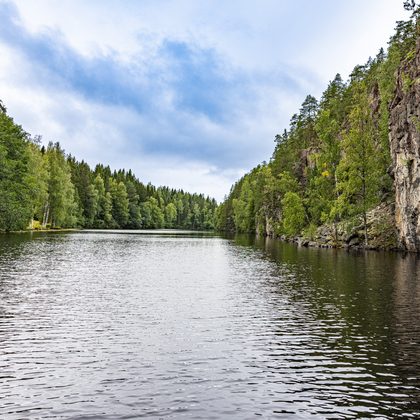
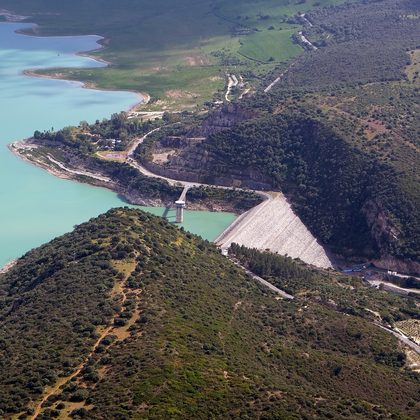
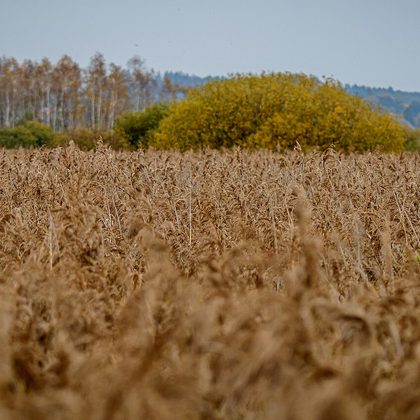
Any fresh water with dense bankside cover: ditches, ponds, town parks, small pools, marshes, canal banks and shrubs overhanging the water. It builds a bulky cup of reed blades low over the water in reed, sedge or a bramble tangle. Feeds on foot on lawns and banks, often within a few metres of people.
Where the bird is most at home, classified with EUNIS — the European standard for habitats.

Range and movements
Breeds almost throughout Europe, from the British Isles to eastern Europe, with gaps only in the far north. Very common in north-west Europe and present everywhere, including city centres. In Iberia it breeds in fresh wetlands from north to south, from river margins to the rice fields of the Guadalquivir, the Ebro and the Albufera, and southern sites gain northern birds in winter.
- Resident
- Breeding (summer)
- Winter
- Passage
- dark = core range, pale = thinly spread
How and when to look
Any month works, but March and April bring territorial fights, two birds upright in the water with feet thrown forward. Visit a town pond or polder ditch early in the morning. In winter check lawns beside open water, where families graze mixed in with Coots.
Conservation status
Numerous and not threatened. Where it does decline, clearing and hard-piling of ditches, stone-faced banks, increased predation by fox and feral cat, and hard winters all contribute. In urban areas the species remains as common as ever and benefits from supplementary feeding.
Scientific name
Gallinula chloropus | (Linnaeus, 1758)
Linnaeus described the species in 1758 as Fulica chloropus; because it was later moved to another genus, the author and year stand in brackets. The genus Gallinula was introduced in 1760 by Brisson. Gallinula is Latin for 'little hen', a diminutive of gallina 'hen'. chloropus combines Greek khlōros 'green' and pous 'foot', for the greenish legs. The specimen the first description was based on came from England.