All species › Passerines › Larks › Crested Lark
Crested Lark | Galerida cristata
Kuifleeuwerik | Cogujada común
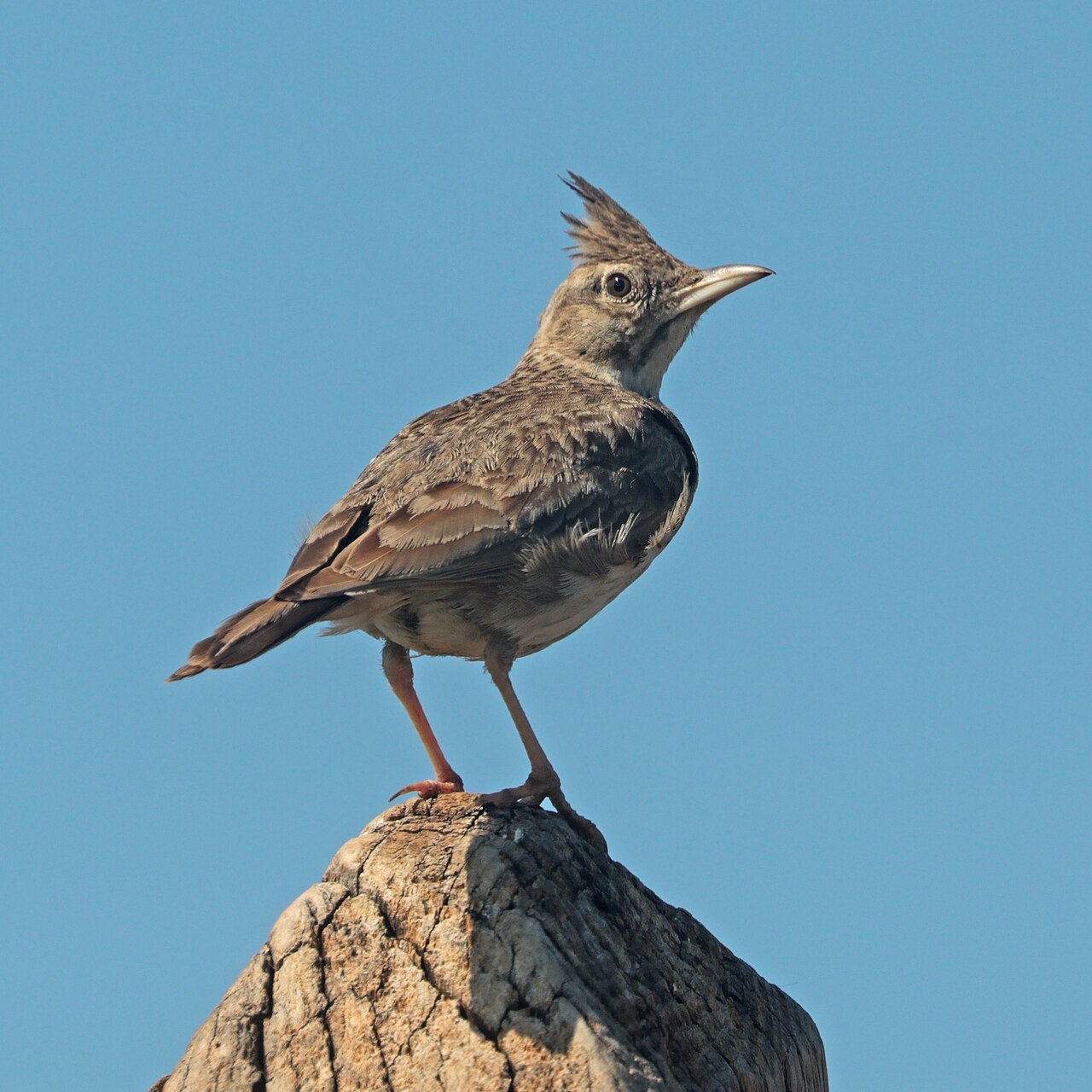
The lark of bare, trodden ground on the edge of built-up land: industrial estates, car parks, railway sidings, road verges and dusty field tracks. A heavy, sandy bird with a spike of a crest that would rather walk away from you than fly, and that whistles its wistful little phrase all year round. As a breeder it has almost gone from large parts of north-west Europe, and in the British Isles barely a handful have ever been recorded; in southern and eastern Europe it is still common, where the real challenge is telling it apart with certainty from Thekla Lark.
Voice
Pure, wistful whistling, and usually the first thing you notice. The call is a liquid, plaintive too-tee-too or doo-dee-oo-dee of three or four clear notes. The song is a short, varied run of those same liquid whistles, laced with imitations of other birds, delivered from the ground, a post, a lamp standard or a flat roof, and sometimes in a slow, high song flight. It sings all year, peaking from February to May, and is strikingly vocal on sunny winter mornings.
Recording: Philippe_Grange — CC0 · xeno-canto
Identification
A coarsely built lark with a big head, a short tail and a long, pointed crest usually carried as a single spike. The bill is long and strong, with a slightly curved culmen and a pinkish lower mandible, and looks almost too heavy for the bird. Upperparts sandy to greyish brown with vague dark streaks; the breast is off-white with blurred brown streaks that fade out on the flanks, and the belly is unmarked. In flight it shows broad, rounded wings with no white trailing edge, a short tail whose outer feathers are rusty buff rather than white, and — the best mark of all — warm rusty-orange underwing coverts. It walks in short steps over bare sand and grit and leaves the ground only at the last moment, slowly and low.
Confusion species
Crested and Thekla's Lark are the hardest pair in this guide; the Thekla's Lark page sets out the same difference from the other side. Work through the bird from front to back. The bill of Crested Lark is long and tapering with an almost straight lower edge, about half the length of the head; on Thekla's it is shorter, deeper at the base and clearly convex along the culmen, so the head looks blunter and rounder. The crest here is long, narrow and spiky and is often held as one point; there it is shorter and fanned, so that the separate feather tips can be counted. The breast streaks here are vague, brown and blurred on an off-white ground; there they are crisp, almost black drops on clean white, carrying onto the flanks. The undertail coverts here are warm ochre to rusty buff; there pale cream to off-white. The underwing here is warm rusty orange, often decisive on a flushed bird; there greyish buff to dirty white. Finally the rump: rusty brown and merging into the tail on Crested Lark, greyer and contrasting on Thekla's. Weigh habitat and voice as well — in Iberia a Galerida perched on a rock or a bush in rough stony ground is more likely to be Thekla's. Skylark has a white trailing edge to the wing, white outer tail feathers, a much shorter crest and a longer tail; Woodlark is small and short-tailed, with a long pale supercilium running to the nape and a black-and-white block at the bend of the wing.
Habitat
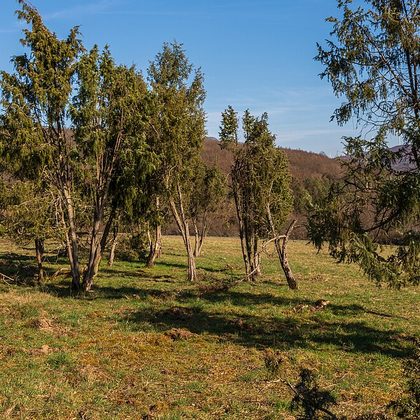
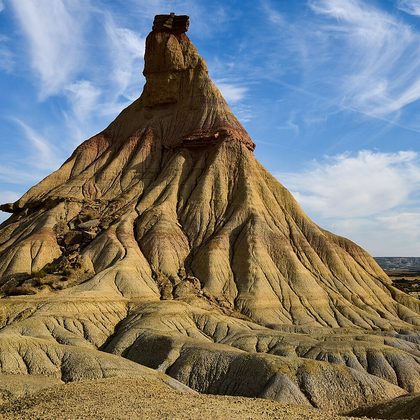
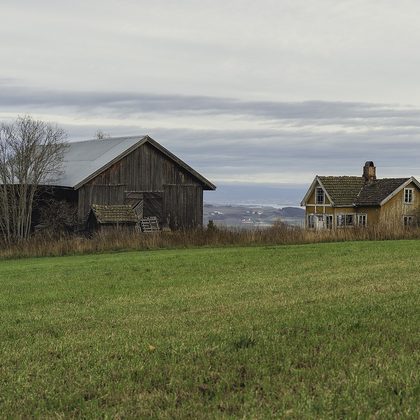
Bare, warm, disturbed ground with low, open vegetation: industrial estates, docks, railway yards, airfields, road verges, farmyards, field margins and stubbles, and beyond that fallow, steppe and semi-desert. It feeds on foot over open sand and grit and needs a few tussocks or weedy patches nearby in which to hide the scrape nest. As soon as such ground is sown, paved, planted up or allowed to close over, the bird is gone within a few years.
Where the bird is most at home, classified with EUNIS — the European standard for habitats.


Range and movements
From Iberia and north-west Africa east through southern and central Europe, the Balkans, Anatolia and the Middle East, and beyond the area of this guide on into Central Asia and East Asia, reaching south to the Sahel. Within Europe it is commonest around the Mediterranean, in the Balkans and in the east. Around the southern North Sea it has effectively gone as a breeding bird, and it is falling fast elsewhere in western and central Europe and in southern Scandinavia too. The British Isles have only a scattering of accepted records, all vagrants; the nearest breeders are across the Channel, and they are thinning out. It is a true resident, staying within a few kilometres of its breeding site all year, and there are hardly any records of migration.
- Resident
- Breeding (summer)
- Winter
- Passage
- dark = core range, pale = thinly spread
How and when to look
In southern Europe it takes no effort. Walk a dusty field track, a car park at an archaeological site, a petrol station forecourt or the edge of a village on a warm morning and watch for a sandy bird that walks away ahead of you instead of flying. The wistful whistle usually gives it away before the binoculars do. If it does flush, look at the underwing: warm rusty orange means Crested Lark. In Iberia, if the bird is perched on a rock or a bush in stony, scrubby ground, check bill and breast streaks first, because Thekla's Lark is at least as likely.
Conservation status
Not globally threatened (LC), but in north-western Europe the Crested Lark has gone from commonplace to absent within a single lifetime. The explanation lies in the nature of its habitat. It lived off temporary bare pioneer ground, and that ground was sown, paved, planted or tidied away as soon as a district or an estate was finished. Farm intensification, neater verge management and the loss of stubbles and grain-strewn farmyards did the rest. In southern and eastern Europe it is still common, though numbers there are slipping too.
Scientific name
Galerida cristata | (Linnaeus, 1758)
Linnaeus described the species in 1758 as Alauda cristata; because it was later moved to another genus, the author and year stand in brackets. The genus Galerida was introduced in 1828 by Boie. Galerida is Latin for a crested lark, from galerum 'cap', after the upright crest. cristata is Latin for 'crested', from crista 'crest'. The specimen the first description was based on came from Vienna.