All species › Waders, gulls and terns › Pratincoles and coursers › Cream-Colored Courser
Cream-Colored Courser | Cursorius cursor
Renvogel | Corredor sahariano
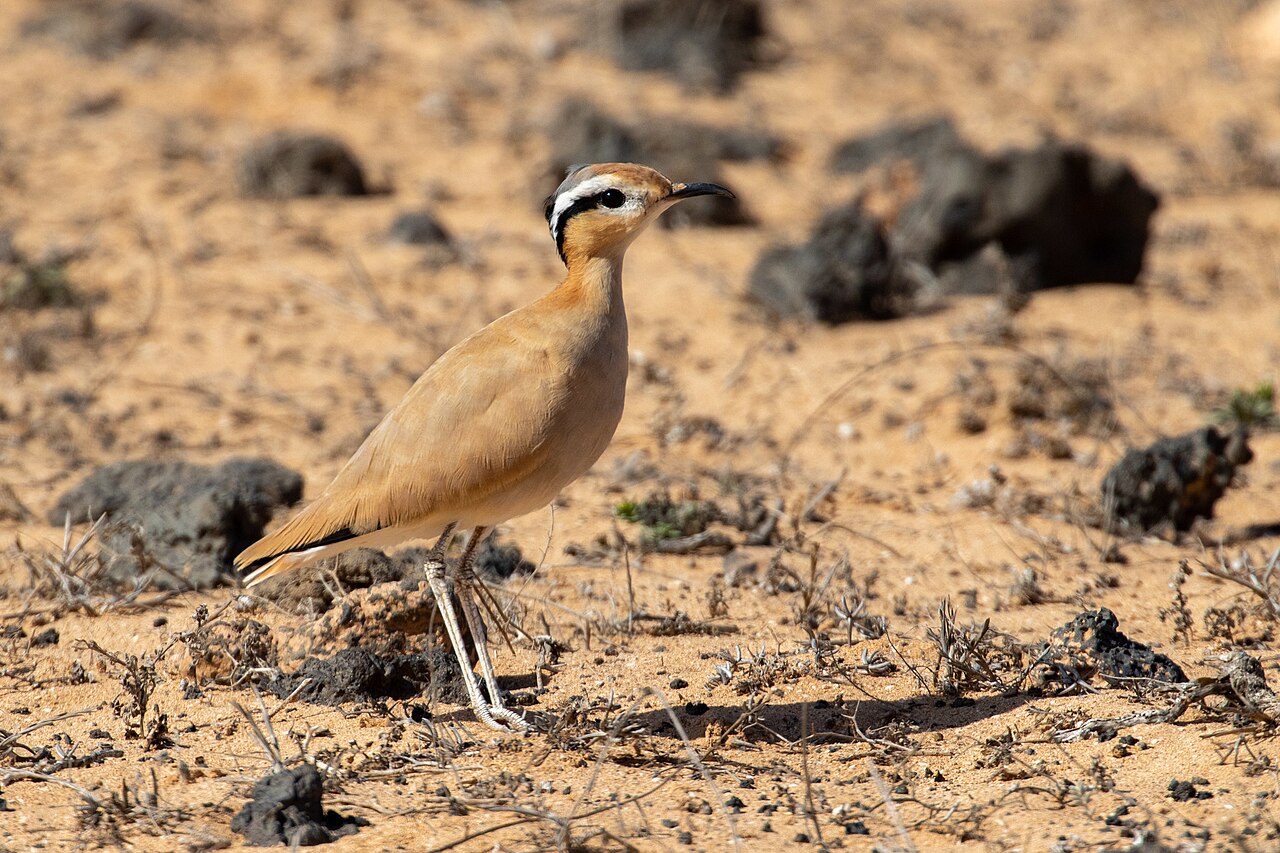
Sandy from head to tail, with a blue-grey nape and a black-and-white head stripe that meets in a point on the nape. It rarely flies and prefers to run, in short sprints with the head held low.
Click a thumbnail to switch the photo above.
Voice
Usually silent. Disturbed birds give a short sharp whistled kwit-kwit, sometimes repeated in flight. In display the call is a nasal whaur and a harsh frog-like praak-praak that carries a long way over bare ground.
Recording: David Darrell-Lambert — CC BY-NC-SA 4.0 · Wikimedia Commons
Identification
The whole bird is warm sandy buff, paler on the belly, with a blue-grey rear crown and nape. A black stripe runs back from the eye with a white supercilium above it, and the two meet in a sharp V on the nape. The bill is black and slightly decurved, the legs long and off-white. Perched or walking the bird shows no black at all; the moment it flies, the primaries and the entire underwing are jet black, giving a striking contrast.
Confusion species
At range the shape suggests a plover, but no plover combines long pale legs, a decurved black bill and head stripes meeting in a nape V. Dotterel shares the V but is shorter legged, shows a white breast band and habitually crouches, whereas a courser stands very upright, runs with the head held low and then freezes. Stone-Curlew is bulkier and heavier, with a huge yellow eye, bold black-and-white wing bars and a stealthy, crouched walk; it is largely crepuscular, while the courser is out running in full sun.
Habitat
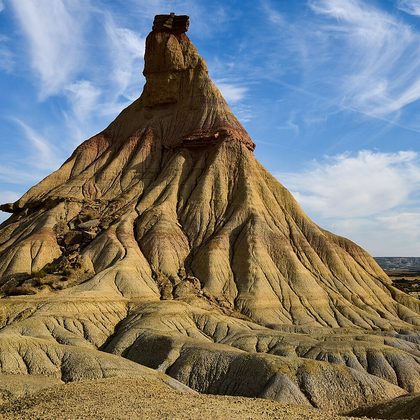
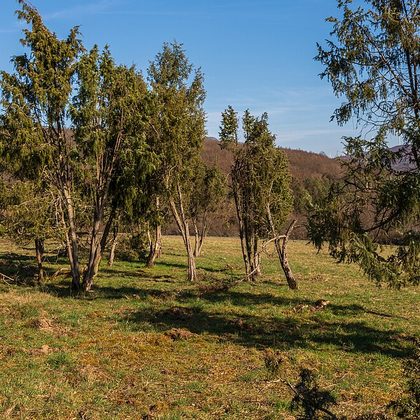
Semi-desert and bare steppe: flat, sparsely vegetated ground of sand, grit or stone with at most scattered dwarf shrubs. On the eastern Canaries this means the jables (Canarian sand fields of wind-blown shell sand), the wind-blown sand plains, together with the adjoining lava flats and malpaís (rough, impassable lava field). The species avoids closed scrub and irrigated farmland, and feeds on foot with a short dash and a stab at beetles, ants and larvae.
Where the bird is most at home, classified with EUNIS — the European standard for habitats.

Range and movements
Breeds from the Canary Islands and the Sahara east through Arabia to west Pakistan and north-west India. Within Europe it breeds only on Fuerteventura and Lanzarote, with a few birds on La Graciosa and irregular presence on Tenerife and Gran Canaria, and since 2001 it has also bred sporadically on the Iberian mainland (Almería, Albacete, Granada). Further north and on the rest of the Iberian mainland it is a real exception: on the British Isles records typically concern single birds on coastal grassland, links and cliff-top fields in autumn, though the species has become rarer there.
- Resident
- Breeding (summer)
- Winter
- Passage
- dark = core range, pale = thinly spread
How and when to look
To see the species reliably, book a flight to Fuerteventura and, in the first two hours of daylight, work the plains around Tindaya and the Llanos de la Concepción, or the jable between La Oliva and Lajares, scanning from the car with the sun behind you: at a hundred metres the bird is almost invisible until it moves, and it is usually the movement you see rather than the bird. On Lanzarote, the plain at Sóo, on the edge of El Jable, is the classic address. A vagrant in north-west Europe turns up on short grass rather than mud: expect a golf links, an airfield or a grazed cliff top in autumn, not an estuary.
Conservation status
Not globally threatened, but the Canarian population is small: the first full census, in 2005 and 2006, put it at roughly two thousand birds, more than four fifths of them on Fuerteventura. The pressures are local: building and tourist infrastructure on the plains, off-road vehicles crossing the jables, and disturbance by free-running dogs during the breeding season.
Scientific name
Cursorius cursor | (Latham, 1787)
Latham described the species in 1787 as Charadrius cursor; because it was later moved to another genus, the author and year stand in brackets. The genus Cursorius was introduced in 1790 by Latham. Cursorius comes from Latin cursor 'runner', from currere 'to run', after the habit of chasing insects on foot across dry open ground. cursor repeats the sense of the genus name: Latin for 'runner'. The specimen the first description was based on came from Kent, England.