All species › Passerines › Bush warblers › Cetti's Warbler
Cetti's Warbler | Cettia cetti
Cetti's zanger | Ruiseñor bastardo
You hear ten Cetti's Warblers for every one you see. It lives hidden in the densest waterside scrub and gives itself away with a song so loud and so sudden that it makes you jump. Since the turn of the century it has become a settled breeding bird in north-west Europe as well.
Voice
The song is an explosion out of nothing. After minutes of silence a deafening, full-volume chewp! erupts from a dense bush, followed by a short pause and then a rapid, stuttering, loud rattle: chewp! — chwee-chwee-chwee-chwee-chi-chi-chi, over in less than two seconds. The phrase starts at full strength with no run-up and cuts off as abruptly as it began; afterwards there is silence again and the bird is usually already twenty metres away. The volume is out of all proportion to the bird: at fifty metres it still sounds as if it is beside you. The call is a hard, dry tchik or plit, like stone struck on stone, often repeated in short bursts by an agitated bird. It sings all year round, including November and January, but most fiercely from late February into June, and not only at dawn: midday, dusk and even the night produce phrases.
Recording: Joost van Bruggen — CC BY-SA 4.0 · Wikimedia Commons
Identification
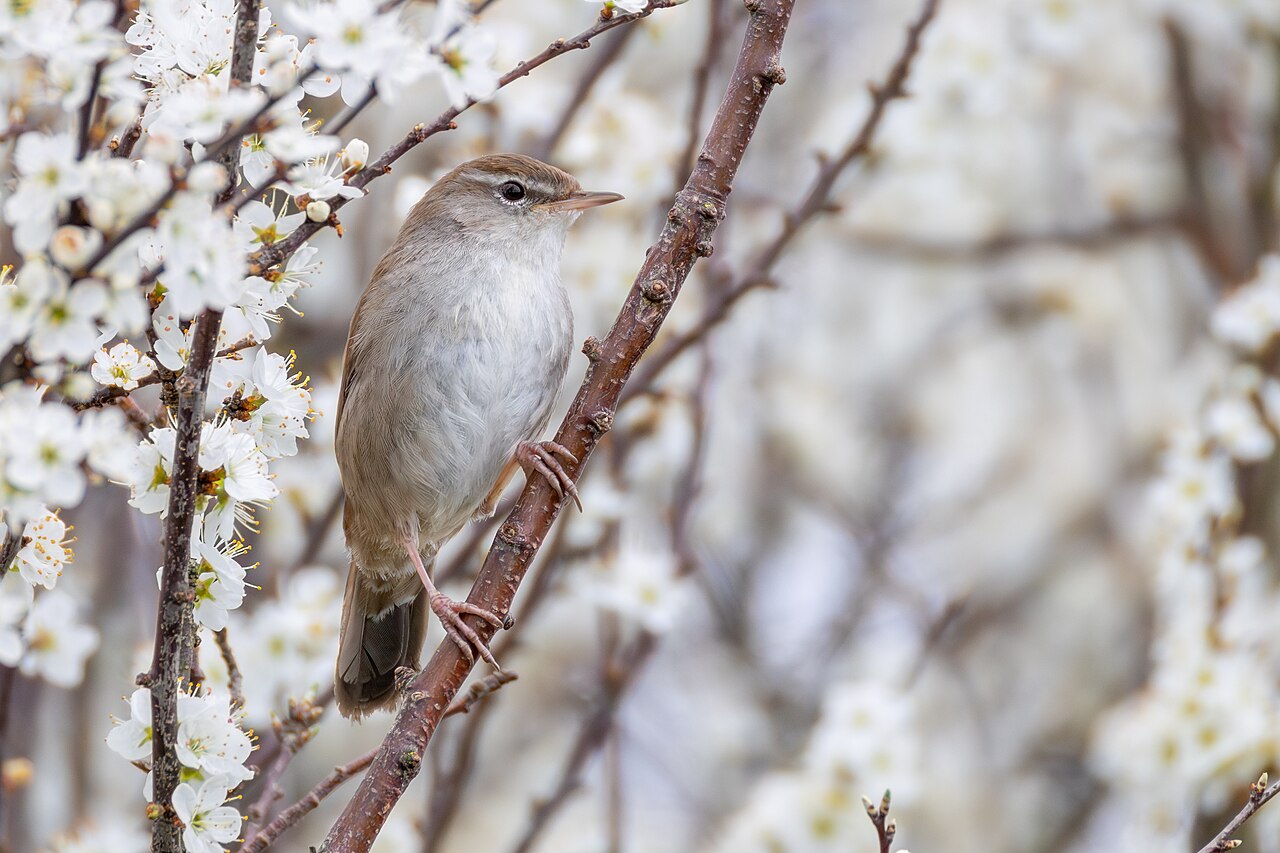
A stocky, dark warbler, heavily built with a short rounded wing. Upperparts warm chestnut-brown and unstreaked, underparts greyish-white with dingy grey flanks and a vague grey supercilium over a dark eye. The best feature is the tail: broad, rounded and conspicuously full, with only ten feathers, often slightly cocked or fanned as the bird dives through cover. The undertail coverts are dark with pale tips, giving a scaly edge. Legs sturdy and flesh-coloured. Sexes look alike, but the male is markedly larger and heavier than the female.
Confusion species
On looks, Nightingale comes closest: larger and slimmer, warmer rufous on the tail, with a big dark eye in a pale eye-ring and longer legs, and it hops on the ground rather than creeping through bushes. Sedge Warbler has a boldly streaked back and a broad cream supercilium. Blyth's Reed Warbler is colder olive-brown, longer-winged and even more skulking. In practice this is a species you identify by ear, and that explosive outburst is unmistakable in Europe.
Habitat
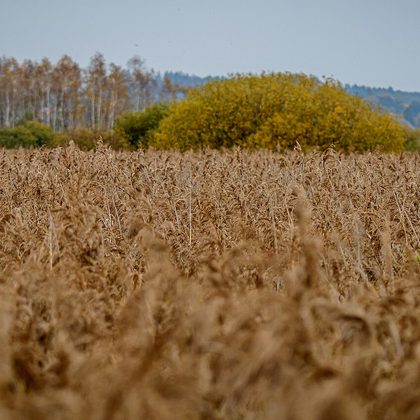
Dense, low, impenetrable scrub on damp ground, always close to water: bramble thickets and willow scrub along ditches and creeks, the rank transition from reed to woodland, thick bank vegetation along canals, carr woodland and osier beds. It is the structure that matters, not the reed itself: a bare reed fringe is no good to it, a bramble bank along a watercourse is. In Iberia also tamarisk thickets, riverine woodland, rice fields and irrigation canals.
Where the bird is most at home, classified with EUNIS — the European standard for habitats.


Range and movements
Originally a Mediterranean species that has expanded strongly northwards since the mid-twentieth century. In the Mediterranean it is one of the commonest birds of every river bank and marsh, from Galicia to the Ebro delta and the Guadalquivir, and on east to Anatolia and the Levant; it also occurs in the Maghreb. In north-west Europe colonisation began in the 1970s, but the severe winters of the late 1970s and 1980s wiped the northern outposts out again; only since the start of this century has it truly established itself there. Around the southern North Sea coast the strongholds are in the Delta, along the great rivers and in the Biesbosch, and the spread northwards continues.
- Resident
- Breeding (summer)
- Winter
- Passage
- dark = core range, pale = thinly spread
How and when to look
Go to a rank reed fringe or a bramble bank along a creek in February or March, and simply stand still. Talking and walking do not help; waiting does. Within ten minutes a phrase usually detonates somewhere, and then you know where the bird is. For a view of the bird itself, the top of a bush in early morning sun is the best chance: it comes up for a second or two, that broad tail half cocked, and is gone again. In north-west Europe the highest densities are in the deltas and along the great rivers; around the Mediterranean any scrubby river will do.
Conservation status
Not threatened, and clearly increasing in numbers and range across Europe, almost certainly helped by milder winters. Against that, the species lays down no fat reserves and does not migrate: a genuinely hard winter with prolonged frost and snow can knock northern populations back by tens of percent. Recovery is quick, however, because pairs can raise more than one brood a year.
Scientific name
Cettia cetti | (Temminck, 1820)
Temminck described the species in 1820 as Sylvia cetti; because it was later moved to another genus, the author and year stand in brackets. The genus Cettia was introduced in 1834 by Bonaparte. Cettia honours the eighteenth-century Italian zoologist Francesco Cetti, after whom the bird itself is also named. cetti honours the same Francesco Cetti as the genus name. The specimen the first description was based on came from Sardinia.