All species › Passerines › Finches › Brambling
Brambling | Fringilla montifringilla
Keep | Pinzón real
The Brambling is the northern counterpart of the Chaffinch: it breeds in the birch woods and taiga from Lapland to Siberia and pours south in autumn. In a good beech mast year a single wood can hold millions of them, the largest concentration of birds in Europe.

Click a thumbnail to switch the photo above.
Voice
The winter call is a hard, nasal, drawn-out tsweeek, harsher and more grating than the springy pink of a Chaffinch; in flight a dry, hard chek chek. The song, rarely heard away from the breeding grounds, is a monotonous rasping dzheee repeated from a treetop in northern birch forest.
Recording: Sonothèque ADVL — CC0 · xeno-canto
Identification
Orange shoulders and breast, a sharply defined white rump and black spots along the flanks. The summer male has a jet-black head and mantle; in winter brown feather fringes veil this and the head looks scaled. The bill is then yellow with a black tip, blue-black in summer. The female is a duller orange-buff, with two dark stripes framing the grey side of the neck. The tail is dark and slightly forked, with no white at the sides.
Confusion species
Chaffinch is the bird it will be standing next to, and two hard characters settle it. The Brambling's shoulder is orange where the Chaffinch's is white, and its rump is clean white where the Chaffinch's is greenish. That white rump shows at long range as a flock lifts off a stubble field. The Brambling also lacks the Chaffinch's white outer tail feathers and, in winter, has a yellow bill with a black tip.
Habitat
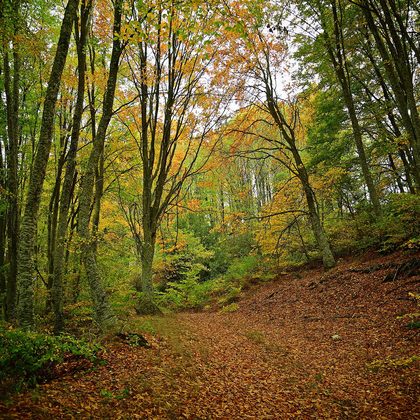
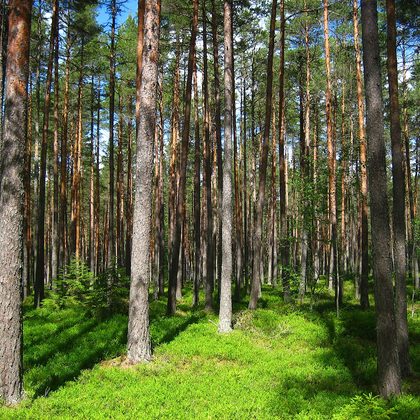
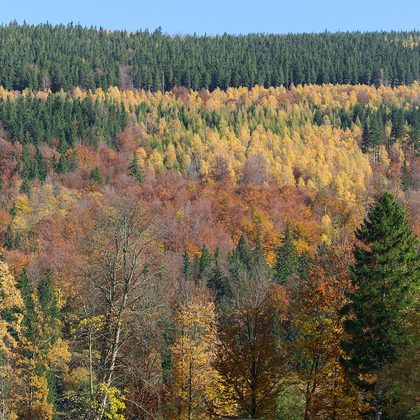
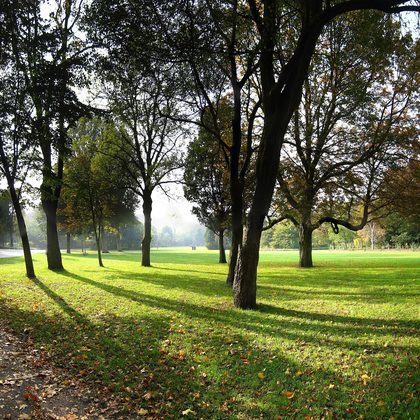
Breeds in birch woods, willow scrub and old conifer forest along the northern edge of the tree line. In winter it uses beech woods, cereal and maize stubbles, farmyards and garden feeding stations, usually in mixed flocks with Chaffinches.
Where the bird is most at home, classified with EUNIS — the European standard for habitats.

Range and movements
Breeds across northern Scandinavia and the northern taiga further east, right out to the Barents coast. It moves south in October and November in huge numbers, reaching Iberia, the Apennine peninsula and North Africa. Where the beech crop is heavy the flow simply stops: roosts of millions have been described from the Alps and their foothills, while the same district may hold few Bramblings the following winter. In Iberia wintering numbers are highly erratic for the same reason: some years see thousands in the beech and oak woods of the north, other years almost none; the beech woods of the Pyrenees and the Cantabrian coast are the most reliable spot.
- Resident
- Breeding (summer)
- Winter
- Passage
- dark = core range, pale = thinly spread
How and when to look
In November and December work a mature beech wood and listen for rustling in the leaf litter: Bramblings feed on foot among the mast and go up into the canopy as one cloud when disturbed, white rumps flaring. At a feeder the bill is the quickest check — yellow with a black tip, not the blue-grey of a Chaffinch.
Conservation status
Not globally threatened (IUCN: Least Concern), with a very large breeding population in the north. Wintering numbers swing wildly from year to year with the beech crop and say little about the state of the species. In the longer run, logging of northern birch and conifer forest is the main concern.
Scientific name
Fringilla montifringilla | Linnaeus, 1758
Linnaeus described the species in 1758 and placed it straight away in the genus where it still stands. He introduced the genus Fringilla in that same work. Fringilla is the Latin word for 'finch'. montifringilla is Latin for 'mountain finch', from mons, montis 'mountain' and fringilla 'finch'. The specimen the first description was based on came from Sweden.