All species › Passerines › Chats and flycatchers › Blue Rock-Thrush
Blue Rock-Thrush | Monticola solitarius
Blauwe rotslijster | Roquero solitario
The bird of hot rock: sea cliffs, limestone gorges, quarries and, just as naturally, the top edge of a cathedral or an abandoned castle. It sits high and alone, sings slowly and mournfully over the drop, and rarely lets anyone close. In Iberia it breeds almost wherever there are rock outcrops or coastline, and yet many people know it by voice before they ever see one. In north-west Europe it is a vagrant.
Click a thumbnail to switch the photo above.
Voice
The song is the best character at range: slow, loud, purely fluted phrases of four to eight notes, mournful in tone and separated by long silences, carrying right across a gorge or a harbour basin. Blackbird-like in quality but shorter, clipped, higher and sadder, and without the muttering ending. It sings from the highest point available — a cliff edge, a spire, a television aerial — and sometimes in a short gliding song flight. Calls: a hard, far-carrying chak-chak and a thin, plaintive seee. Sung from February into June, most freely at first light.
Recording: Tanguy Loïs — CC BY-SA 4.0 · xeno-canto
Identification
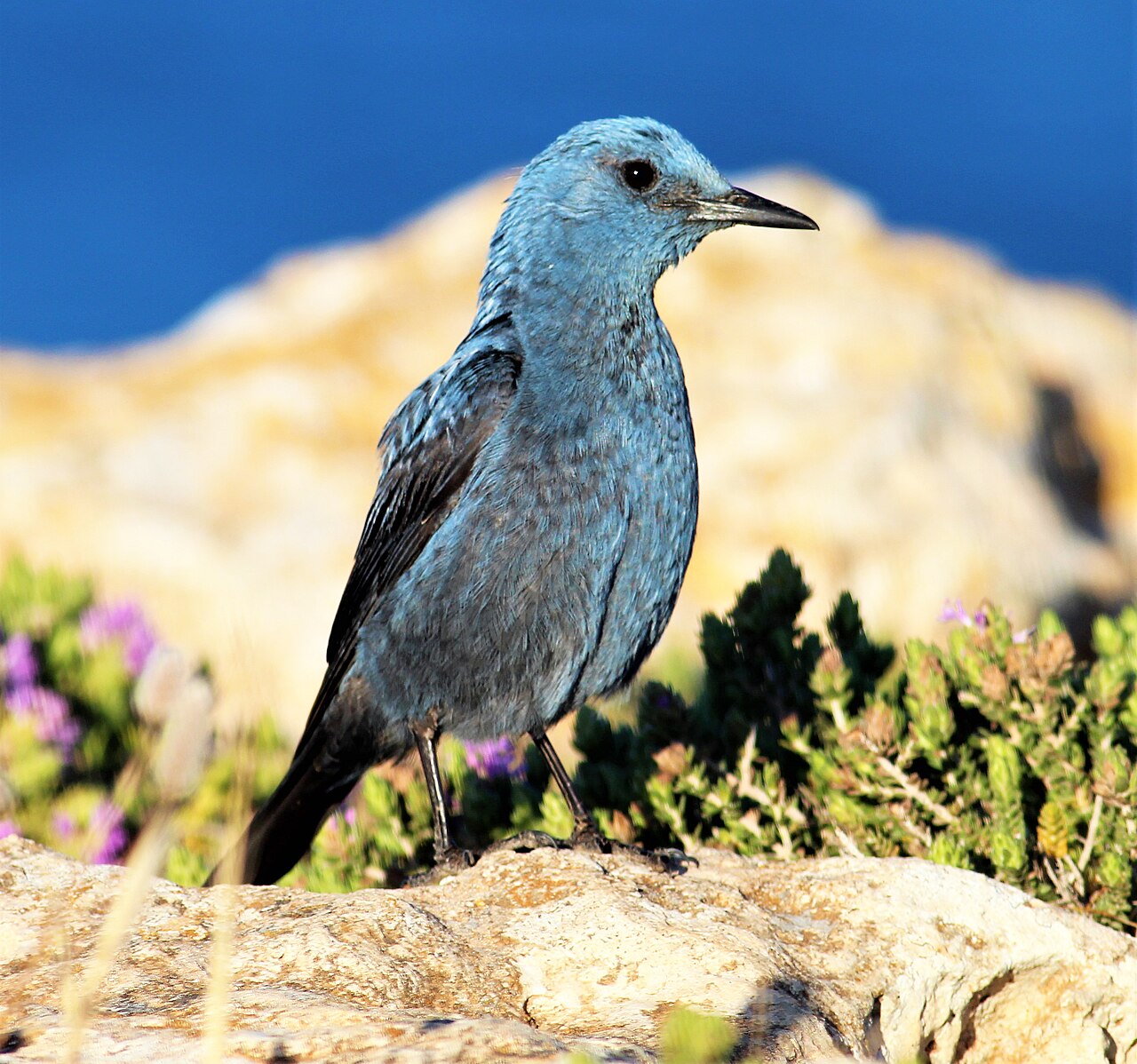
A long, slim thrush-like chat with a long dark bill, a fairly long dark tail and an upright, high-shouldered stance. The male is dark slate blue throughout; in sunshine and at close range the blue is deep and warm, against the light and at distance he simply looks black. In fresh autumn plumage narrow pale fringes give a finely scaled effect. The female is dark grey-brown above and buff below, the whole underside closely covered in dark crescents, with a weak pale eye-ring; juveniles resemble her but are spotted on the back as well. In every plumage: dark bill, long tail, no red or orange anywhere.
Confusion species
Rufous-Tailed Rock Thrush is the first comparison and the tail decides it — see its own species page. That bird is shorter-tailed, with an orange-red tail and orange underparts; Blue Rock-Thrush has a longer, wholly dark tail with no red at all. The female Blue Rock-Thrush is colder and darker grey-brown than the female Rufous-Tailed, and marked with crescents rather than fine vermiculation. Blackbird is the second trap, especially backlit on a roof: the male Blackbird has a yellow bill and yellow eye-ring, a longer tail and a rounder head, and hops on grass instead of standing upright on stone. Starling also looks dark on a ridge tile at range, but is far shorter-tailed, triangular-winged, and walks rather than hops. Vagrants from the east may belong to the form philippensis, which has a chestnut belly below the blue breast.
Habitat
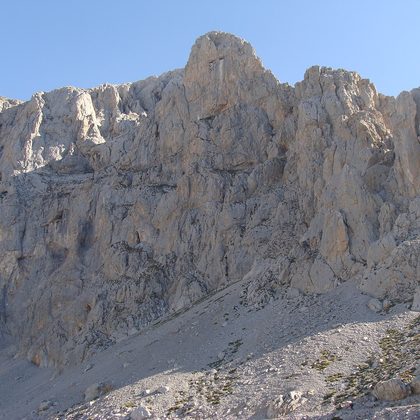
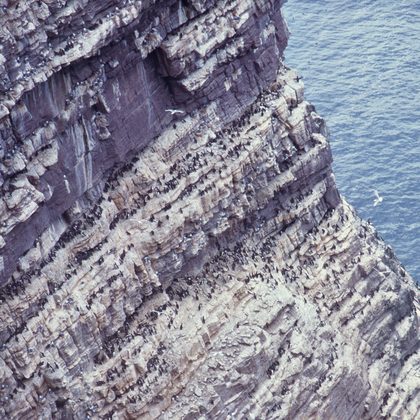
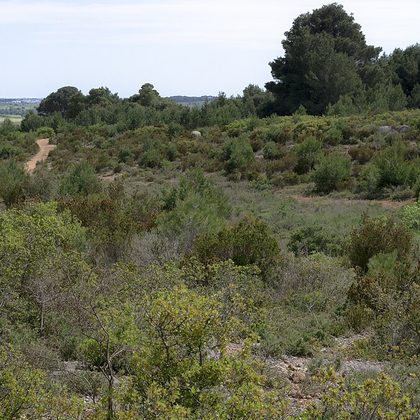
Hot, dry rock in the broadest sense: sea cliffs and rocky coasts, limestone gorges and canyons, steep mountain faces, quarries — and throughout southern Europe the built structure just as readily as the natural one. Castles, town walls, cathedrals, forts, ruins, viaducts and old harbour moles are cliffs to this bird, and it both nests and hunts on them, taking insects and lizards from the cornice, the square below and the roof tiles. From sea level to about 2,000 metres, with the highest sites occupied only in summer.
Where the bird is most at home, classified with EUNIS — the European standard for habitats.


Range and movements
From Iberia and north-west Africa right across the Mediterranean basin and the Middle East, and eastwards through Central Asia to China and Japan. In the western part of that range it is resident, with only altitudinal movements; eastern populations do migrate. Around the Mediterranean it is a widespread breeder of coast and mountain: in Iberia from the Costa Brava to Gibraltar and from the Pyrenees to the Sierra Nevada, scarce only on the Cantabrian coast and in the big farming plains, and on Malta, Sardinia, Sicily and the Aegean islands it is one of the commonest birds of the cliffs. Also resident in North Africa, Anatolia and the Levant. North of the Mediterranean zone it is a great rarity, with only a handful of records in north-west Europe.
- Resident
- Breeding (summer)
- Winter
- Passage
- dark = core range, pale = thinly spread
How and when to look
Easiest in March and April, early in the morning, from a viewpoint over a gorge, a harbour basin or an old walled town in southern Europe — the gorges of the Duratón or the Júcar, a castle in the Iberian interior, the cliffs of Malta or of an Aegean island. Find it by ear first: the slow fluted phrases with silences between them are unmistakable and give away the perch. Then scan the highest points — a tower cross, a rock pinnacle, an aerial — and read the posture: upright, head slightly raised, tail hanging. On sunny afternoons the blue only shows at close range; in morning backlight the silhouette combination of long bill, long tail and topmost perch works fastest.
Conservation status
Not globally threatened and stable across most of southern Europe. The concerns are local: the restoration of castles, church towers and town walls in which niches and crevices are sealed, the expansion of quarries, climbing pressure on breeding faces and, in parts of the Mediterranean, illegal trapping for the cagebird trade. Where old buildings keep their holes and cliffs are left alone during the breeding season, the species holds its own without difficulty.
Scientific name
Monticola solitarius | (Linnaeus, 1758)
Linnaeus described the species in 1758 as [Turdus] solitarius; because it was later moved to another genus, the author and year stand in brackets. The genus Monticola was introduced in 1822 by Boie. Monticola is Latin for 'mountain-dweller', from mons, montis 'mountain' and colere 'to dwell'. solitarius is Latin for 'solitary', after the bird's habit of living alone or in pairs. The specimen the first description was based on came from Italy.