All species › Gamebirds › Pheasants and partridges › Barbary Partridge
Barbary Partridge | Alectoris barbara
Barbarijse patrijs | Perdiz moruna
The one European partridge without a black gorget. Instead it wears a broad chestnut collar spangled with white spots, like a beaded scarf around the neck. For the European birder it means just three places: the Canary Islands, Sardinia and the Rock of Gibraltar, and nowhere else in Europe.

Click a thumbnail to switch the photo above.
Voice
Loud and far-carrying. The call is a shrill, grating ketch-ketch-ketch that climbs in pitch as it goes and can be heard for a mile down a quiet barranco. Also a short, hard chek when uneasy and soft clucking between birds of a covey. Most vocal from February to May, given from a rock ledge or a terrace wall.
Recording: Stanislas Wroza — CC BY-NC-SA 4.0 · Wikimedia Commons
Identification
Grey-looking gamebird with red bill and legs. Face, throat and cheeks blue-grey, crown and forehead chestnut, and below that a broad chestnut collar thickly spotted with white. Upperparts grey with a bluish bloom and a rusty tinge on the shoulder; flanks barred in blue-grey, chestnut, black and white. A pale rufous stripe runs back behind the eye. Flight low and direct, showing rusty tail sides.
Confusion species
Within the genus this one separates at a glance: the other three have a black-edged throat, Barbary has a chestnut, white-spotted collar around a blue-grey face under a chestnut crown. Red-Legged Partridge has a white throat whose black surround breaks downwards into a broad field of black streaks and drops over neck and upper breast, with a warm chestnut crown and chestnut in the flank bars — the bird most watchers across the map area already know for comparison, since releases have made red-legged widespread. Rock Partridge has a pure white bib running further onto the upper breast, edged by an unbroken, knife-sharp black line, with black at the base of the bill and a blue-grey crown and nape, and broad, widely spaced flank bars. Chukar has a cream, not white, throat, a closed but slightly broader and more ragged black line, a grey-brown crown with a vinous cast, a rufous ear patch inside the black eye-stripe, and narrower, more numerous flank bars. Ranges touch mainly at the Strait of Gibraltar: Barbary holds the Rock and North Africa, red-legged holds the Campo de Gibraltar and all of Andalusia; on Sardinia the two overlap because of released red-legs; on the Canary Islands Barbary stands alone. Bear in mind too that releases in Iberia and on the Apennine peninsula have put Chukar × Red-Legged hybrids into the field, with a creamy throat and a gorget only half broken into streaks.
Habitat
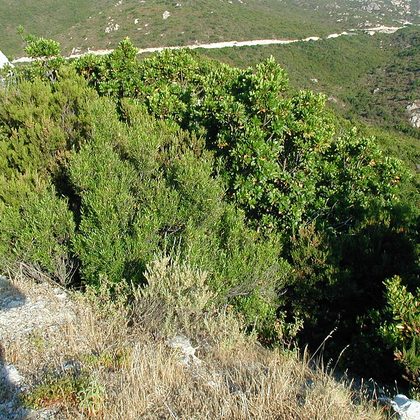
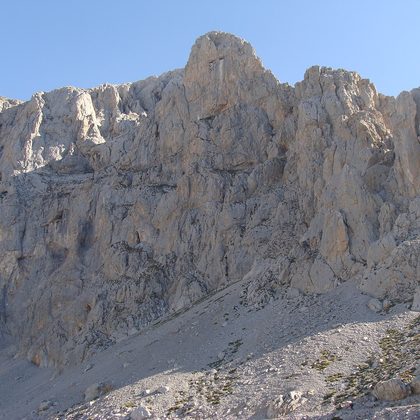
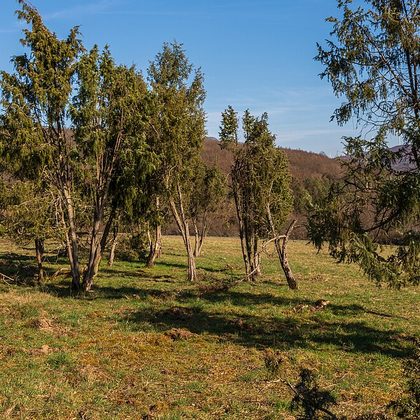
Dry, warm slopes with open low scrub: the cardón and tabaiba succulent scrub of the Canaries, macchia and garrigue on Sardinia, and the maquis on the flanks of the Rock of Gibraltar. Also steep barranco walls, terraces, the edges of small cultivated plots and open pine woodland. To at least two thousand metres on Tenerife.
Where the bird is most at home, classified with EUNIS — the European standard for habitats.


Range and movements
Naturally a bird of North Africa, including Ceuta and Melilla. In Europe it breeds on Sardinia and on the Rock of Gibraltar; the Canary Island birds go back to stock released in the early nineteenth century and belong to the race A. b. koenigi. Birds have also been released on Madeira and in parts of western Iberia. It is absent from mainland Iberia.
- Resident
- Breeding (summer)
- Winter
- Passage
- dark = core range, pale = thinly spread
How and when to look
The Barranco del Infierno above Adeje on Tenerife, or the upper Rock at Gibraltar, early in the morning. Follow the calls up the barranco and scan the terraces and walls; the birds feed in the shade of the tabaibas and step onto a wall in the first sun. On Sardinia work the inland stubbles and macchia instead.
Conservation status
Not globally threatened, but the European populations are small and exposed. Gibraltar holds a few hundred birds on a couple of square kilometres, Sardinia a few thousand pairs, and on the Canaries the species faces hunting pressure alongside feral cats and rats. The annual topping-up with reared birds brings disease and genetic mixing with it.
Scientific name
Alectoris barbara | (Bonnaterre, 1790)
Bonnaterre described the species in 1790 as Perdix barbara; because it was later moved to another genus, the author and year stand in brackets. The genus Alectoris was introduced in 1829 by Kaup. Alectoris is Greek, from alektoris 'farmyard hen', from alektōr 'cockerel'. barbara is Latin for 'foreign' and points here to the Barbary Coast of North Africa. The specimen the first description was based on came from Morocco.