All species › Flamingos › Flamingos › American Flamingo
American Flamingo | Phoenicopterus ruber
Rode flamingo | Flamenco del Caribe
The flamingo of the Caribbean, far more deeply coloured than the Greater Flamingo: orange-red to vermilion across head, neck and body. In Europe it is almost always an escape, or a bird of mixed parentage standing among Greater Flamingos in the Camargue, the Ebro delta or the Guadalquivir marshes.

Click a thumbnail to switch the photo above.
Voice
Goose-like honking, exactly as in Greater Flamingo: a nasal bleating ka-ha and a low grunting chatter from feeding parties that carries for kilometres over flat water. Flying birds call loudly and continuously. The voice cannot be separated from that of Greater Flamingo in the field and is no help at all in identification.
Recording: Justin Watts — CC BY-SA 4.0 · xeno-canto
Identification
As large and as long-legged as Greater Flamingo but saturated with colour: head, neck, breast and flanks orange-red, the coverts deeper crimson, the flight feathers black. The legs are pink to red along their whole length, the iris pale yellow, and the face is feathered pink to the bill base. The bill is orange-pink with a sharply defined black tip and the usual downward kink. Juveniles are grey-brown with grey bill and legs and take several years to colour up.
Confusion species
Greater Flamingo (Phoenicopterus roseus) is the comparison that matters: pale pink-white over body and neck, with red confined to the coverts, so that it reads as a white bird at range. On American Flamingo the saturated colour runs right up the neck and into the head. Chilean Flamingo has grey-blue legs with red joints and more black on the bill; Lesser Flamingo is much smaller with a dark red bill. Two warnings: birds in collections are fed pigmented food and are also strongly coloured, and hybrids with Greater Flamingo are frequent in European flocks. Judge colour, bill pattern and leg colour together, and always look for a ring.
Habitat
Shallow saline and brackish water without vegetation: salt pans, coastal lagoons, mudflats and estuaries, where it filters the mud with its head upside down. In Europe it uses exactly the sites Greater Flamingo uses, usually as a single bird among hundreds.
Where the bird is most at home, classified with EUNIS — the European standard for habitats.
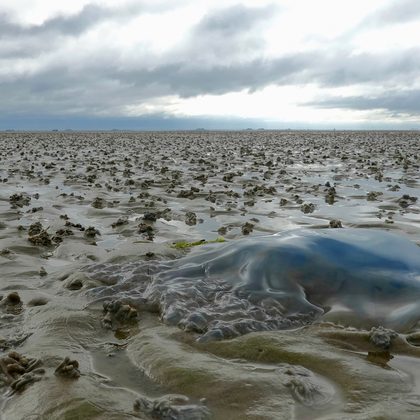
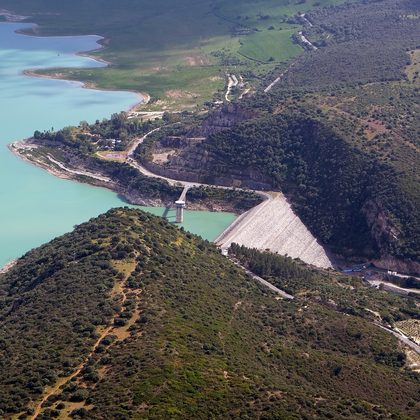
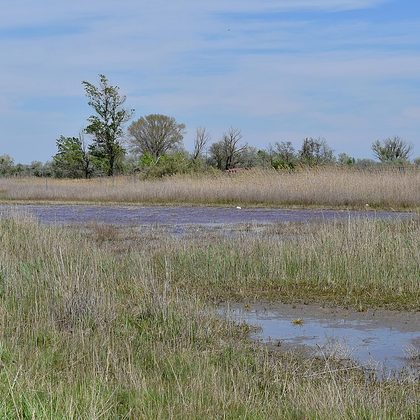
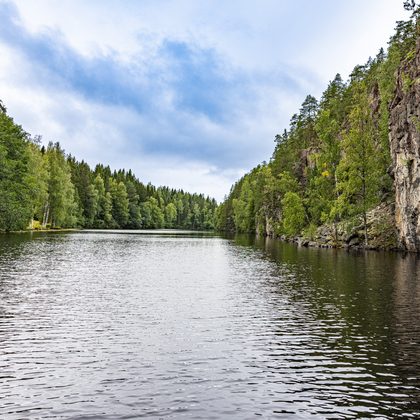
Range and movements
The natural range covers the Caribbean, Yucatán, the north coast of South America and the Galápagos. Accepted wild records in Europe are effectively absent: rarities committees treat almost every bird as an escape or as being of unknown provenance, and the species sits in Category E on most national lists. Birds appear irregularly in the mixed flamingo flocks of north-west Europe, including the Zwillbrocker Venn and the Delta, and among the flamingos of the salinas of southern Iberia and the Levante.
How and when to look
Work through any flamingo flock in the Camargue, the Ebro delta, Fuente de Piedra or Santa Pola with a telescope and pick out the bird whose neck, not just its coverts, is orange-red. Low morning and evening light exaggerates pink in every bird, so judge colour in flat light and with the birds at the same angle to the sun. Read rings whenever you can: with this species they usually settle the question of origin.
Conservation status
Not globally threatened, and the Caribbean population has grown since the main colonies were protected. The European birds are not a self-sustaining population and depend on fresh escapes from collections. In Europe they add to the mixing of the flamingo flocks, making hybrids increasingly hard to untangle.
Scientific name
Phoenicopterus ruber | Linnaeus, 1758
Linnaeus described the species in 1758 and placed it straight away in the genus where it still stands. He introduced the genus Phoenicopterus in that same work. Phoenicopterus is Greek, from phoinix 'crimson' and pteron 'feather', thus 'red-feathered'. ruber is Latin for 'red', after this species' deep rose-red plumage. The specimen the first description was based on came from the West Indies.