All species › Parrots › African and New World parrots › Yellow-chevroned Parakeet
Yellow-chevroned Parakeet | Brotogeris chiriri
Chiririparkiet | Catita Chirirí
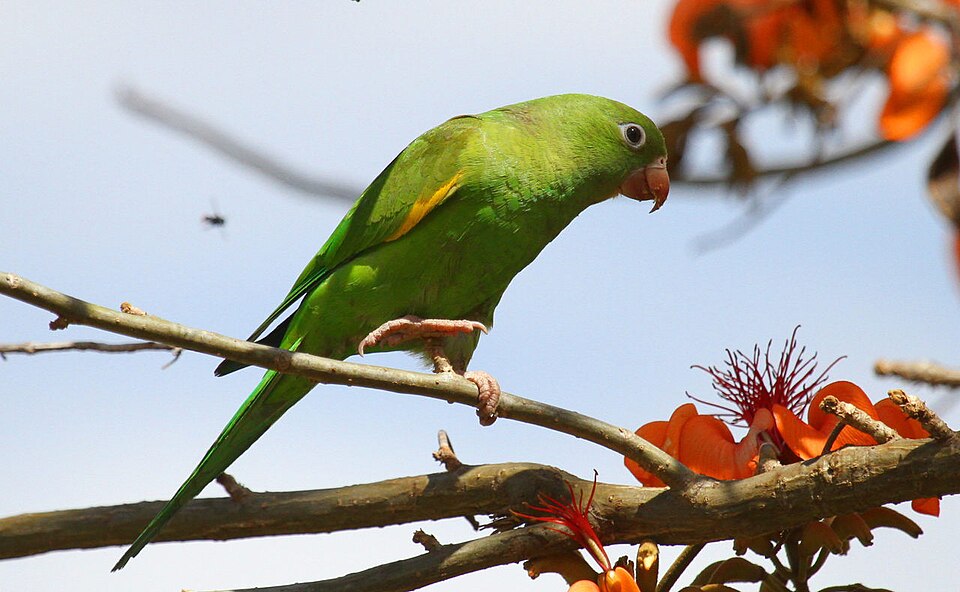
The Yellow-chevroned Parakeet is a small, pale green parrot with a yellow stripe across the wing, treated as the same species as White-winged Parakeet until 1997. Native to central Brazil, Bolivia, Paraguay and northern Argentina, it has been naturalised since the 1960s and 1970s in and around Miami and Los Angeles, descended from escaped cage birds.
Voice
Short, scratchy squawks and a rattling chatter reminiscent of a red squirrel, but slower and lower in pitch. In flight a small group calls almost continuously; perched in a tree the species is far quieter.
Recording: JAYRSON ARAUJO DE OLIVEIRA — CC BY-NC-SA 4.0 · São Paulo, Jardim Botânico, Brazil · xeno-canto
Identification
Mostly pale green, with a yellow stripe across the folded wing that remains visible in flight, and dark blue outer primaries. The bill is horn-coloured, the legs grey; male and female cannot be told apart in the field. About the same size as White-winged Parakeet, but without its white wing panel.
Confusion species
White-winged Parakeet (Brotogeris versicolurus), treated as the same species until 1997 and present in the same cities, shows a white rather than yellow wing panel in flight; beyond that mark the two species are nearly identical. Larger green parakeets from the same region, such as Monk Parakeet, are clearly bigger and lack any yellow or white on the wing.
Habitat
Open woodland, savanna and disturbed sites near settlement in its native range; in North America mainly city parks, avenues and gardens in south Florida and southern California, often alongside White-winged Parakeet. For the nest it chooses tree cavities or tunnels in dead palm fronds, and outside the breeding season forms large communal roosts.
Where the bird is most often found, arranged by the USNVC — the vegetation classification of the United States and Canada — and CMECS for sea and coast.



Range and movements
Its original range lies in tropical South America south of the Amazon basin, from central Brazil to southern Bolivia, Paraguay and northern Argentina; that falls outside this map. In North America it established from escaped cage birds: it has been present in Miami and Los Angeles since the 1960s and 1970s, while a population in San Francisco disappeared in the early 2000s. It does not migrate: the birds stay in the same neighbourhood all year.
- Resident
- Winter
- dark = core range, pale = thinly spread
Where and when to look
Look for a small group flying tree to tree while chattering loudly and check the wing: a yellow stripe rather than a white panel points to this species rather than White-winged Parakeet. The two often occur at the same site, so compare two birds side by side where possible.
Conservation
The species is of Least Concern (LC) worldwide; the population across its native South American range is doing well. The naturalised groups in Florida and California are small and cause no reported agricultural damage in this region.
Scientific name
Brotogeris chiriri | (Vieillot, 1818)
Vieillot described the bird in 1818 as Psittacus chiriri; because it was later moved to another genus, author and year stand in parentheses. The genus Brotogeris was introduced by Vigors in 1825 and comes from Greek brotogērus, 'with a human voice'. chiriri comes from the name the bird carries in South America, an imitation of its call.