All species › Tubenoses › Southern storm petrels › Wilson's Storm-Petrel
Wilson's Storm-Petrel | Oceanites oceanicus
Wilsons stormvogeltje | Paíño de Wilson
Wilson's Storm-Petrel is one of the most numerous birds in the world — estimates run from eight to twenty million — and yet not a single pair breeds in North America. It is a bird of two summers: it breeds in the southern summer around Antarctica and spends the northern summer off the Atlantic coast of this continent. Anyone taking a boat out to deep water in July usually sees this species and no other.
Voice
At sea it is almost always silent, and what there is to hear is lost in the wind and the engine. At a feeding slick where dozens of birds gather there is a soft, rapid pip-pip-pip, more peeping than calling, which becomes audible only when the boat cuts the engine. At the colony, in the southern hemisphere, a continuous chattering with a rattling close comes out of the crevice beneath the boulders, and above it in the air a high, repeated chee. In this region nobody need count on sound: here it is a bird to be seen.
Recording: Fabrice Schmitt — CC BY-NC-SA 4.0 · Cabo de Hornos (near Puerto Williams), Antártica Chilena, Magallanes and Chilean Antarctica, Chile · xeno-canto
Identification
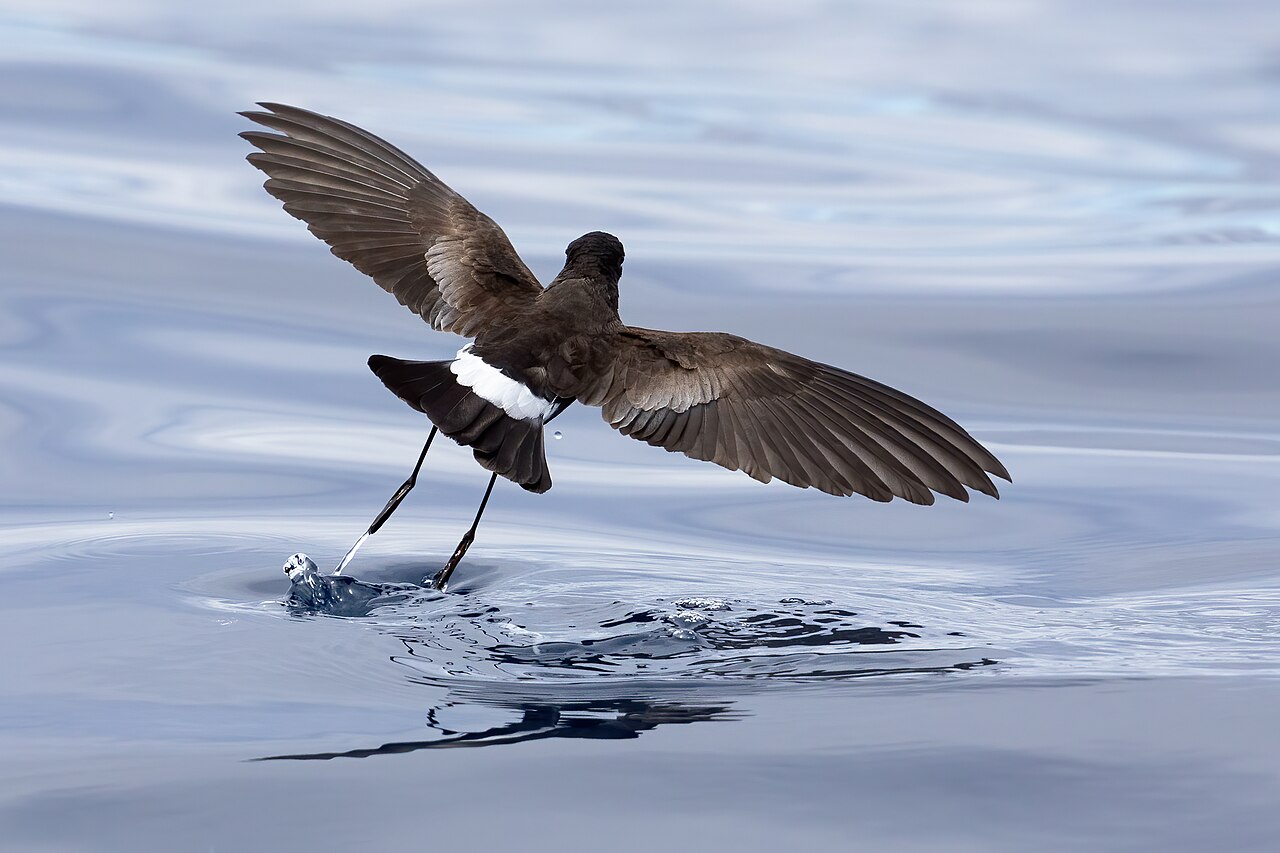
A small, sooty black seabird with a broad, pure white rump that runs on into the flanks and across the undertail coverts, so that from the side the white lies like a band around the rear end. The tail is cut square, with no notch, and the wings are short and rounded at the tip; a vague, pale brown band crosses the upperwing. The best character is at the feet: the webs between the toes are yellow, and on a bird that passes close alongside the boat that really can be seen. The sexes are alike, and young birds cannot be told from adults.
Confusion species
Leach's Storm-Petrel (Hydrobates leucorhous) is larger and longer-winged, with a forked tail, a narrower white rump often with a dark central line, and an irregular, bounding flight. Band-rumped Storm-Petrel (Hydrobates castro) has a sharply edged white rump band that does not run onto the flanks, a shallow fork in the tail and a steady, shearing flight. European Storm-Petrel (Hydrobates pelagicus), rare in the western Atlantic, is smaller still and has a white stripe along the underwing. At long range swimming phalaropes are also taken for storm-petrels; those sit on the water instead of over it.
Habitat
Warm water over the shelf edge and along the inner edge of the Gulf Stream, where the water shears and food gathers at the surface; it avoids shallow inshore water, and here it wants nothing to do with land. It gathers at anything that floats at the surface or brings something up to it: at whales, at a school of hunting tuna, behind a fishing boat and over a slick of fish oil that birders put out themselves. To breed it uses crevices and cavities beneath boulders on the ice-free coasts of Antarctica and the islands around it — which happens outside this region, on the other side of the world.
Where the bird is most often found, arranged by the USNVC — the vegetation classification of the United States and Canada — and CMECS for sea and coast.

Range and movements
It breeds from November to March in Antarctica and on the subantarctic islands, from South Georgia and the South Shetlands to Kerguelen, and then crosses the equator northwards. Off the Atlantic coast of North America it appears in May, is numerous from June to August and moves back south during September; in the deep Gulf of Mexico it is common at the same season. In the Pacific it is rare and off California hardly to be expected. The map cannot show its breeding range, which lies outside the guide area; what it does show is the sea where the bird actually is here, coloured as a non-breeding visitor — even though its stay falls in the middle of the northern summer.
- Breeding (summer)
- Passage
- dark = core range, pale = thinly spread
Where and when to look
Join a day trip from Cape Hatteras, Cape May, Long Island or Massachusetts between mid-June and mid-August and watch the birds that come to the chum slick behind the boat: nine out of ten storm-petrels will be this species. That is exactly why it pays to count them and look them over — the rarer species are in among them, and the difference is in tail shape and wing length. From land it is virtually unseeable, except after a tropical storm that drives birds into the bays.
Conservation
The species stands as Least Concern (LC) on the Red List and, at eight to twenty million birds, is one of the most numerous there are; how the number is changing nobody knows, because colonies in Antarctica are barely countable. Threats there certainly are: introduced rats and cats on the breeding islands, plastic and heavy metals that accumulate in the food, and the fishery for krill, precisely the animal this bird lives on. To that is added the warming of the Southern Ocean, which shifts the sea ice and with it the krill; what that means for a bird of these numbers cannot yet be said.
Scientific name
Oceanites oceanicus | (Kuhl, 1820)
Heinrich Kuhl described the species in 1820 as Procellaria oceanica, among the petrels; because it was later moved to another genus, author and year stand in parentheses. The genus Oceanites was introduced by Keyserling and Blasius in 1840 and refers to the Oceanids, the sea nymphs of the Greek stories; the specific name comes from Latin oceanus 'ocean'. Kuhl gave no type locality — he described the bird without saying where it came from; Murphy therefore designated South Georgia in 1918. The English and Dutch names honour Alexander Wilson, the Scottish-American founder of ornithology on this continent.