All species › Passerines › Wagtails and pipits › White Wagtail
White Wagtail | Motacilla alba
Witte kwikstaart | Lavandera blanca
The White Wagtail is a black-and-white, long-tailed songbird of Eurasia that in North America occurs only as a small breeding bird of western Alaska and Greenland. It is the one wagtail in this guide that almost always nests in a man-made cavity: an abandoned fishing shack, an old gold dredge, an empty fuel tank.
Voice
The call is a hard, two-syllable tschi-zik or tsi-lip, almost always given in flight and audible at a distance; when alarmed, a shorter, sharp zip. The song strings those same call notes together with some twittering between them, without a fixed phrase, usually from a roof edge, a post or a rock. A singing male also delivers it in a low, undulating flight.
Recording: Simon Gillings — CC BY-NC-SA 4.0 · Bransdale, North Yorkshire, England, United Kingdom · xeno-canto
Identification
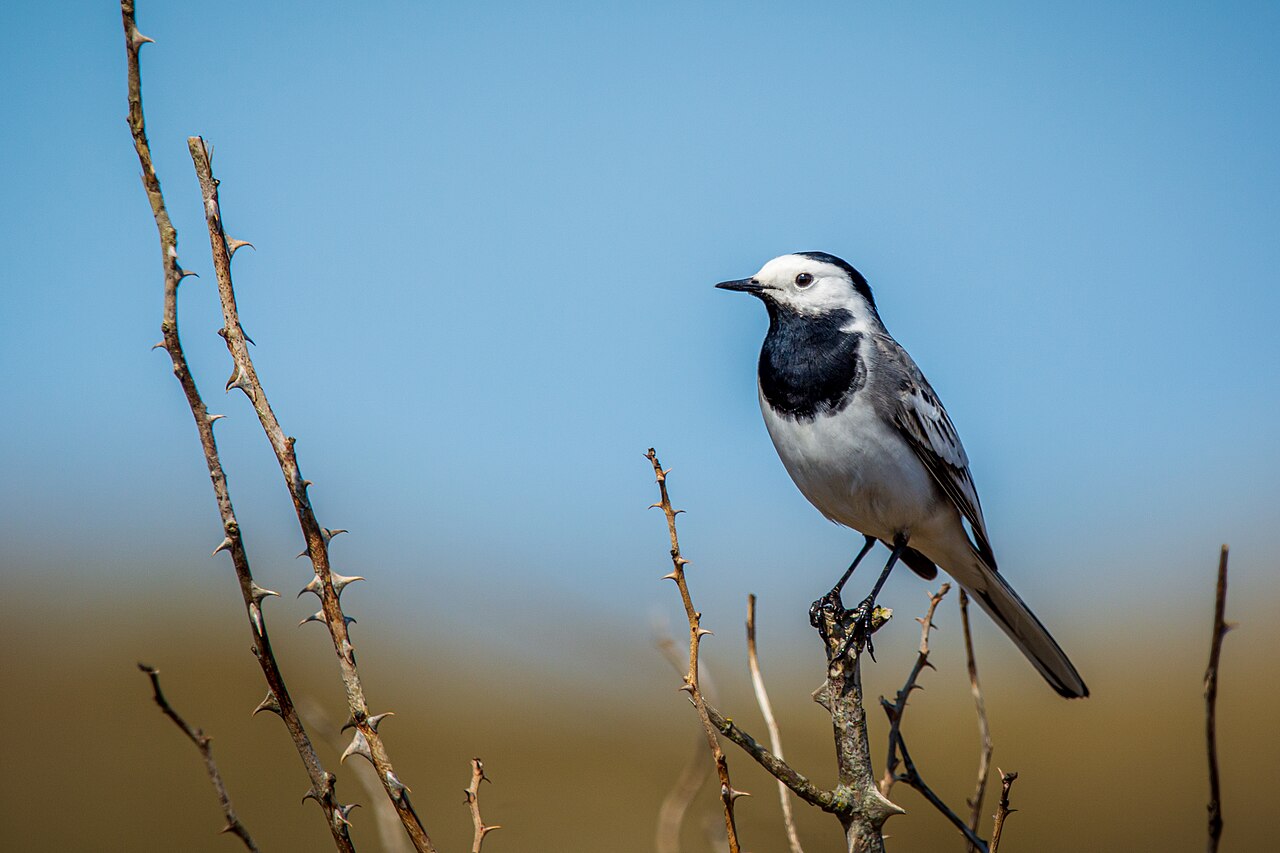
A slender bird with a long black-and-white tail that is pumped up and down continuously; the outer tail feathers are white. The back is grey, the crown and throat black, the forehead and cheeks white. Bill and legs are black, the bill short and pointed. The Alaskan subspecies ocularis has a black line through the eye, which the European form lacks. In non-breeding plumage and in young birds the black of the throat retreats to a crescent-shaped breast band and the whole bird turns browner grey. On the ground it walks and runs; it does not hop.
Confusion species
In the Alaskan breeding range the Eastern Yellow Wagtail is the only other wagtail, and it is green above and yellow below. The Black-backed Wagtail (lugens), formerly treated as a separate species, has a black rather than grey back in the breeding male and more white in the wing; females and winter birds are often not separable on that. American Pipit and other pipits have a shorter tail, streaked plumage and no black-and-white head pattern.
Habitat
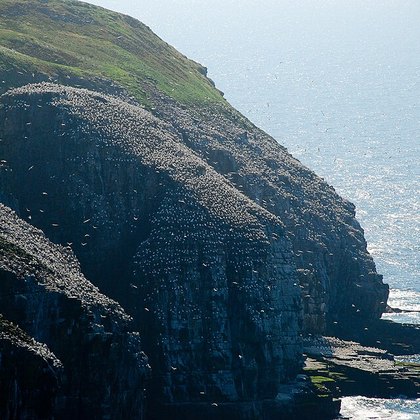
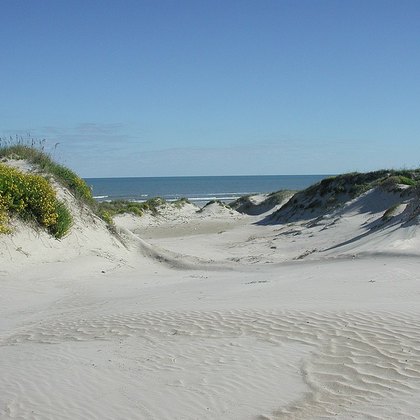
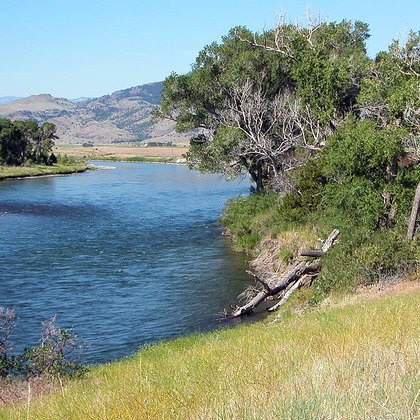
In Alaska it keeps to the coast and to rivers: low sea cliffs, coastal villages, shacks on beaches and river gravel flats well inland. Open tundra without buildings or rock it avoids. Across most of its Eurasian range it is a bird of villages, farmyards, river banks, car parks and lawns, nearly always close to water and on short or bare ground where it can take insects while walking.
Where the bird is most often found, arranged by the USNVC — the vegetation classification of the United States and Canada — and CMECS for sea and coast.


Range and movements
The range covers almost all of Europe and Asia and parts of North Africa. Within the guide area it breeds only along the west coast of Alaska, from the Seward Peninsula and the Bering Sea coast to the lower Yukon, in small and scattered numbers; the nominate form breeds in Greenland. Alaskan birds do not move south into North America but to eastern and southeastern Asia. Away from the breeding range it is a rare visitor in North America, most records coming from the Pacific coast in autumn and winter.
- Breeding (summer)
- Winter
- Passage
- dark = core range, pale = thinly spread
Where and when to look
Look for it in June and July around human structures on the west Alaskan coast — an abandoned shack, a dredge, a jetty — rather than out on the open tundra. The flight call is what you notice first, often from a roof or a gravel bar. Check for the eye-line to pin down the Alaskan form.
Conservation
The species is listed as Least Concern (LC) globally and the Eurasian population is large and stable. The Alaskan breeding population is small and local and is not systematically surveyed; numbers are tied to the availability of suitable cavities in buildings and wrecks, so clearing or collapse of old structures in coastal villages reduces nest sites locally. Greenland likewise holds a small population at the edge of the range.
Scientific name
Motacilla alba | Linnaeus, 1758
Linnaeus described the species in 1758 as Motacilla alba; the name still stands in its original genus, so author and year appear without parentheses. Motacilla is the Latin name Varro used for a wagtail; it is traced to motare 'to keep moving', the ending later being read as though it contained cilla 'tail' — a word classical Latin does not have. Alba is Latin for 'white'. The English wagtail and the Dutch kwikstaart both name the pumping tail; Spanish lavandera 'washerwoman' refers to the bird at waterside washing places. The specimen described came from Sweden.