All species › Owls › Owls › Western Screech-Owl
Western Screech-Owl | Megascops kennicottii
Westelijke schreeuwuil | Tecolote del Oeste
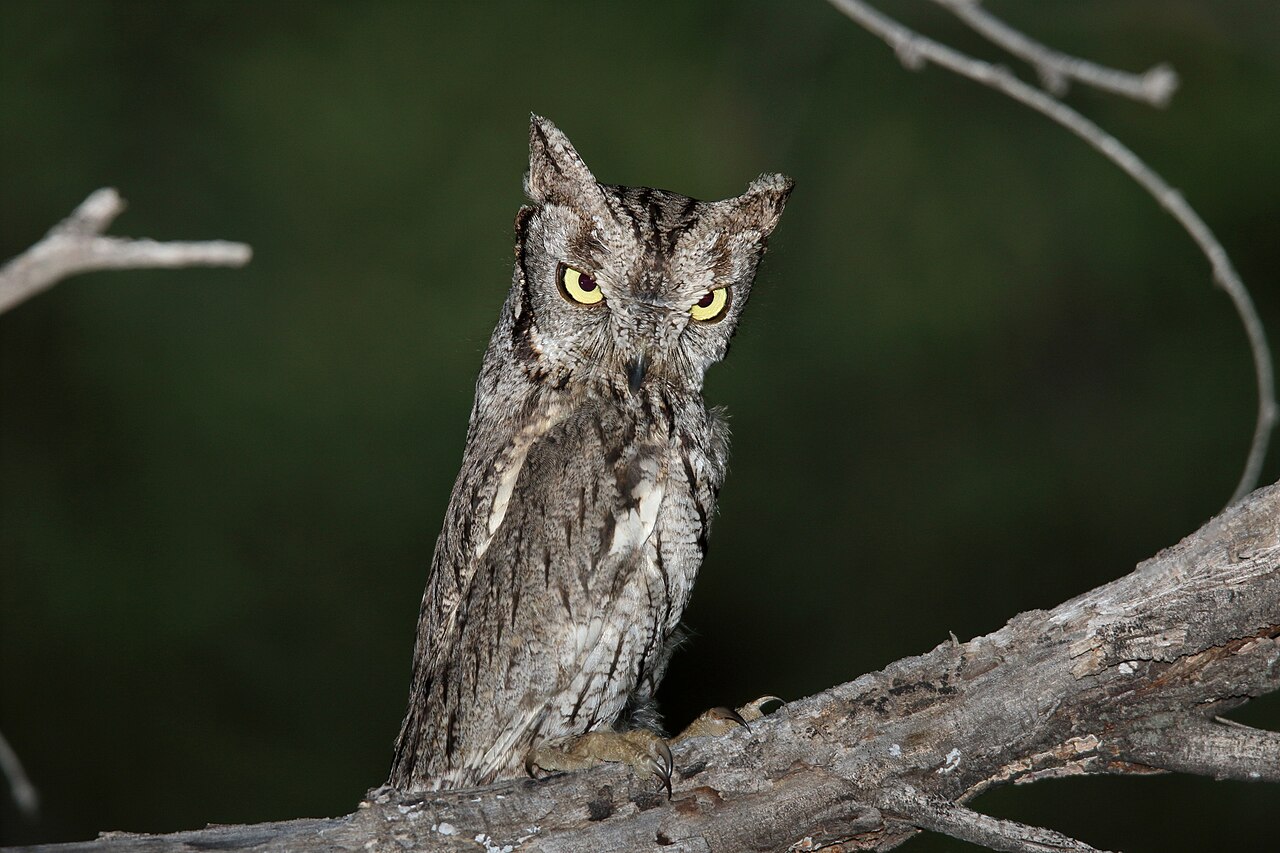
The Western Screech-Owl is the small grey owl of the West: about as tall as a pair of binoculars, with a square head, short tail and prominent ear tufts. Its name is wrong — it never screeches, but gives a run of short whistles that speeds up like a bouncing ball coming to rest. It eats almost anything it can handle, from earthworms and crayfish to rats, bats and cottontails heavier than itself.
Voice
The song is a run of roughly ten short, hollow whistles on one pitch that follow each other faster and faster: poo… poo… poo-poo-poo-poo-poroo, the rhythm of a dropped ball settling. The pitch does not change, only the tempo — and that is what separates it from every other small owl in its range. There is a second song as well, the double trill: a short roll followed at once by a longer one, used by a pair to keep contact. The male calls lower than the female, and sharp barks are given when the bird is disturbed.
Recording: David Tattersley — CC BY-NC-SA 4.0 · Silver City, Grant County, New Mexico, United States · xeno-canto
Identification
A small, stocky owl with an almost square head, no visible neck, a short tail and ear tufts that go up when it is uneasy and otherwise lie flat. The plumage is grey to grey-brown, finely marbled with black lengthwise streaks and cross bars that match tree bark exactly; this species has no rufous morph. Birds differ from region to region: pale and sandy in the Mojave, dark and brownish on the wet northwest coast. The eyes are yellow, the bill dark grey to blackish. Male and female look alike, the female the heavier of the two; by day the bird flattens its feathers against a trunk and becomes nearly invisible.
Confusion species
Eastern Screech-Owl (Megascops asio) is hardly separable by appearance; the ranges meet only along the Rio Grande in west Texas and on the eastern plains of Colorado. There, watch the bill — dark grey to black in Western, pale greenish-yellow in Eastern — and remember that no red birds occur in the West; the voice decides in any case, since Eastern whinnies and purrs and never accelerates. Whiskered Screech-Owl (Megascops trichopsis) overlaps in southeastern Arizona and southwestern New Mexico: it is slightly smaller, more coarsely barred below, has a paler olive-yellow bill, and gives an even series of toots or a morse-like rhythm, never a bouncing run. Flammulated Owl (Psiloscops flammeolus) is much smaller, has dark brown eyes and calls on a single low note.
Habitat
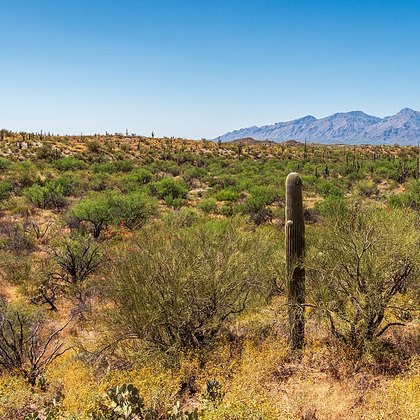
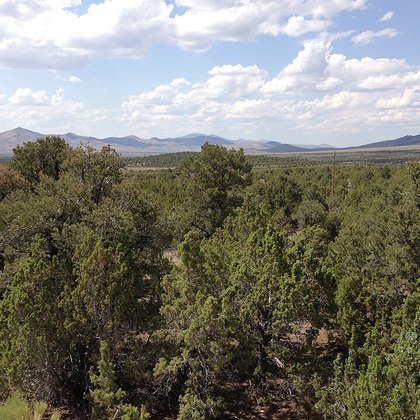
Chiefly ribbons of broadleaf trees along canyons, creeks and rivers — cottonwood, aspen, alder, oak — and beyond that desert with saguaro (the giant columnar cactus of the Sonoran Desert), pinyon-juniper woodland, coastal conifer forest, and the old standing greenery of gardens, parks and small towns. The species is a cavity nester with no chisel of its own: old woodpecker holes, natural rot pockets and nest boxes set the limits of where it can live. Closed high forest held by Great Horned Owls is avoided. It occurs from sea level to about 1,800 metres.
Where the bird is most often found, arranged by the USNVC — the vegetation classification of the United States and Canada — and CMECS for sea and coast.



Range and movements
Resident across western North America, from southeastern Alaska and coastal British Columbia south through Washington, Oregon, Idaho, California and the Great Basin to Arizona, New Mexico, west Texas and both Baja California peninsulas, and on into central Mexico. It does not migrate and keeps one territory year-round; only young birds wander short distances in their first autumn. It was long treated as one species with Eastern Screech-Owl; the two were separated during the 1980s on the evidence of voice. In the Pacific Northwest it has become scarcer in many places since the arrival of the Barred Owl.
- Resident
- Breeding (summer)
- Winter
- Passage
- dark = core range, pale = thinly spread
Where and when to look
Look for it after dark along streamside woodland or a canyon floor with old cottonwoods, and listen for the acceleration at the end of the run; that, and not the pitch, is what identifies it by ear. In the desert, an old saguaro with a woodpecker hole between eye level and two metres above your head often produces a bird sitting in the opening. Do not call it in with a recording at a site many birders visit: territorial birds answer more weakly each time and in the end abandon the cavity.
Conservation
Partners in Flight puts the population at about 180,000 birds and rates concern as relatively low, with a slight downward trend since 1966; the IUCN lists the species as Least Concern (LC). The clearest threat is in the northwest: the Barred Owl, which has spread west since the twentieth century, preys on this species and has removed it from parts of British Columbia and the Puget Sound country. Beyond that count the loss of streamside timber and of standing dead trees with cavities, and high-density development. Nest boxes in mature garden trees or creekside woodland are taken up readily.
Scientific name
Megascops kennicottii | (Elliot, 1867)
Elliot described the species in 1867 as Scops Kennicottii; because it was later placed in another genus, author and year stand in parentheses. The genus Megascops was introduced by Kaup in 1848, from Greek megas, 'large', and skōps, 'little owl'. The specific name kennicottii honours Robert Kennicott, the American naturalist who collected in Alaska and the northwest and died there in 1866 at the age of thirty, shortly before the description of M. kennicottii appeared. The described specimen came from Sitka, Alaska.