All species › Waders, gulls and terns › Sandpipers and allies › Western Sandpiper
Western Sandpiper | Calidris mauri
Alaskastrandloper | Correlimos de Alaska
The Western Sandpiper is the most numerous of North America's small sandpipers and one of the great mass spectacles of the Pacific coast: in May the mudflats of the Copper River Delta hold hundreds of thousands of birds at once. It breeds almost entirely in western and northwestern Alaska and winters from Washington to Peru. Its whole range therefore hangs on a handful of mudflats where migration piles up.
Voice
The flight call is a high, rasping jeet, thinner and sharper than the low, hoarse cherk of the Semipalmated Sandpiper; in a mixed flock you usually hear it before you pick the bird out. Over the tundra the male sings in a slow display flight, a thin, rising te-e-e-e followed by a series of tweer-tweer-tweer and a falling, buzzy trill. On the breeding grounds it adds a range of alarm and contact calls that are never heard elsewhere in the year. Outside the breeding season it is otherwise a quiet bird: a feeding flock produces only a soft, continuous murmur of short notes.
Recording: Paul Marvin — CC BY-NC-SA 4.0 · Poe Road, Salton Sea, Imperial County, California, United States · xeno-canto
Identification
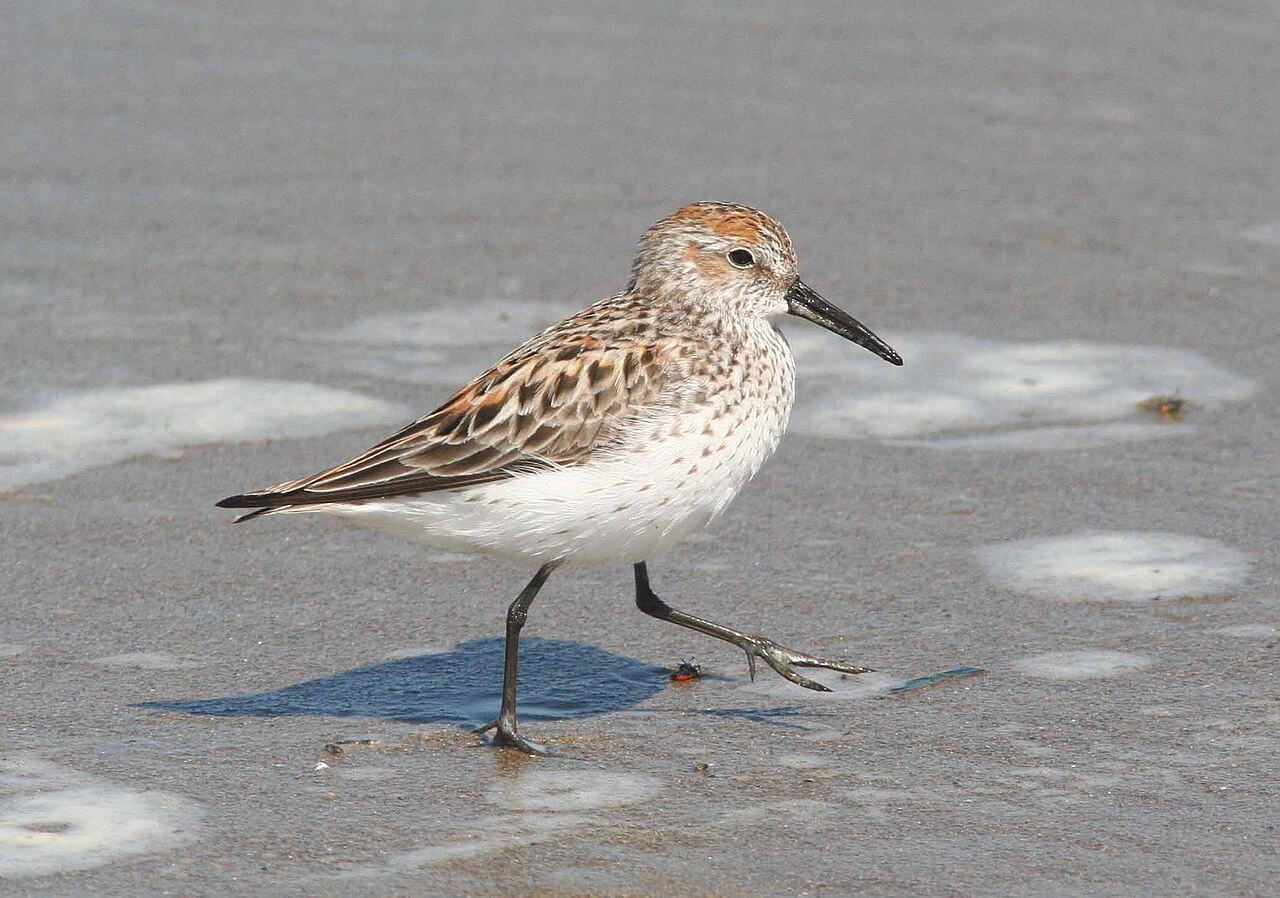
A sparrow-sized sandpiper with black legs and a black bill that curves downward towards the tip — clearly longer in females than in males. In breeding plumage it has a rufous crown, ear patch and scapulars, with black arrowhead marks running from the breast well down the flanks. In nonbreeding plumage it is plain pale grey above and white below, with at most a faint grey wash on the sides of the breast. Juveniles resemble that but have gold and rufous feather fringes forming a warm band across the upperwing. In flight it shows a narrow white wingbar and a dark central stripe down rump and tail. The toes are half-webbed at the base, which together with the Semipalmated Sandpiper sets it apart from the other small sandpipers.
Confusion species
Semipalmated Sandpiper (Calidris pusilla) is the most similar species: it has a shorter, straighter bill with a blunt tip, lacks the rufous crown and ear patch in breeding plumage, and has no arrowheads on the flanks. Least Sandpiper (Calidris minutilla) is smaller and browner, has yellow-green legs and feeds in a crouch at the wet margin, while Western Sandpiper wades upright into the water up to its belly. Dunlin (Calidris alpina) is a size larger, with a longer, evenly decurved bill and a black belly patch in breeding plumage. In winter plumage the bill decides it: long, drooping at the tip and finely pointed is almost always this species.
Compare sandpipers, snipes and allies: bill, legs, wing bar and rump
Habitat
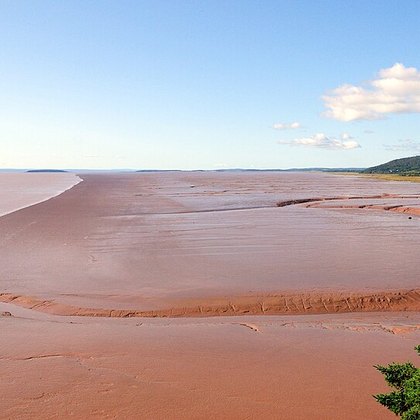
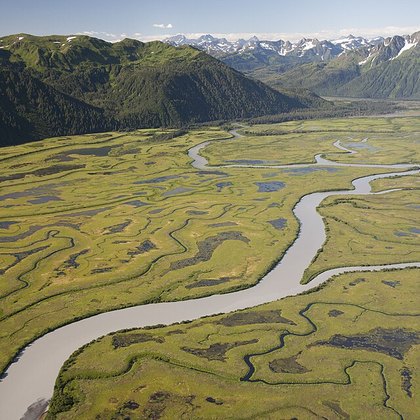
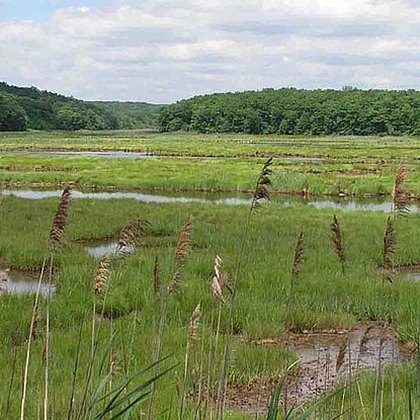
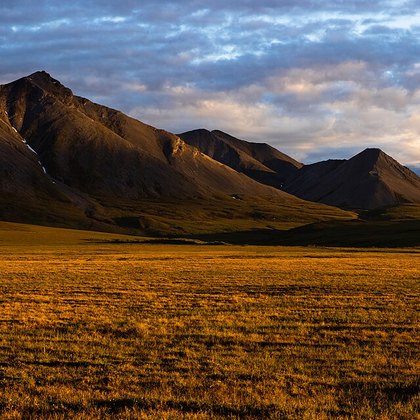
It breeds on dry tundra with dwarf birch, willow and sedge, always within walking distance of shallow pools where the chicks can feed. On migration and in winter it is a bird of mud: tidal flats, estuaries, lagoons and the edges of salt marsh, and in California and Mexico also salt pans and abandoned salt-evaporation ponds. It avoids rocky shores, densely vegetated banks and deep water. Unusually for a shorebird it lives largely on biofilm — the slick layer of diatoms, bacteria and sediment on the flats — which it scrapes off the surface with its tongue.
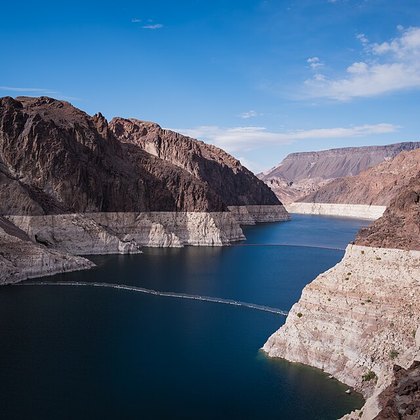
Where the bird is most often found, arranged by the USNVC — the vegetation classification of the United States and Canada — and CMECS for sea and coast.
Range and movements
The breeding range covers western and northwestern Alaska and St. Lawrence Island, with a small extension onto the Chukotka Peninsula in Siberia. It winters along the Pacific coast from Washington to Peru, along the Gulf coast and up the Atlantic coast to about Virginia, in the Caribbean, in Central America as far as northern Costa Rica, and at lakes in interior Mexico. Migration runs through a small number of large staging sites — the Copper River Delta, the Fraser Delta, Grays Harbor, San Francisco Bay and the Bay of Panama — where much of the world population passes within a few weeks. That concentration is the species' weak point: during the twentieth century several of those flats were lost or altered, in San Francisco Bay partly by an introduced cordgrass that overgrew the bare mud.
- Resident
- Breeding (summer)
- Winter
- Passage
- dark = core range, pale = thinly spread
Where and when to look
Look for it on the Pacific coast in late April and early May on a rising tide, when the water pushes the flocks to the edge of the flat and packs the birds together. Check the bill first: longer than the head and clearly drooping at the tip. Then look at where the bird stands — Western Sandpiper wades further out than the other small sandpipers, often up to its belly.
Conservation
The world population is estimated at about 3.5 million birds; Partners in Flight gives it 12 out of 20 points on its Continental Concern Score (a 1–20 scale), which amounts to low concern. The trend is not known with certainty, although counts at some of the major staging sites point to decline. The main threats are the draining of coastal wetlands in Central America, introduced cordgrasses closing over the Californian mudflats, pollution, and the warming of the arctic breeding grounds.
Scientific name
Calidris mauri | (Cabanis, 1857)
Cabanis described the species in 1857 as Ereunetes Mauri — the capital letter was then usual for a name honouring a person. Because it was later placed in the genus Calidris, author and year stand in parentheses. Calidris goes back to Greek kalidris, a word Aristotle used for grey birds of the waterside; mauri honours Ernesto Mauri (1791–1836), an Italian botanist. The specimen described came from Cuba, thousands of kilometres from the breeding grounds: the species was named from a wintering bird.