All species › Waders, gulls and terns › Skimmers, noddies, terns and gulls › Western Gull
Western Gull | Larus occidentalis
Californische meeuw | Gaviota occidental
The Western Gull is the big dark gull of the American west coast: from Washington to Baja California it is the default gull on every pier, beach and harbour front. Its entire range covers less than two thousand kilometres of coast, with the largest colony on the Farallon Islands off San Francisco. And yet the population has more than halved in fifty years.
Voice
Loud, hoarse and piercing, with a scraping edge that sets it apart from every other gull of the west coast. The long call is a series of drawn-out kyah-ow cries, given first with the neck stretched down and then with the head thrown far back. There is also a barking gag-ag-ag in alarm and a soft mewing kee-ow at the nest. Young birds beg with a persistent squealing that hangs over a colony all summer, and on a rock island the sound is then unbroken.
Recording: Thomas G. Graves — CC BY-NC-SA 4.0 · Morro Bay State Park Campground (near Morro Bay), San Luis Obispo County, California, United States · xeno-canto
Identification
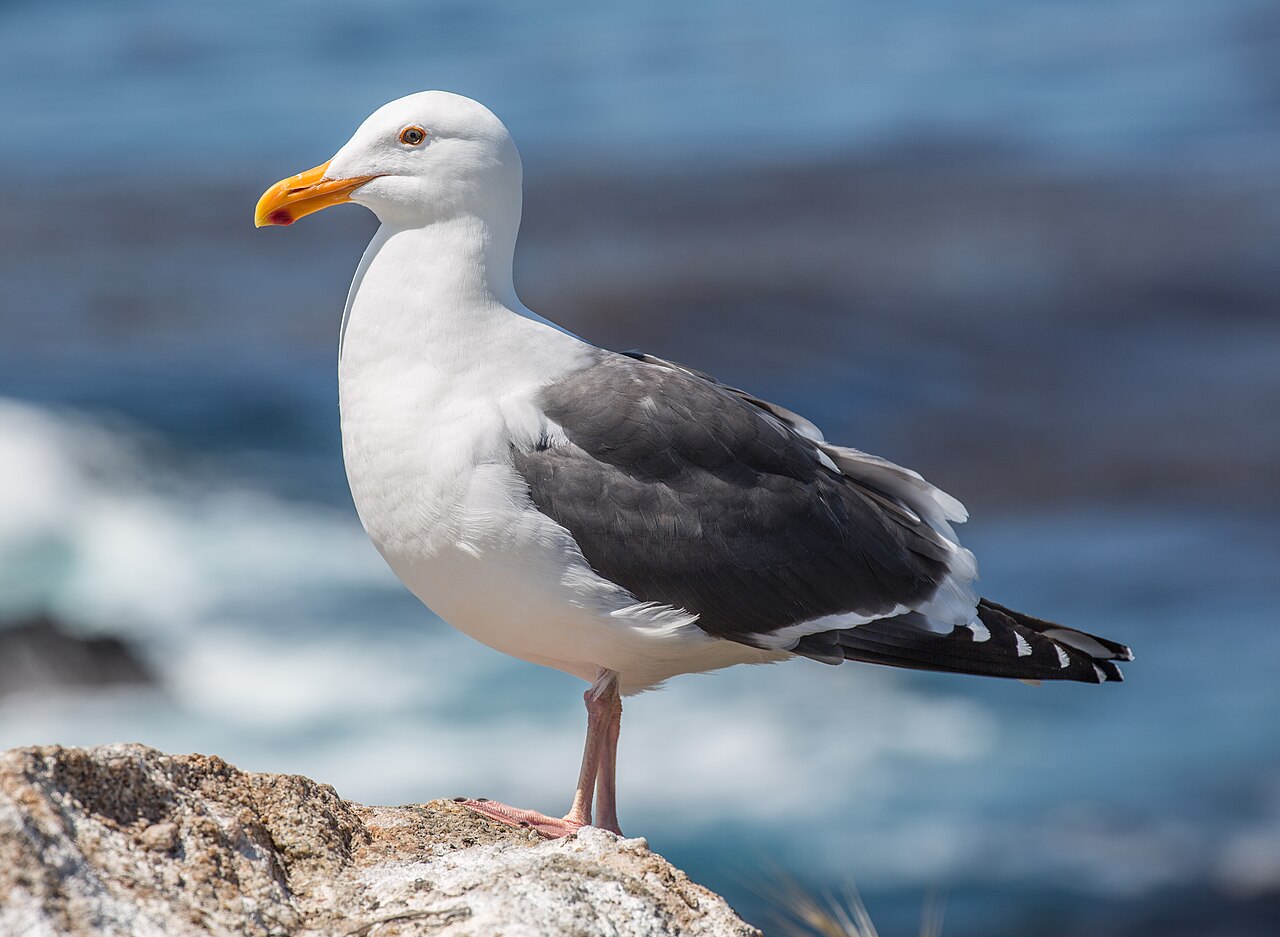
A heavy, broad-shouldered gull with a thick yellow bill, clearly bulbous at the tip and marked with a red spot. The adult has a white head and white underparts, pink legs, and a dark grey to almost black mantle — darker than any other common gull of the west coast. The head stays largely white in winter too, without the heavy brown streaking of a Herring Gull. Eye colour changes with latitude: pale olive-yellow in the birds of southern California, dark brown in those of the north. It takes four years to reach adult plumage: first-year birds are uniformly dark brown with a black bill, second-year birds gain the first dark feathers on the back.
Confusion species
Glaucous-winged Gull (Larus glaucescens) of the north is the most similar: the same size and the same pink legs, but with a wingtip as grey as the mantle instead of black, and a dark eye. Between Puget Sound and northern Oregon the two hybridise so freely that many birds there are intermediates, with a dusky black wingtip exactly between the two; a confident call is often impossible. California Gull (Larus californicus) is smaller and paler grey, with greenish-yellow legs, a dark eye and both a red and a black spot on the bill. American Herring Gull (Larus smithsonianus) is far paler on the mantle and slimmer-billed, and Yellow-footed Gull (Larus livens) of the Gulf of California is larger still, with yellow legs and an even heavier bill.
Compare gulls: legs, head, bill and wing tip side by side
Habitat
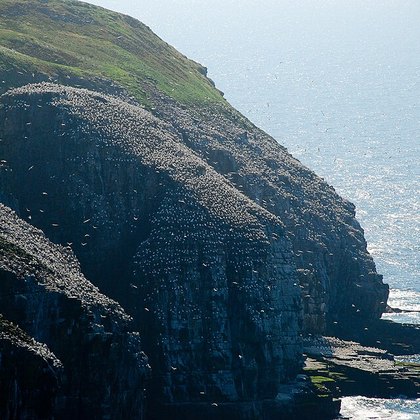
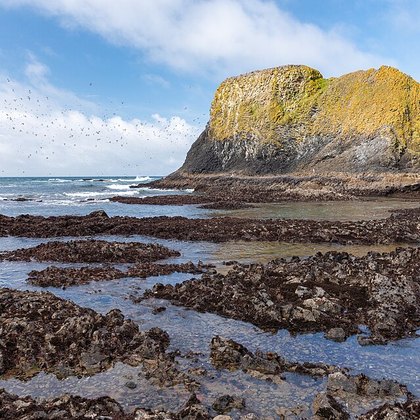
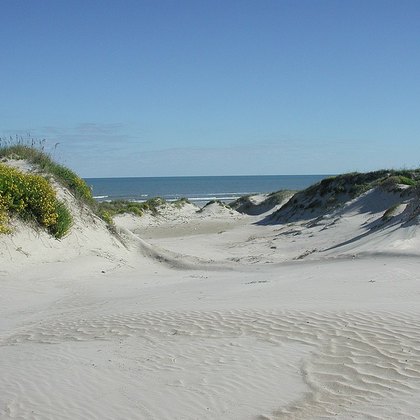
Almost entirely marine: coastal waters, river mouths, beaches, piers and harbour quays, plus the sea between the shore and the nesting islands. Breeds on islands, sea cliffs and abandoned structures out of reach of ground predators — Alcatraz and the Channel Islands as much as the Farallones. It rarely goes more than a few kilometres inland, though it uses car parks and landfills just behind the coast. The interior and the open ocean far offshore it leaves to other species.
Where the bird is most often found, arranged by the USNVC — the vegetation classification of the United States and Canada — and CMECS for sea and coast.

Range and movements
From British Columbia to Baja California Sur, with birds present all year in California, Oregon, southern Washington and Baja California. It does not travel far: after breeding, birds disperse north into British Columbia and south into southern Baja, but the centre of gravity stays where it is. In the nineteenth century so many eggs were taken from the Farallon Islands for the growing city of San Francisco that the colony collapsed; after the lighthouse was automated and the prison on Alcatraz closed, numbers recovered. Since the 1970s they have been going the other way again.
- Resident
- Breeding (summer)
- Winter
- Passage
- dark = core range, pale = thinly spread
Where and when to look
Any pier in California will produce one, but the best place is a sea cliff in the breeding season — Point Reyes, Bodega Head or the wharf at Monterey — where you can see at close range how dark that mantle really is beside a passing Herring Gull. North of Oregon, count on hybrids: watch the wingtip above all, because in intermediates its black waters down to a dirty grey.
Conservation
Partners in Flight puts the world population at about 86,000 birds — few for a species that looks so ordinary — and more than half of that has gone in fifty years. The 2025 State of the Birds report lists it as an orange-alert tipping point species. The causes named are the lingering effects of DDT, the El Niño years of the 1980s and 1990s with their collapsing fish stocks, and oil pollution along the coast.
Scientific name
Larus occidentalis | Audubon, 1839
John James Audubon described the species in 1839 as Larus occidentalis, the name it still bears, so author and year stand without parentheses. occidentalis is Latin for western, from occidens, the setting sun. The described specimen came from Cape Disappointment, the headland at the mouth of the Columbia in Washington. Two subspecies are recognised, grading into one another from north to south in mantle shade and eye colour.