All species › Tubenoses › Northern storm petrels › Townsend's Storm-Petrel
Townsend's Storm-Petrel | Hydrobates socorroensis
Townsends stormvogeltje | Paíño de Isla Socorro
Townsend's Storm-Petrel is one of the smallest tubenoses to reach North American waters at all: a sooty, swallow-sized bird that spends its entire life at sea. It breeds only on a handful of rocky islets off Guadalupe Island, off the west coast of Mexico, and reaches the United States solely as a scarce summer and autumn visitor far off the California coast. Its tiny breeding range earns it an endangered listing.
Voice
Like most storm-petrels, this species is essentially silent at sea; what little is heard comes from the breeding burrows at night, where both parents give a sustained, chattering purr — much as related storm-petrels do — to find their mate and burrow in the dark. By day, offshore, it stays completely quiet: observers on boats off California see the bird readily but almost never hear it. Nothing is recorded of its voice within the area this guide covers, simply because it is always encountered far from its colonies.
No recording with a suitable Creative Commons licence has been found for this species yet; what to listen for is described below.
Identification
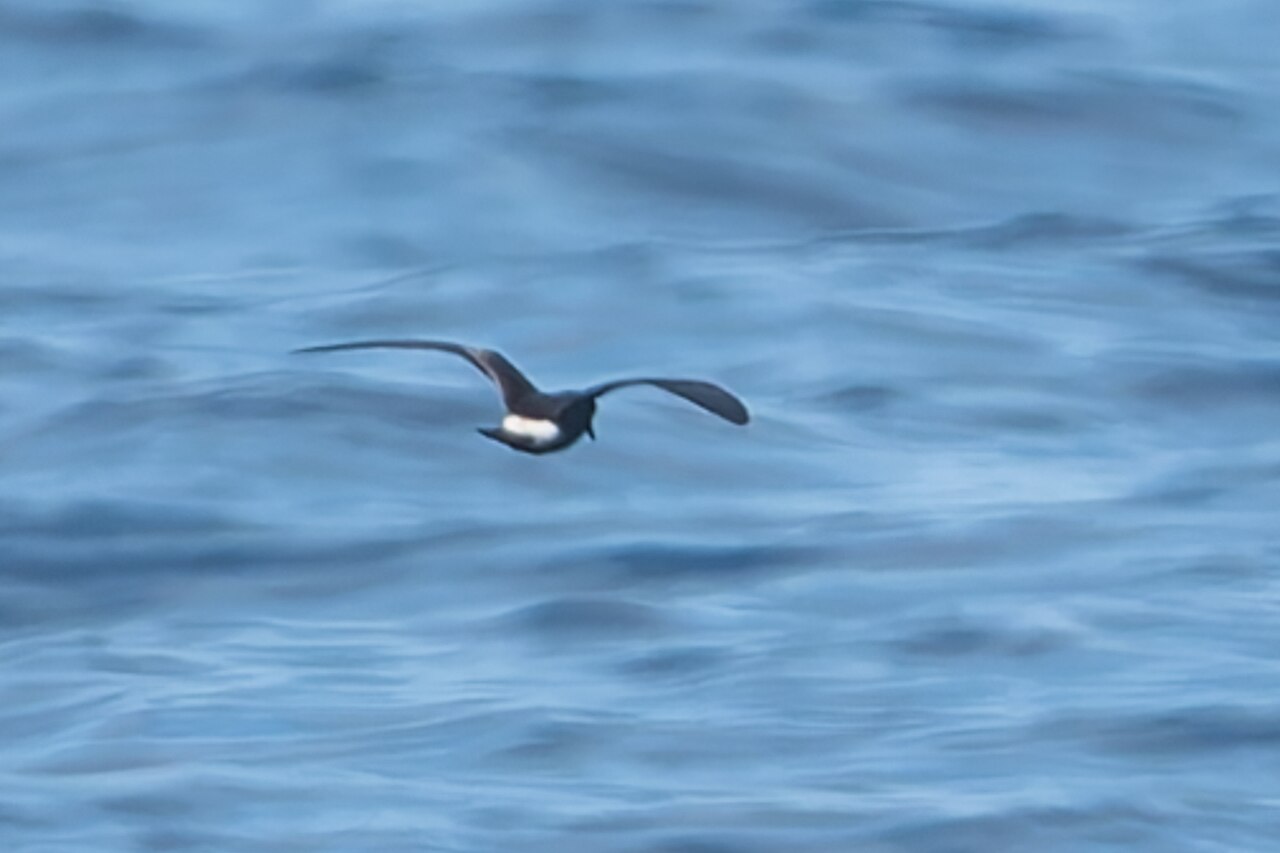
A small, compact storm-petrel: sooty black on the head, breast and back, with a pale, often indistinct bar across the upperwing coverts. Most birds show a white rump that wraps onto the sides of the undertail coverts, but part of the population is entirely dark-rumped — a variation that complicates identification. The tail is distinctly forked but shorter than in the related Leach's Storm-Petrel, and the wingtips are more rounded. Male, female and juvenile look alike. In flight it flutters low and erratically over the water, with short glides breaking up the wingbeats.
Confusion species
The greatest confusion risk is Leach's Storm-Petrel (Hydrobates leucorhous), which is larger, longer-winged and more deeply forked-tailed, with a white rump split by a thin dark line. Ainley's Storm-Petrel (Hydrobates cheimomnestes) breeds on the same islets off Guadalupe but in winter, and looks nearly identical; the difference lies in a shallower tail notch and a duller rump, and the species has not yet been confirmed with certainty off the United States. Black Storm-Petrel (Hydrobates melania) is clearly larger, entirely dark with no white rump, deeply forked-tailed and slower and more languid in flight. It is especially the dark-rumped form of Townsend's Storm-Petrel that often goes unidentified on pelagic trips.
Habitat
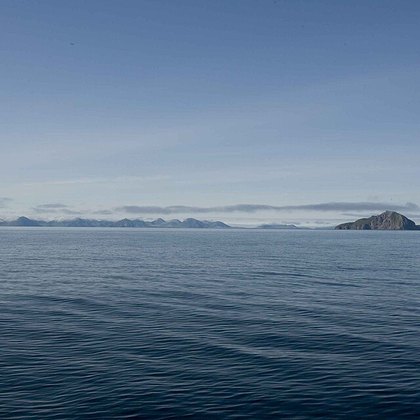
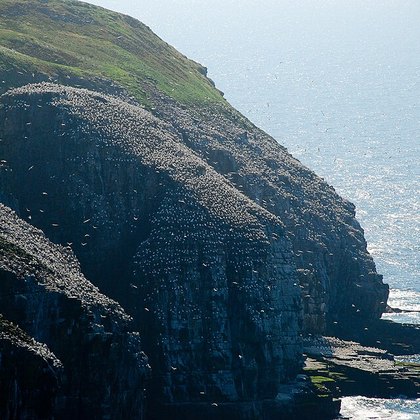
Townsend's Storm-Petrel lives almost entirely over open, cool ocean water, usually in areas of upwelling where prey is drawn closer to the surface. On land it occurs only on its breeding islets, hiding in rock crevices and self-dug burrows among the rubble. Off California it is rarely seen close inshore; it avoids shallow water and stays well beyond the surf. It never occurs on the mainland.
Where the bird is most often found, arranged by the USNVC — the vegetation classification of the United States and Canada — and CMECS for sea and coast.
Range and movements
This species breeds only on a small number of rocky islets off the southern end of Guadalupe Island, off the west coast of Baja California, Mexico. After breeding it disperses across the eastern Pacific, roughly from the latitude of California south to about 10°N, off Central America. Within the United States it is seen almost exclusively in summer and autumn, from June to early November, in small numbers far off southern California. Until 2016 it was treated as one species together with Leach's and Ainley's Storm-Petrel; since then it has been recognized as a species in its own right.
- Breeding (summer)
- Winter
- Passage
- dark = core range, pale = thinly spread
Where and when to look
This storm-petrel can only be found on a boat trip well offshore, usually several tens of kilometres out from southern California; look from July through October, when it is most numerous. Focus on wing shape and tail rather than rump colour, which is too variable to rely on alone.
Conservation
The entire world population breeds on a few rocks off one island, making the species vulnerable to a single disaster, disease outbreak or newly introduced predator. Feral cats on Guadalupe Island itself have already driven one related storm-petrel to extinction in the past; since the cats were removed there, conditions for the island's remaining seabirds have improved, though this species' tiny breeding range still keeps it listed as Endangered (EN). Reliable population numbers are not known.
Scientific name
Hydrobates socorroensis | (Townsend, 1890)
Charles Haskins Townsend described the species in 1890 as Oceanodroma socorroensis, named after Socorro Island — even though it does not breed there, and the type material was likely only collected offshore; because it has since been moved to another genus, author and year stand in parentheses. The current genus Hydrobates was introduced as early as 1822 by Boie, from Greek for 'water walker', after the way storm-petrels appear to patter across the water's surface with their feet while foraging. The type locality is Socorro Island, in the Revillagigedo Islands. Genetically and in plumage it forms a group with Leach's and Ainley's Storm-Petrel that was treated as a single species until 2016.