All species › Passerines › New World blackbirds, troupials and allies › Spot-breasted Oriole
Spot-breasted Oriole | Icterus pectoralis
Vlekborsttroepiaal | Turpial de pecho manchado
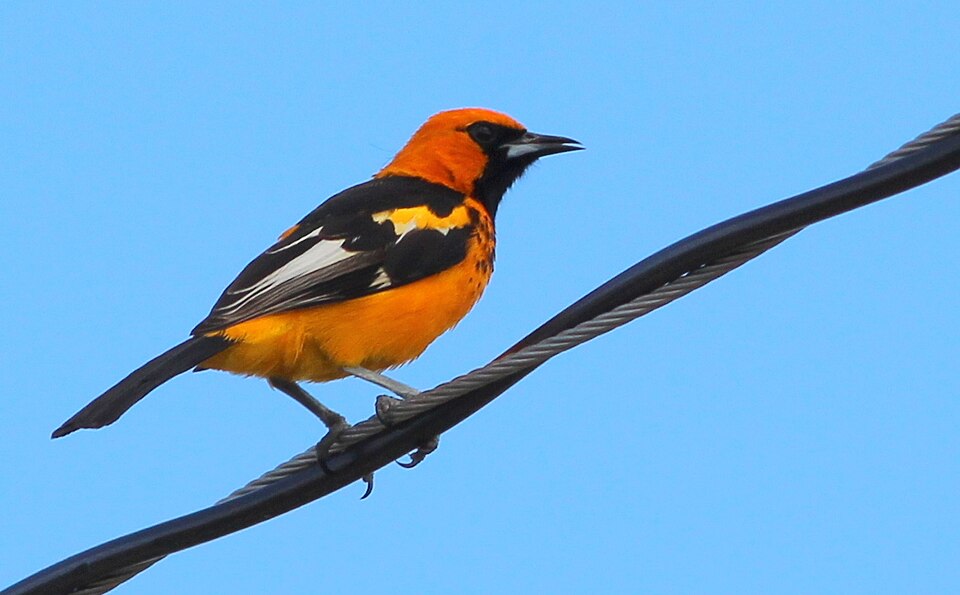
The Spot-breasted Oriole is the only oriole in North America with black spots along the sides of the orange breast. It belongs naturally to the Pacific slope of Central America; within the guide area it also has an introduced population in the suburbs of southeastern Florida, established from escaped cage birds around 1948.
Voice
The song is a series of clear whistles rising and falling, often in short repeated motifs and more drawn out than in other orioles; both sexes sing, and they do so year-round, outside the breeding season as well. Calls include a scratchy, nasal nyeh and a hoarse chatter. In Florida the song is often the first sign of the bird, from a mango tree or a royal palm in a residential street.
Recording: Alfonso Auerbach — CC BY-NC-SA 4.0 · El Tizatillo, near Tegucigalpa, Honduras · xeno-canto
Identification
Head and nape are deep orange, with a black mask around bill and eye and a black throat patch running onto the upper breast. Back and mantle are black, the rump orange, the tail wholly black. The wing is black with orange coverts on the shoulder and broad white edges to the secondaries, which show as a white panel. Along the sides of the orange breast, below the black bib, stands a row of black spots — the feature the species is named for. The female is slightly duller; young birds are yellower with an olive-brown back and lack both the black face and the breast spots.
Confusion species
No other oriole in the area has that row of black spots on the breast sides; in adults the feature alone is enough. Streak-backed Oriole has black streaks on the back rather than spots on the breast and is smaller. Baltimore Oriole has a wholly black head with no orange cheek and an orange-and-black tail rather than an all-black one. Young Spot-breasted Orioles without spots are identified in Florida by size, the heavy straight bill and the broad white edges to the secondaries.
Habitat
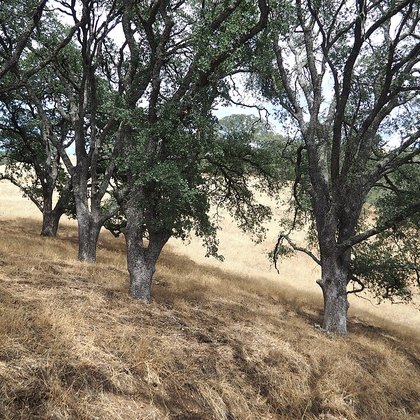
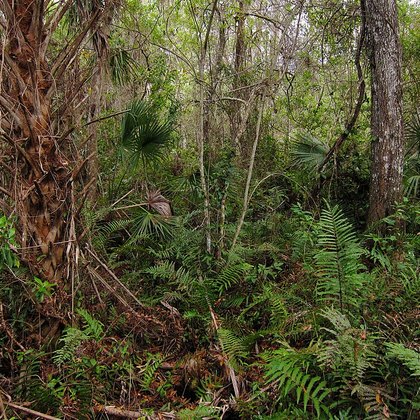
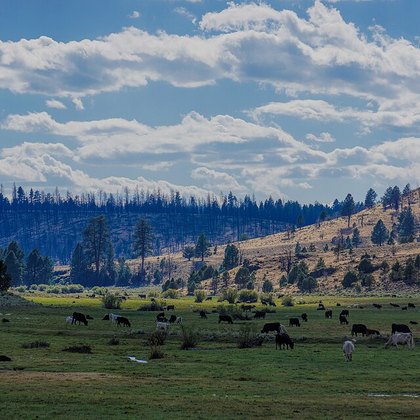
In its natural range, dry open woodland and thorn scrub with acacia and mesquite (a thorny pod-bearing shrub of the Southwest that forms dense thickets), forest edges, lightly wooded pasture, villages and the edges of shade-coffee plantations, up to about 1500 metres. In Florida it is a bird of older residential districts with large exotic trees: mango, poinciana, ficus and flowering ornamentals, with nectar and fruit from gardens as an important food source. The nest is a long woven pouch of fibres and thin epiphyte roots, hung in the fork of a branch.
Where the bird is most often found, arranged by the USNVC — the vegetation classification of the United States and Canada — and CMECS for sea and coast.



Range and movements
Naturally it occurs from southwestern Mexico — Jalisco and Colima south through Michoacán, Guerrero, Oaxaca and Chiapas — through Guatemala, El Salvador and Honduras to Nicaragua, mainly on the Pacific side; the southern end of the range lies outside the guide area. The Florida population goes back to birds that escaped or were released near Miami around 1948. By the 1970s it occupied seven counties from Miami to West Palm Beach. Severe winters in the early 1980s cut numbers sharply; partial recovery followed, with a core in Miami-Dade and Broward. The species is resident and does not migrate.
- Resident
- Breeding (summer)
- Winter
- Passage
- dark = core range, pale = thinly spread
Where and when to look
In Florida an older residential neighbourhood with large flowering trees is the best place, for instance in Miami Shores or Coral Gables; follow the song and then search the crown of the tree. In the natural range it is most obvious in thorn woodland along cattle tracks early in the morning. The long hanging nest pouch marks an occupied territory even when the birds are silent.
Conservation
The world population is put at at least half a million mature birds and the species is listed as Least Concern (LC), although estimates point to a decline in the natural range as dry forest is cleared. In Florida the population is small and depends on suburban planting; cold spells have proved the main limiting factor there, and the species counts as an established exotic with no demonstrated effect on native birds.
Scientific name
Icterus pectoralis | (Wagler, 1829)
Wagler described the species in 1829 as Psarocolius pectoralis; the later move to Icterus puts author and year in parentheses. The genus Icterus comes from Greek ikteros, the name of a yellow bird. The species name pectoralis is Latin for 'of the breast', from pectus 'breast', after the black spots on the breast sides — the same feature carried by the Dutch, English and Spanish names. The specimen described came from Totolapa in Oaxaca.