All species › Waders, gulls and terns › Plovers and lapwings › Snowy Plover
Snowy Plover | Anarhynchus nivosus
Amerikaanse strandplevier | Chorlo Nevado
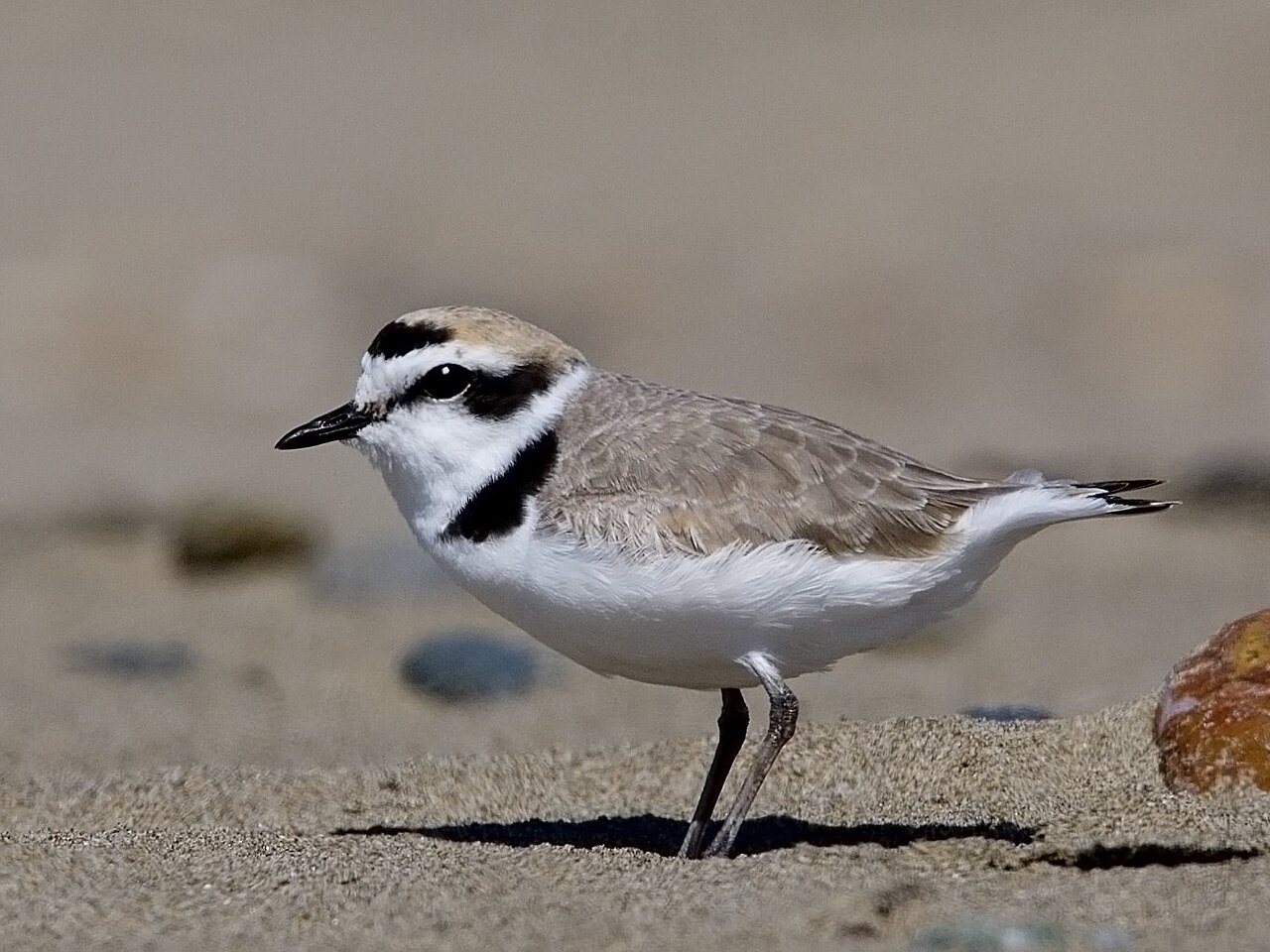
The Snowy Plover is the palest and smallest plover of the coast: barely bigger than a sparrow, sand-coloured like the dry beach it walks on, and marked only by a black ear patch and a broken breast band. It lays its eggs in a scrape in the bare sand above the tideline, exactly where people, dogs and vehicles go. From the Pacific to the Gulf of Mexico and the Bahamas, its colonies therefore depend one and all on fencing and wardening.
Voice
The usual note is a soft, high and rather plaintive tu-wheet, two syllables with the second rising; over bare sand it carries far. Disturbance brings a low rolling rattle, krrrt, which is often the first sign that a nest is nearby. In display the male runs in circles while calling, drawing the same notes out into a faster, softer series. Birds in flight give a short choop. Beyond that it is a silent bird, more likely to betray itself by sitting still than by making a sound.
No recording with a suitable Creative Commons licence has been found for this species yet; what to listen for is described below.
Identification
A small, pale plover with a large round head, a thin black bill and dark grey legs. The upperparts are light sandy grey, the underparts white, and the breast band is never closed: there is only a dark patch on either side of the breast. The breeding male has a black bar across the forecrown, a black mark behind the eye and black breast patches; the female carries the same pattern in brown and much fainter. In non-breeding and juvenile plumage everything is brown and pale, and the shoulder patch is all that sets the bird off from the sand. In flight it shows a clear white wingbar and white sides to the tail, and it goes off low and fast to land abruptly a little further on and vanish at once.
Confusion species
Piping Plover is as pale and as small but shorter and rounder in shape, with bright orange legs and, in the breeding season, an orange bill with a black tip; Snowy Plover always has grey legs and an entirely black, slender bill. Semipalmated Plover is darker brown above, has a complete breast band, a white neck ring and orange legs. Wilson's Plover (Anarhynchus wilsonia) of the same southern beaches is larger and darker and has a heavy, long black bill. Grey legs together with a thin black bill and a broken breast band settle it.
Habitat
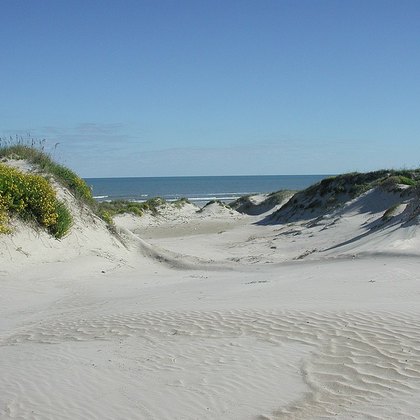
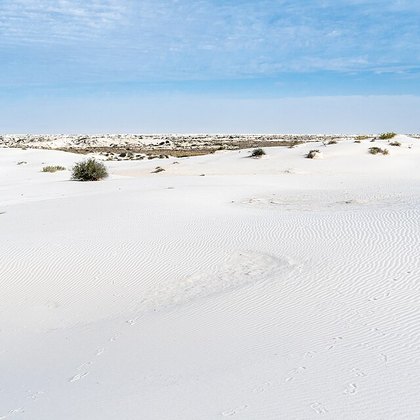
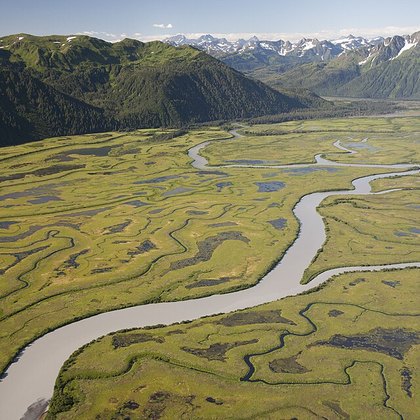
Bare, dry, open sand: the beach above the tideline, the foot of the dunes, sand and shell flats in estuaries, and the levees and drying beds of salt ponds. Inland it uses alkali flats, dry lake beds and the salt crust around saline lakes and playas (shallow, temporary lakes in desert basins without outflow), and along rivers the bare sandbars. What all these places share is the absence of vegetation: as soon as marram or other grass closes over, the bird leaves. It feeds on mudflats but nests on dry, firm sand with a scatter of shell grit or wrack to shelter the scrape from the wind.
Where the bird is most often found, arranged by the USNVC — the vegetation classification of the United States and Canada — and CMECS for sea and coast.
Range and movements
Breeds on the Pacific coast from Washington south through California and Baja California to Oaxaca, in the dry interior of the Great Basin and on the salt flats of the Great Plains east to Kansas and Oklahoma, and along the Gulf of Mexico coast from Texas to Florida. On the islands of the Bahamas and the Caribbean and along the Mexican coasts it is present all year. Interior birds move to the coast — those of the Great Basin to the Pacific, those of the Great Plains to the Gulf — while coastal breeders largely stay put or shift only short distances along the shore. The range has thinned over the past half century: on the United States Pacific coast fifty of seventy-eight breeding sites have been lost since 1970, and on the Great Plains numbers fell by more than three quarters between 1998 and 2009.
- Winter
- dark = core range, pale = thinly spread
Where and when to look
Walk the dry strip above the tideline early in the morning and watch the wrack line: the bird flattens itself into a footprint, a tyre rut or the lee of a piece of weed and then cannot be told from the sand. You usually find it because a lump of sand suddenly moves ten paces and stops again. Stay outside the fenced nesting areas and keep dogs on a lead — a disturbed pair leaves the nest unattended for twenty minutes and that is enough to lose it. The salt ponds of San Francisco Bay, the beaches of the Florida panhandle and the salt flats of Oklahoma are good places.
Conservation
The world population is put at twenty-four to thirty-one thousand mature birds and the species is assessed as Near Threatened (NT). The threats are everywhere the same: recreation and dogs on the nesting beaches, beach grooming, development, and on the United States Pacific coast the planted European beachgrass, which closes over the bare sand. Add to that the crows, gulls and foxes that live on human waste and rob the nests, and the flooding of low-lying colonies in storms.
Scientific name
Anarhynchus nivosus | (Cassin, 1858)
Cassin described the species in 1858 as Aegialitis nivosa; because it was later placed in another genus, author and year stand in parentheses. The description appeared in the ninth volume of the reports of the United States Pacific railroad surveys, from a bird taken at the Presidio of San Francisco in California. nivosus is Latin for 'snowy', from nix, 'snow', after the pale, almost white plumage. The genus Anarhynchus was introduced in 1830 by Quoy and Gaimard, from Greek ana- 'back, sideways' and rhunkhos 'bill'; most of the plovers now in this genus stood until recently in Charadrius.