All species › Cuckoos › Cuckoos › Smooth-billed Ani
Smooth-billed Ani | Crotophaga ani
Kleine Ani | Garrapatero Piquiliso
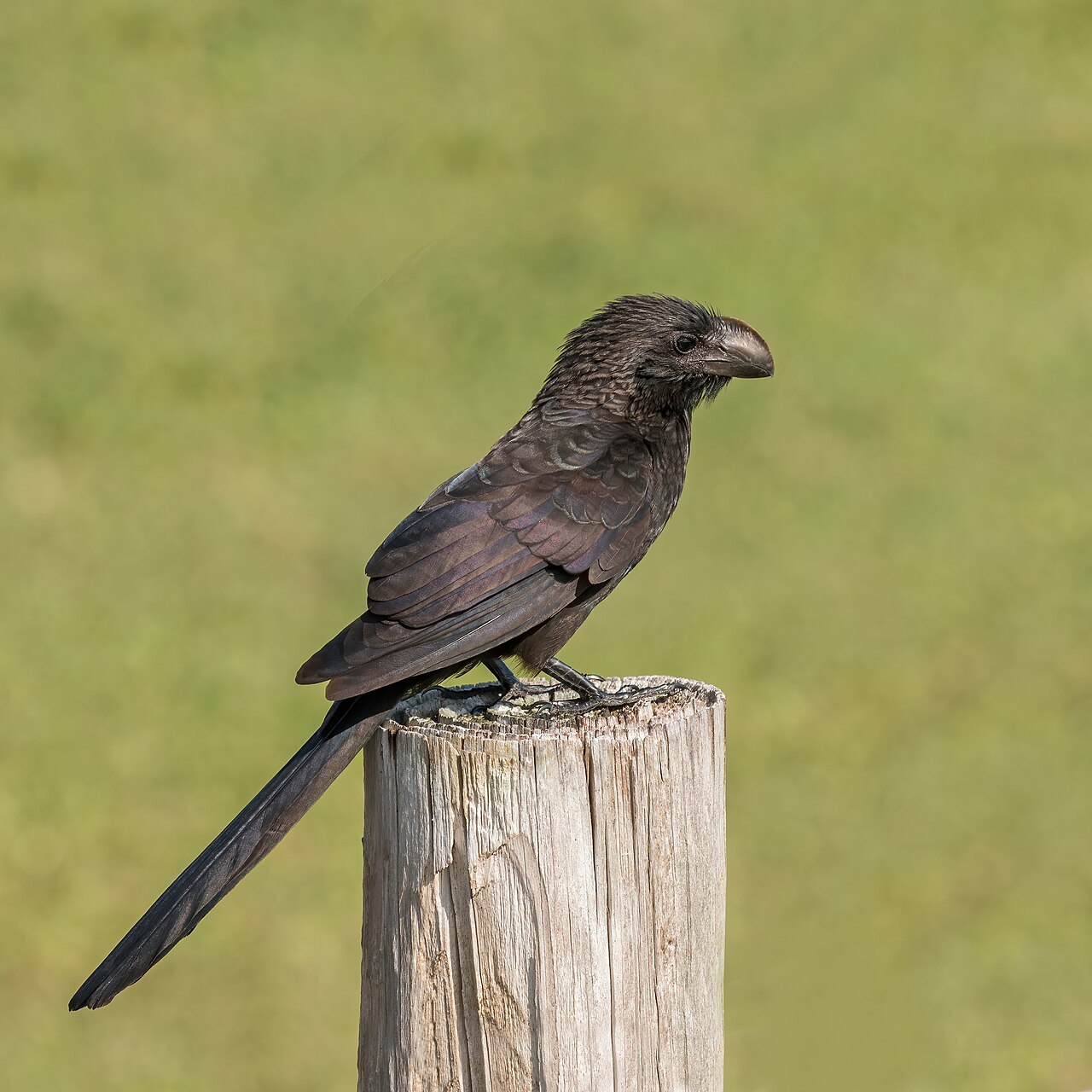
Smooth-billed Ani is an all-black cuckoo with a loose, swinging tail and a deep, smooth bill that rises above the line of the crown like a comb. It lives in small groups that do everything together: feeding together, roosting together, and building a single nest in which every female of the group lays her eggs. Within the guide area it is above all a bird of the Caribbean islands; the short-lived population in Florida has gone again.
Voice
The usual sound is a rising, whining oo-leek, stressed on the upward end, which every member of the group repeats in turn. A party taking off together therefore sounds like a row of squeaking gates. While feeding, the birds keep contact with short clucking and growling notes low in the bushes. At a cat or a hawk the whole group switches to a hard, rattling alarm.
Recording: José María Loaiza B. — CC BY-NC-SA 4.0 · Distrito Metropolitano de Quito, Pichincha, Parroquia Nanegalito, Nueva Granada, Hacienda Los Yumbos, Ecuador · xeno-canto
Identification
It is black from head to tail, with a bronze or purple gloss over mantle and breast in good light and fine scaling on the neck and wing coverts. The bill is deep and laterally compressed and carries a high, smooth arch on top that breaks the line of the crown; there are no grooves in it. The tail is long, narrow and so loosely set that it wobbles on after each landing and can look half detached. The wings are short and rounded, and the flight is a few hurried beats and a glide, low from bush to bush. Male and female are alike; young birds lack the high arch on the bill and are a duller black.
Confusion species
Groove-billed Ani (Crotophaga sulcirostris) is the only real confusion species: it has three or four grooves along the side of the bill and lacks the high smooth arch, and its call is a liquid, whistled tee-ho rather than a rising whine. The two largely live apart: on the Caribbean islands Smooth-billed Ani is almost everywhere the only ani, while on mainland Mexico and in Texas Groove-billed Ani is the ordinary one. A crow is far larger, with broad wings, a short tail and a straight, powerful flight. Black songbirds of open country have pointed bills and stiff tails and do not hang about in bushes so untidily.
Habitat
It keeps to low, open country: pasture with cattle and scattered bushes, rank overgrown fields, cane, roadsides, farmyards and the untidy edges of villages and towns. What it needs is a dense bush or low tree to roost and nest in, with short grass or bare ground around it in which to hunt grasshoppers and lizards. A group often sits close to water: a pool, a ditch or a reed fringe to creep into at night. Closed forest and dry, bushless country are not used.
Where the bird is most often found, arranged by the USNVC — the vegetation classification of the United States and Canada — and CMECS for sea and coast.




Range and movements
Within the guide area it is resident in the Bahamas, Cuba, Jamaica, Hispaniola, Puerto Rico, the Cayman Islands and the Turks and Caicos, on Aruba and Curaçao, and on the mainland in Quintana Roo; most of its range lies further south, from Costa Rica to northern Argentina. In Florida the first breeding was recorded near Miami in 1938, after which the species spread up the peninsula to Lake Okeechobee, Tampa and Cape Canaveral. From the 1970s that population fell away fast, and it no longer breeds there; what is still seen are single birds, chiefly in the Keys and along the southeast coast. The causes are not established with certainty: changed land use and a few severe freezes are named most often, but the groups also disappeared from protected land.
- Resident
- Winter
- Passage
- dark = core range, pale = thinly spread
Where and when to look
On the islands, look along a cattle pasture early in the morning: parties sit hunched on a wire or a post with their breasts to the sun before they go into the bushes. Drive slowly past rank field edges and watch for the loose tail that goes on wobbling after every landing. If you hear the rising whine, count the birds: where there is one there are usually five to ten.
Conservation
Across its whole range the species is numerous — Partners in Flight arrives at a world population on the order of twenty million birds — and the IUCN lists it as Least Concern (LC). Regionally the picture differs: in Florida it has been gone as a breeding bird since the 1970s. Changed land use, pesticides in the pastures and hard winters are the causes named there.
Scientific name
Crotophaga ani | Linnaeus, 1758
Linnaeus described the species in 1758 as Crotophaga Ani; it still stands in that genus, which is why author and year carry no parentheses. Crotophaga comes from Greek kroton ('tick') and phagos ('eating'), after the habit of searching for vermin among grazing cattle. ani is the name the bird carries in Tupi in Brazil, which entered the scientific language with the earliest descriptions. Linnaeus gave the locality as 'America, Africa'; it was later restricted to Jamaica.