All species › Birds of prey › Kites, Old World vultures, eagles and hawks › Sharp-shinned Hawk
Sharp-shinned Hawk | Accipiter striatus
Amerikaanse sperwer | Gavilán americano
The smallest hawk in North America, a short-winged forest hunter that takes songbirds in a chase through dense cover; roughly nine out of ten prey items are songbirds. At hawk watches along ridges and coastlines it is usually the commonest raptor of the autumn. The gap between the sexes is extreme: a male weighs about as much as a kestrel, a female more than twice that.
Click a thumbnail to switch the photo above.
Voice
A quiet bird all year, and genuinely vocal only in the breeding season. The best-known call is a high, frantic kik-kik-kik-kik, used as an alarm at the nest, during courtship flights and by young about to leave. Alongside it comes a plaintive, drawn-out squeal exchanged between the pair. Females on the nest and nestlings beg with a thin, high note as soon as the male arrives with prey, and because he is the smaller bird his voice is the higher of the two. The species has no true song.
Recording: Stanislas Wroza — CC BY-NC-SA 4.0 · La Côte-de-Beaupré (near La Barrière-du-Maurice), Capitale-Nationale, Québec, Canada · xeno-canto
Identification
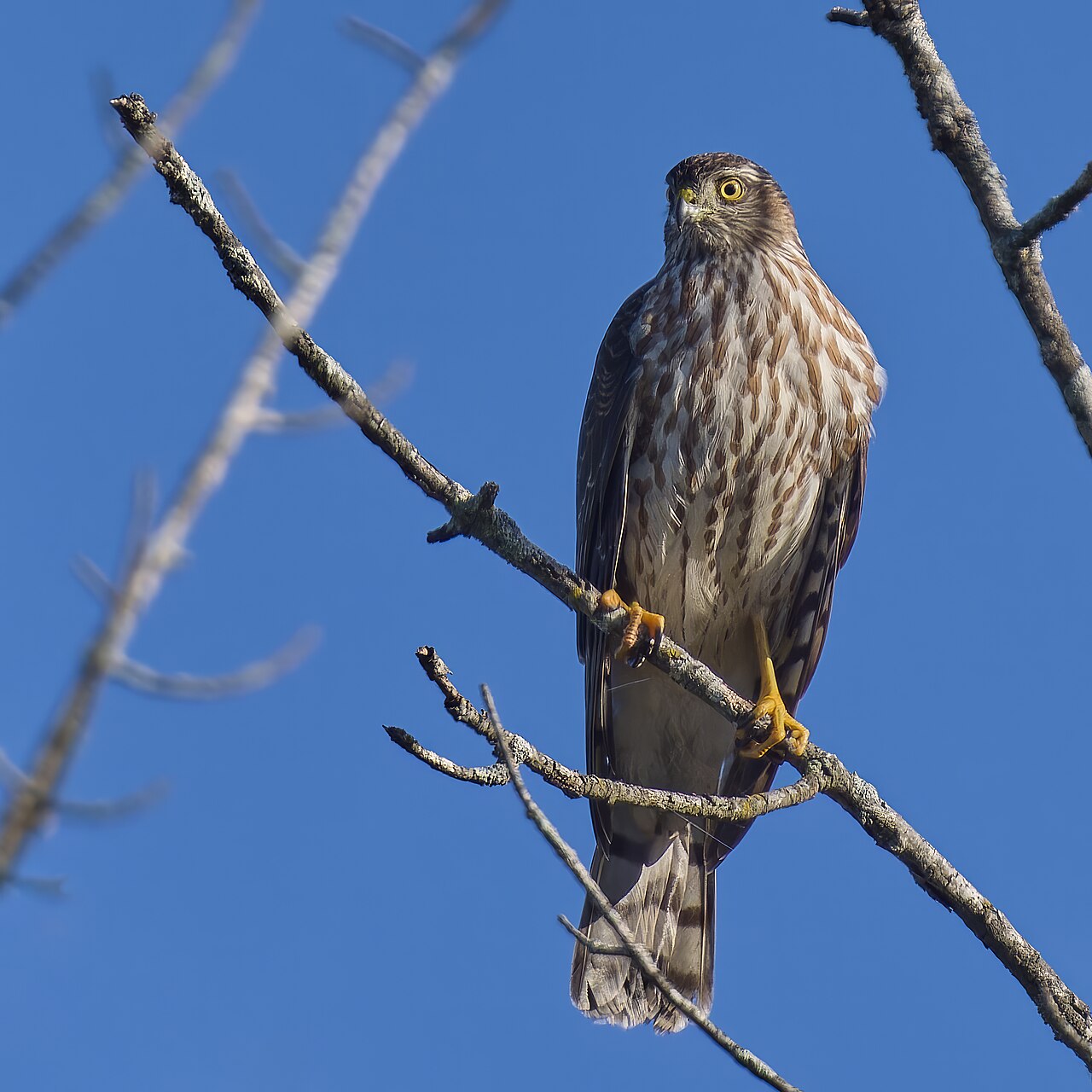
Adults are slaty blue-grey above and white below with fine, horizontal red-orange barring; the eye is orange-red and darkens with age. Juveniles are brown above with coarse vertical streaking on white underparts and a yellow eye. In flight the wings are short and rounded and the tail long, and the silhouette stands out for its small head, which barely projects beyond the wrists. The tail is square-tipped or slightly notched, with broad dark bands and a narrow white tip. It flies in the classic accipiter manner: a few quick beats, then a glide. As in almost all hawks the female is much the larger — about a third longer and half again as heavy as the male, so that in the field the two can read as different species.
Confusion species
Cooper's Hawk is the great pitfall: larger, with a distinctly bigger head that projects well ahead of the wrists, a rounded tail tip with a broad white band, and heavier legs. A big female Sharp-shinned and a small male Cooper's overlap in size, so only head shape, tail tip and the steadier wingbeat of Cooper's will settle it. American Kestrel and Merlin are falcons, with pointed wings and a continuous, fast wingbeat without glides. Juvenile American Goshawk is far bulkier, has a broad white eyebrow and irregular, teardrop-shaped streaking that runs onto the undertail coverts.
Habitat
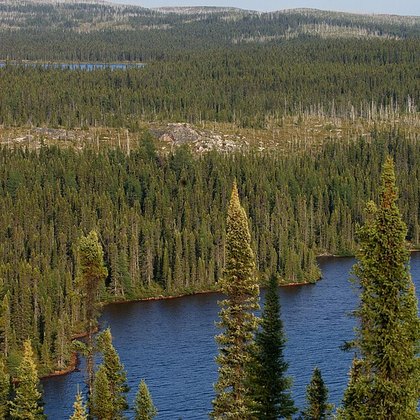
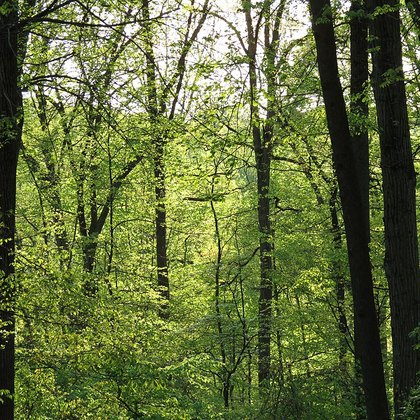
Breeds in closed forest, conifers for preference but also aspen and hardwoods, from the lowlands high into the mountains, with the nest just below the canopy. A dense crown layer matters more for the nest site than the tree species does. Outside the breeding season it is far less particular and hunts along woodland edges, hedgerows, parks and gardens, where it comes deliberately to bird feeders. What it avoids is genuinely open country with no cover: it needs shrubs and trees to close the distance unseen.
Where the bird is most often found, arranged by the USNVC — the vegetation classification of the United States and Canada — and CMECS for sea and coast.



Range and movements
Breeds across the boreal forest of Alaska and Canada up to the treeline, in the northern United States, in the western ranges and in the Appalachians; resident over much of that range and in the mountains of Mexico, Guatemala, Honduras and El Salvador, and on Cuba, Hispaniola and Puerto Rico. Northern birds move south in autumn and winter as far as Central America. The migration is concentrated: along the Appalachian ridges, the Great Lakes shorelines and the Atlantic coast, tens to hundreds pass day after day in September and October. DDT reduced breeding success in the 1950s and 1960s; numbers have been roughly stable since 1966.
- Resident
- Breeding (summer)
- Winter
- Passage
- dark = core range, pale = thinly spread
Where and when to look
Visit a ridge-top or coastal-point hawk watch in late September or early October with a northwest wind: the birds then come past low and close, and the short rounded wings with the small head can be practised on bird after bird. In winter it pays to watch a feeder from indoors — a Sharp-shinned Hawk that hunts one regularly often appears at about the same time every day.
Conservation
The world population is put at around a million birds and is rated Least Concern (LC); numbers were stable between 1966 and 2019. The largest direct loss near people is collision with windows, often during a strike at birds around a feeding station. The Puerto Rican form is listed federally as endangered and lost much of its habitat in hurricanes Irma and Maria in 2017.
Scientific name
Accipiter striatus | Vieillot, 1808
Vieillot described the species in 1808 as Accipiter striatus. accipiter is the Latin word for 'hawk', from accipere, 'to seize'. striatus means 'streaked', from stria, 'furrow' or 'streak', after the coarse lengthwise streaking of the underparts. The described specimen came from Santo Domingo, that is from Hispaniola, which holds a resident form of its own. The Dutch name points to the resemblance to the Eurasian Sparrowhawk, Accipiter nisus, which has the same build and the same way of hunting.