All species › Cranes, rails and allies › Cranes › Sandhill Crane
Sandhill Crane | Antigone canadensis
Canadese kraanvogel | Grulla canadiense
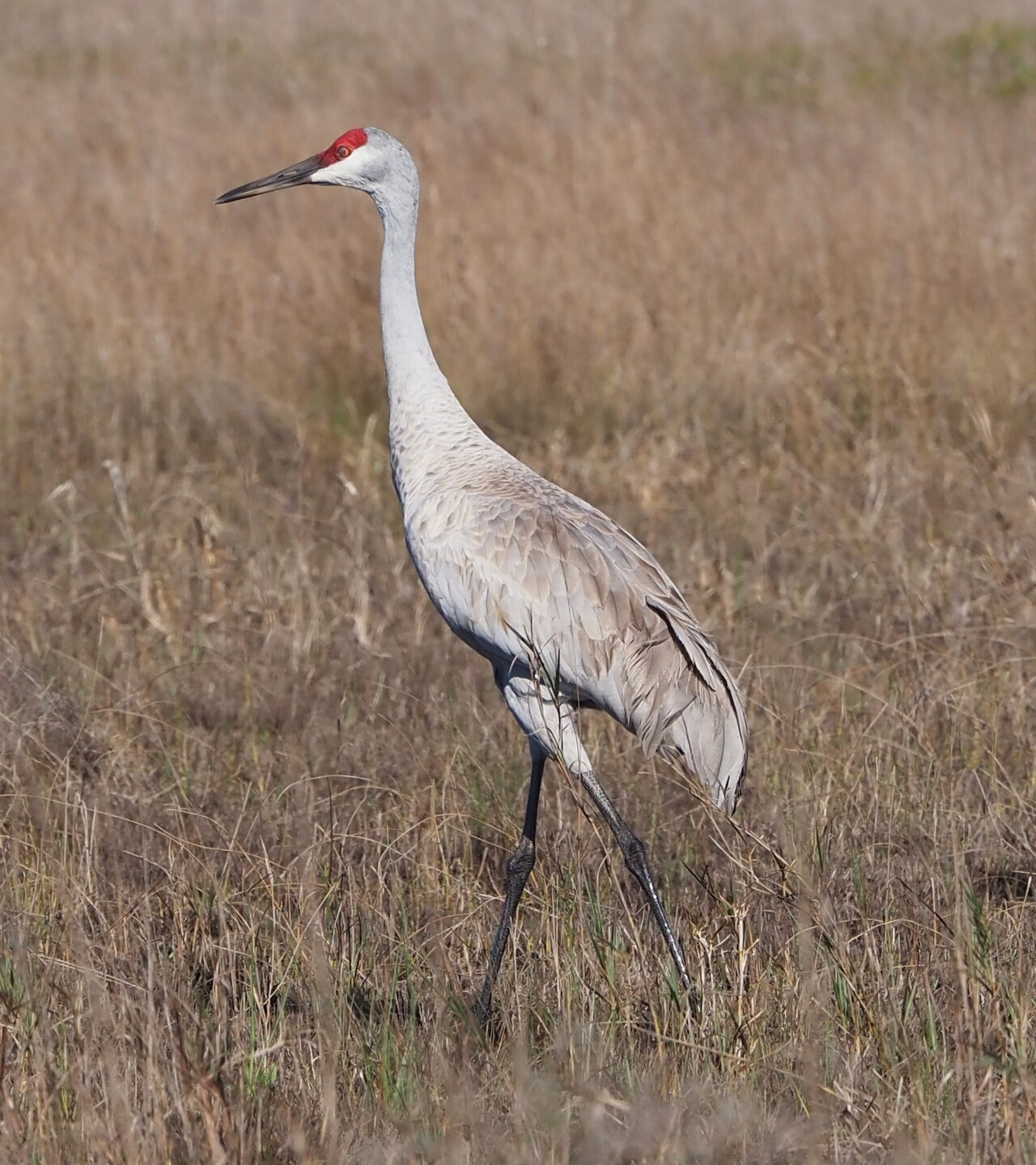
Sandhill Crane is North America's large grey crane, recognisable by its red crown patch and rolling bugling call that carries for kilometres. Where Whooping Crane remained rare, this species numbers in the hundreds of thousands and stages one of the continent's great migration spectacles, when spring flocks gather along Nebraska's Platte River. In the courtship dance the birds leap from the ground with wings spread, bow deeply and toss up tufts of vegetation; they dance year-round and at every age.
Voice
The call is a loud, rolling bugle — garoo-oo — produced by a long trachea coiled into the breastbone, which gives the sound a deep, far-carrying resonance. Flying flocks announce themselves long before they come into view, sometimes from great height. Threat or excitement brings a shorter, harsher call, and chicks beg with a high, peeping sound.
Recording: Don Profota — CC BY-NC-SA 4.0 · South Bozeman, Gallatin County, Montana, United States · xeno-canto
Identification
A large grey bird with a long neck, long black legs and a bare red crown above a white cheek patch; drooping, elongated tertial feathers form a 'bustle' over the rump that hides the short tail. In flight the neck is held outstretched, not folded back as in herons. Juveniles have a rusty-brown feathered head lacking the red crown and white cheek, and more mottled plumage. Breeding birds sometimes preen mud into their feathers, temporarily staining the grey rusty brown.
Confusion species
Great Blue Heron is similarly grey and nearly as large, but flies with its neck folded, lacks the red crown and has a heavier, dagger-shaped bill. Whooping Crane is considerably larger and mostly white with black wingtips — instantly distinct where their migration and wintering ranges overlap. Young Sandhill Cranes, with their brown heads, are sometimes mistaken for young herons, but the outstretched flight posture and the bustle always give the crane away.
Habitat
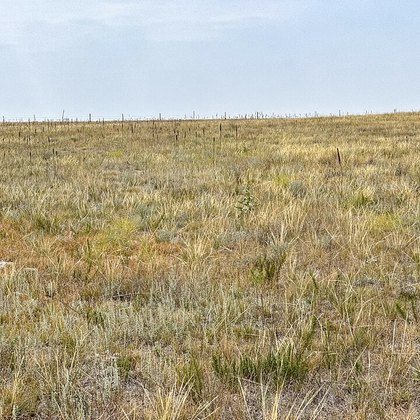
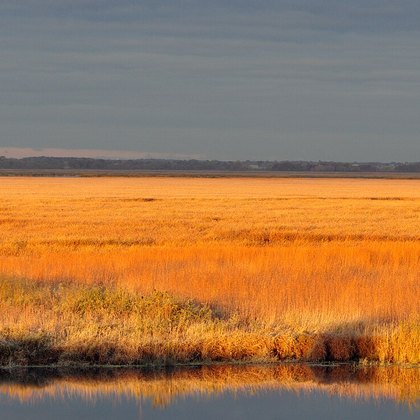
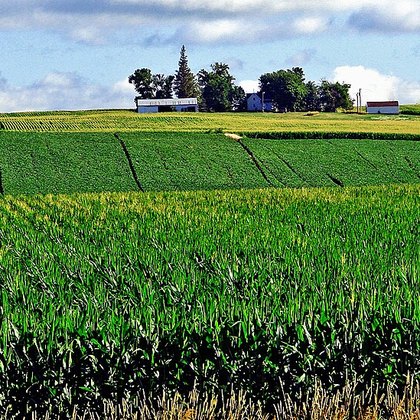
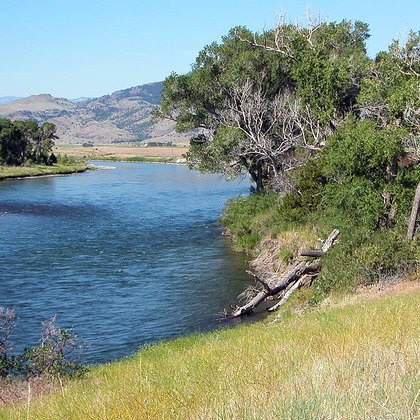
It breeds in open wet grassland, marshes and tundra, and forages in grain stubble fields, damp meadows and shallow river sandbars. During migration it gathers in large numbers on shallow riverbeds to roost overnight, protected from predators by the open water around it. It avoids dense forest and steep mountain terrain entirely.
Where the bird is most often found, arranged by the USNVC — the vegetation classification of the United States and Canada — and CMECS for sea and coast.
Range and movements
It breeds from Alaska and northern Canada south into the northern United States — the Great Lakes, upper Midwest and Rocky Mountains — with non-migratory populations in Florida and Mississippi. The migratory mid-continent population, by far the largest, winters in Texas, New Mexico and northern Mexico and gathers by the hundreds of thousands each spring along the Platte River. After a low point in the early twentieth century caused by hunting and wetland loss, the species has recovered strongly and is expanding its breeding range eastward again, as far as New York state.
- Resident
- Breeding (summer)
- Winter
- Passage
- dark = core range, pale = thinly spread
Where and when to look
Bosque del Apache in New Mexico and the Platte River in Nebraska are, in winter and early spring respectively, the places to see the species tens of thousands at a time; elsewhere the distant bugling often gives away a passing flock before it comes into sight, flying high in loose V-formation. Look in early morning over open fields for foraging groups.
Conservation
The total population has grown strongly over recent decades thanks to protection and management of stopover sites, and the species is again legally hunted in parts of its range. The isolated, non-migratory populations in Mississippi and Cuba, however, remain small and vulnerable to wetland loss.
Scientific name
Antigone canadensis | (Linnaeus, 1758)
Linnaeus described the species in 1758 as Ardea canadensis, in the genus for herons; only in 1853 did Reichenbach introduce the genus Antigone, named after the tragic heroine of Greek mythology — hence the parentheses around author and year. The species name canadensis refers to the type locality, which according to Linnaeus's source Edwards lay near Hudson Bay in Canada. The Dutch name recalls that same origin.