All species › Passerines › Tityras, becards and allies › Rose-throated Becard
Rose-throated Becard | Pachyramphus aglaiae
Grote bekarde | Cabezón degollado
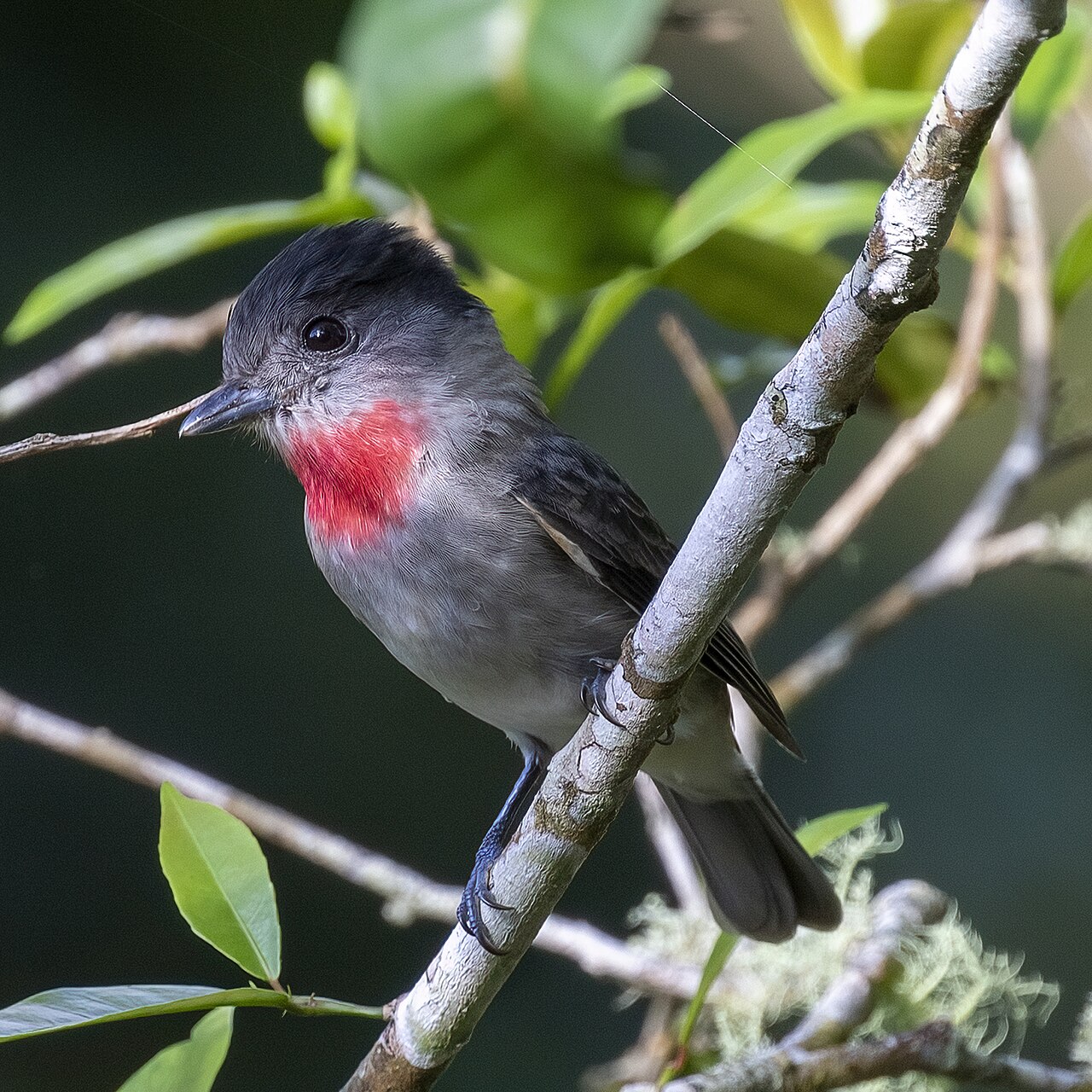
The Rose-throated Becard is a heavily built canopy bird of Mexico and Central America that only just crosses into this region: a handful of pairs in the creek woodland of southeastern Arizona and the extreme south of Texas. The male is slate grey with a black cap and a rose-red patch on the throat, the female warm brown with cinnamon wings — and it is usually the ball-shaped nest that gives the pair away before the birds themselves do.
Voice
The song is a thin, high whistle that slides down in pitch, tseeeu, two notes run together and repeated after long pauses; among the cicadas along a creek it is masked. At the nest there is also a rapid, nasal chik-chik-chik, and the pair keep contact with a drawn-out, plaintive eep. For most of the day the bird says nothing. The first hour after sunrise in June and July is when it speaks up, and that is how it is found in Arizona.
Recording: Zsombor Károlyi — CC BY-NC-SA 4.0 · Taxisco, Taxisco, Santa Rosa Department, Guatemala · xeno-canto
Identification
A stocky bird with a large head, a short broad bill and a quiet, upright stance on the branch. The male is slate grey, with a black crown lying over the head like a low cap, and carries a triangular rose-red patch on the throat; in birds from the humid south that patch may be small or missing altogether. The female is warm brown above with rufous wings and tail, a grey crown and a greyish nape, and pale buff below. Juveniles resemble the female but are yellower, with rusty feather edges. At sixteen to eighteen centimetres it is as long as a large flycatcher, but far heavier in the head and shorter in the tail.
Confusion species
In Mexico another becard, Pachyramphus major, is the main pitfall: that male is white rather than grey below and lacks the rose throat, and its female has a rufous crown with a grey band across the nape. Myiarchus flycatchers sit just as upright but are slimmer, longer-tailed with rufous in the feathers, longer-billed and much more active. The Eastern Kingbird is black and white with a white tail tip and hunts from open perches in full light, while the becard stays inside the canopy. A female becard is often taken for a large flycatcher; the grey crown and the short, thick bill make the difference.
Habitat
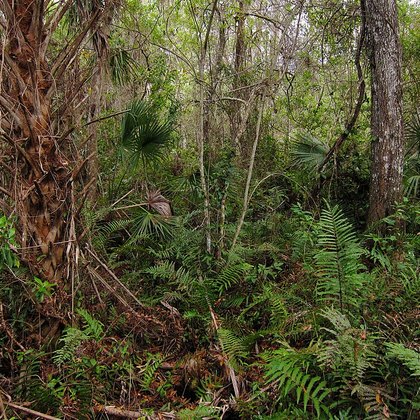
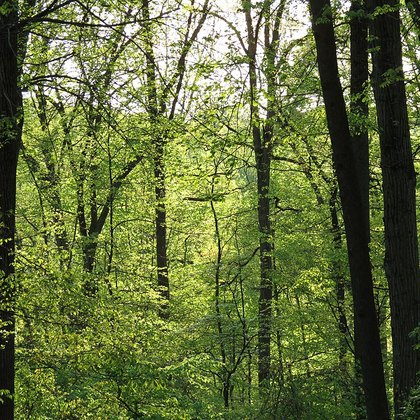
Tall trees at the edge of woodland, and almost always near water. In Arizona and Texas it is wholly tied to the gallery woodland of Fremont cottonwood, Arizona sycamore and willow along the few creeks that carry water all year. Further south it uses tropical deciduous forest that stands bare in the dry season, semi-open pine-oak woodland up to about 1,800 metres, and the shade trees of coffee plantations and village edges. It passes by closed, dark rainforest and open treeless desert.
Where the bird is most often found, arranged by the USNVC — the vegetation classification of the United States and Canada — and CMECS for sea and coast.


Range and movements
From northwestern Mexico, in Sonora, and from Tamaulipas south through Central America to western Panama; Costa Rica and Panama lie outside the guide area and so do not appear on the map. In the United States it reaches only southeastern Arizona and the extreme south of Texas, which makes it one of the rarest breeding birds there: in Arizona a few pairs along Sonoita Creek and the Santa Cruz, in Texas a handful of nests in the valley of the Rio Grande. The northern birds are summer visitors — arriving in May and gone by September — while those of central Mexico and southwards stay put all year.
- Resident
- Breeding (summer)
- Winter
- Passage
- dark = core range, pale = thinly spread
Where and when to look
Walk the cottonwoods of Sonoita Creek at Patagonia, or the riverbank in the Santa Ana refuge in Texas, early on a June or July morning, and listen for the thin, sliding whistle. Then look not for the bird but for its nest: that big hanging ball at the end of a slender branch over the path or the water can be seen from far off, and the pair return to it all day. Look high and wait: the bird stays in the canopy and moves from branch to branch in short, slow flights.
Conservation
Least Concern (LC). Partners in Flight arrives at about two million birds and the population appears stable; over by far the greater part of its range, in Mexico and Central America, it is an ordinary bird of woodland edges. The pairs at the northern rim, however, depend entirely on gallery woodland along creeks that are drying up through groundwater extraction and drought. If that woodland goes, the species goes from this region without the world population noticing.
Scientific name
Pachyramphus aglaiae | (de Lafresnaye, 1839)
Lafresnaye described the species in 1839 as Pachyrhynchus aglaiae; that genus name turned out to be already taken by a group of beetles, and the bird now stands in Pachyramphus, which Gray introduced in 1840 — hence the parentheses around author and year. Pachyramphus is Greek for 'thick bill', from pakhus, 'thick', and rhamphos, 'bill'. The epithet aglaiae honours Aglaé Brelay, wife of the French collector Charles Brelay. Mexico stands as the type locality; it was later narrowed to the neighbourhood of Jalapa in Veracruz.