All species › Passerines › Cardinals and allies › Rose-breasted Grosbeak
Rose-breasted Grosbeak | Pheucticus ludovicianus
Roodborstkardinaal | Picogrueso pechirrosado
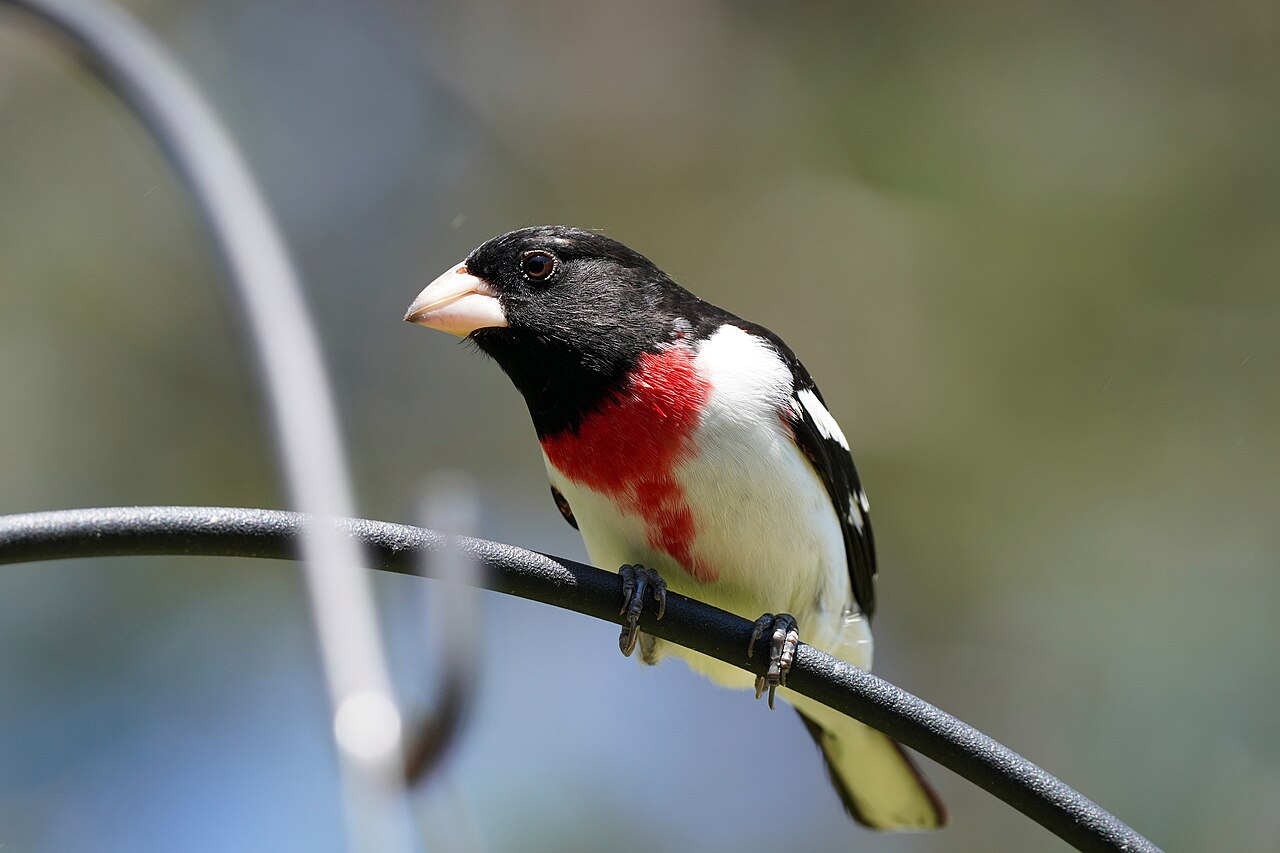
The Rose-breasted Grosbeak is the eastern counterpart of the Black-headed Grosbeak: a heavy seed-eater of deciduous woodland with a triangular, pale bill. The male has a black head and a red triangle on a white breast; the species breeds from British Columbia to Nova Scotia and leaves North America almost entirely in autumn.
Voice
The call is a sharp, hard eek that recalls a sneaker squeaking on a floor, with a thin hiik given in flight. The song is a continuous, flowing warble resembling that of the American Robin but higher, faster and with more sliding transitions. The female sings too, more softly and briefly, sometimes from the nest; the male occasionally sings on while incubating.
Recording: Sue Riffe — CC BY-NC-SA 4.0 · Tuttle Marsh WA, Iosco County, Michigan, United States · xeno-canto
Identification
The breeding male is black on head, back, wings and tail, white on breast and belly, with a sharply defined rose-red triangle on the upper breast and rose-red underwing coverts visible in flight. Two white wing bars and white patches in wing and tail flash as it takes off. The female is brown and streaked, with a broad white eyebrow, a pale central crown stripe and yellow underwing coverts. The bill in both sexes is thick, conical and horn-coloured to pink. First-year males have a brown head and a dull orange-pink breast.
Confusion species
Black-headed Grosbeak overlaps on the Great Plains and hybridises with this species there; its male has orange-brown rather than white underparts and yellow underwing coverts. The females are the closest: a female Rose-breasted has clear, sharp streaking across breast and flanks, a female Black-headed a buff ground colour with finer, more limited streaking. A female-type bird may also suggest a large sparrow, but the bill is considerably heavier.
Habitat
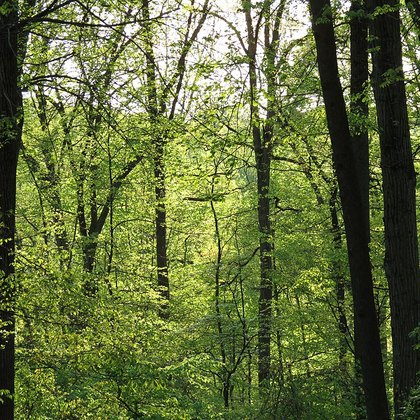
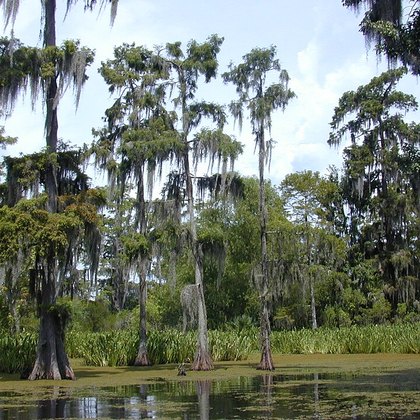
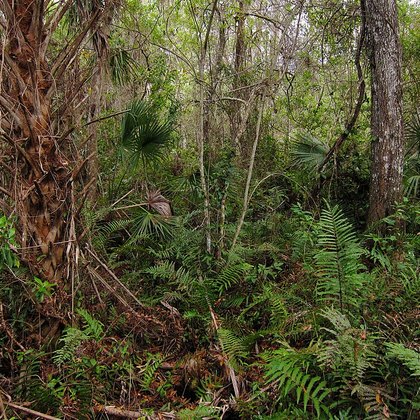
Open deciduous and mixed woodland with a well developed understorey, especially second growth, forest edges, hedgerows and streamside woodland; also parks and gardens with mature trees. On the breeding grounds it becomes commoner where logging or storms have opened gaps in the canopy. In winter it occupies semi-open woodland, shaded coffee plantations and forest edges in Mexico and Central America.
Where the bird is most often found, arranged by the USNVC — the vegetation classification of the United States and Canada — and CMECS for sea and coast.



Range and movements
The breeding range runs from northeastern British Columbia and Alberta east through the boreal fringe of Canada to Nova Scotia, and south in the United States to Kansas, Missouri, Ohio and along the Appalachians to northern Georgia. In autumn almost the whole population moves through the eastern United States and the Gulf Coast to Mexico, Central America, western Cuba and South America as far as Peru. Small numbers reach western Europe as vagrants. Numbers are rising in the northwest of the breeding range while falling in the southeast.
- Resident
- Breeding (summer)
- Winter
- Passage
- dark = core range, pale = thinly spread
Where and when to look
In May, before the trees are fully in leaf, males sing high in the canopy at woodland edges and can be located by their song. Outside the song period the call is the most useful: that hard squeaking eek is often heard before the bird is seen. The species appears at feeders with sunflower seed during the May passage.
Conservation
The IUCN places the species in the Least Concern (LC) category. The North American Breeding Bird Survey shows a moderate decline since 1970, sharpest in the southeast of the range; Partners in Flight puts the breeding population at several million birds. Forest loss on the wintering grounds and collisions with windows and towers during nocturnal migration are the best documented pressures. In parts of the northern breeding range forest is regrowing.
Scientific name
Pheucticus ludovicianus | (Linnaeus, 1766)
Linnaeus described the species in 1766 as Loxia ludoviciana from a specimen from Louisiana; because of its placement in another genus, author and year stand in parentheses. The species name ludovicianus means 'of Louisiana', formed on Latin Ludovicus for the name Louis, after whom the territory was named. The genus Pheucticus goes back to Greek pheuktikos 'shy, inclined to avoid'. The Dutch and English names both refer to the male's red breast patch.