All species › Pigeons and doves › Doves and pigeons › Rock Pigeon
Rock Pigeon | Columba livia
Rotsduif | Paloma bravía
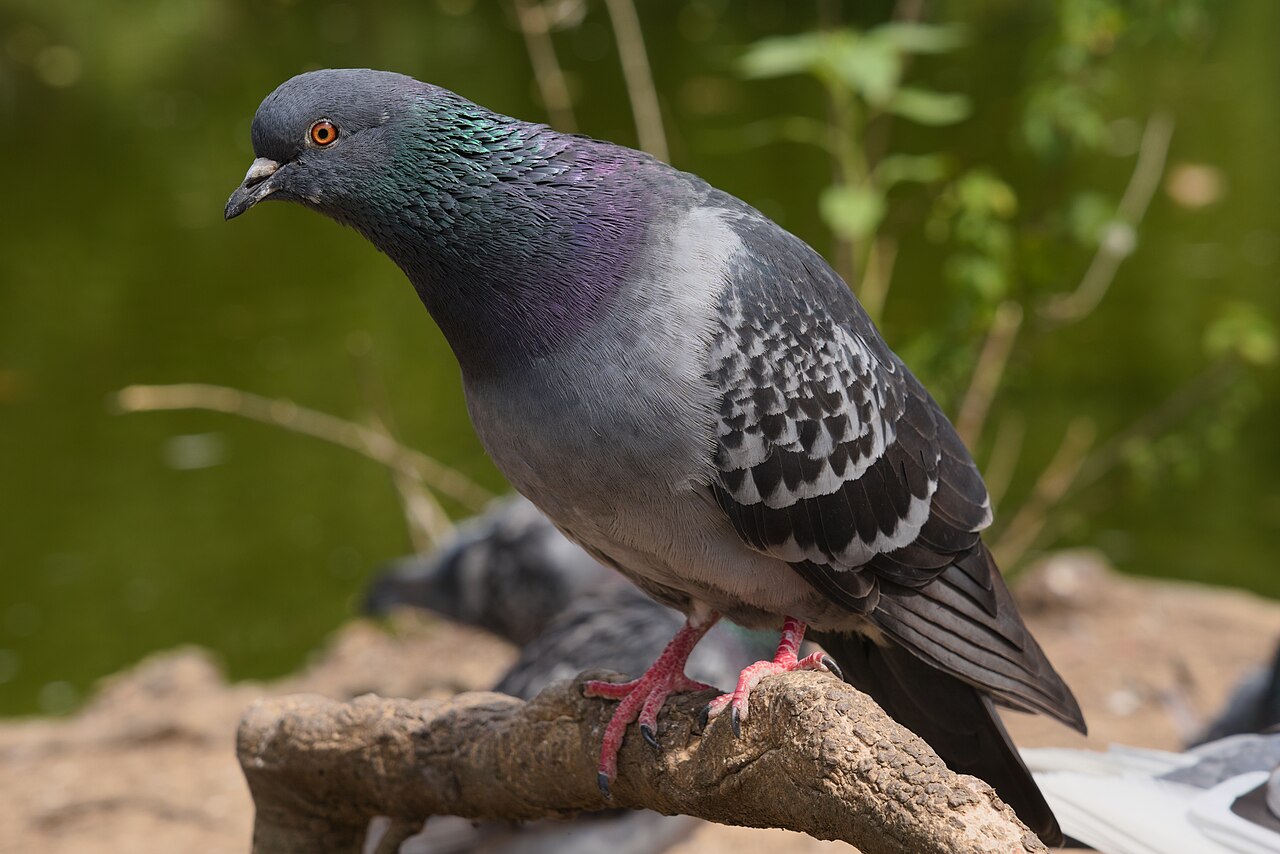
Rock Pigeon is the dove of squares, bridges and grain silos: chunky, short-tailed, with two black bars across the wing and a pale rump. The birds on the street are feral domestic pigeons, brought to North America by colonists in the early seventeenth century, and they show every colour that breeding has produced. Nowhere on the continent is there a population that did not come from those captive birds.
Voice
The voice is a soft, rolling coo, oo-roo-coo-coo, given above all while a displaying male bows and turns, and at close range it fills a whole roost. On take-off the wings clap sharply together, a sound heard over city squares all year round. At the nest the birds hiss at intruders and the young beg with a thin, piping note. Unlike most doves of this continent it does not sing at a distance: the cooing is close-range sound, meant for one listener.
Recording: Stanislas Wroza — CC BY-NC-SA 4.0 · Gmina Hańsk (near Wojciechów), włodawski, lubelskie, Poland · xeno-canto
Identification
A compact dove with a short, square-cut tail ending in a dark band, broad wings and fast, direct flight. The original plumage is blue-grey with two black bars across the inner wing, a white rump, a glossy green and purple neck and an orange-red eye; the bill is dark with a white fleshy knob at the base and the legs are red. Feral birds add white, red-brown, blackish and chequered types, and a single flock usually mixes them. Male and female look alike, the male a little glossier on the neck. Juveniles are duller with a grey rather than white bill knob; when gliding, the species holds its wings in a clear V.
Confusion species
Band-tailed Pigeon of the west is larger and longer-tailed, with a yellow black-tipped bill, a white half-collar on the nape and a broad pale band across the tail tip. White-crowned Pigeon of south Florida is dark with a sharply marked white crown and lacks the wingbars. Red-billed Pigeon is plain dark purple without any wing pattern. Eurasian Collared-Dove and Mourning Dove are both slimmer, paler and far longer-tailed.
Habitat
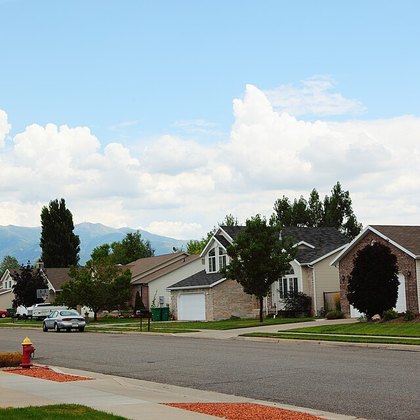
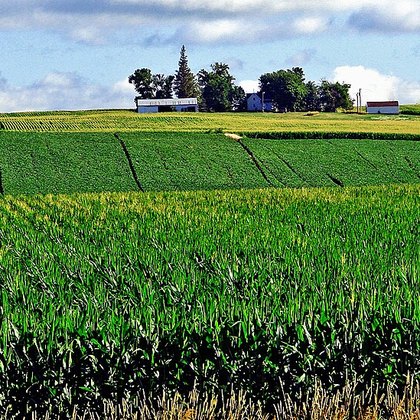
Cities and towns, bridges, overpasses, harbours, industrial sites, grain handling and farmyards form the core; all of these offer ledges to nest on and spilled grain to live on. Locally it also uses the kind of site it originally occupied: rock faces, canyon walls, sea cliffs and quarries, far from buildings. It avoids closed forest and unbroken wilderness entirely. Water nearby is welcome, since it drinks by suction with the bill immersed, which few birds other than pigeons do.
Where the bird is most often found, arranged by the USNVC — the vegetation classification of the United States and Canada — and CMECS for sea and coast.


Range and movements
Colonists brought domestic pigeons to the east coast in the early seventeenth century, and feral birds held on there; with the railways, the grain trade and the growth of cities the species spread across the whole continent. It is now resident in every state of the United States, Hawaii and coastal Alaska included, across settled southern Canada, throughout Mexico and the West Indies and into Central America. It does not migrate: most birds spend their lives within a few kilometres of the ledge they hatched on. Numbers in North America nonetheless fell by 46 per cent between 1966 and 2015, while the range itself stayed the same.
- Resident
- Breeding (summer)
- Winter
- Passage
- dark = core range, pale = thinly spread
Where and when to look
On a city square or under a bridge, look not at the species but at the flock: count how many birds are blue-grey with two bars and how many are white, red-brown or chequered, and you read that town's breeding history at a glance. In early spring watch for the display flight, in which the male claps its wings loudly, climbs and then glides down with the wings held up. The largest gatherings are at grain silos and harbour quays.
Conservation
The world population is put at some 140 million birds and the species is listed as Least Concern (LC). In North America numbers fell by 46 per cent between 1966 and 2015, probably because grain is stored and handled less openly than it once was. As a non-native bird it falls outside the protection of the migratory bird law in the United States and is controlled in cities and at airports.
Scientific name
Columba livia | Gmelin, 1789
Gmelin described the form in 1789 as Columba domestica livia, as part of the domestic pigeon; because the species has never since changed genus, author and year stand without parentheses. Columba is the ordinary Latin word for a dove. The name livia goes back to Latin lividus, 'lead-blue', after the ground colour of the wild plumage. Gmelin gave no type locality; it was later fixed on southern Europe.