All species › Parrots › African and New World parrots › Red-masked Parakeet
Red-masked Parakeet | Psittacara erythrogenys
Guayaquilaratinga | Aratinga de Guayaquil
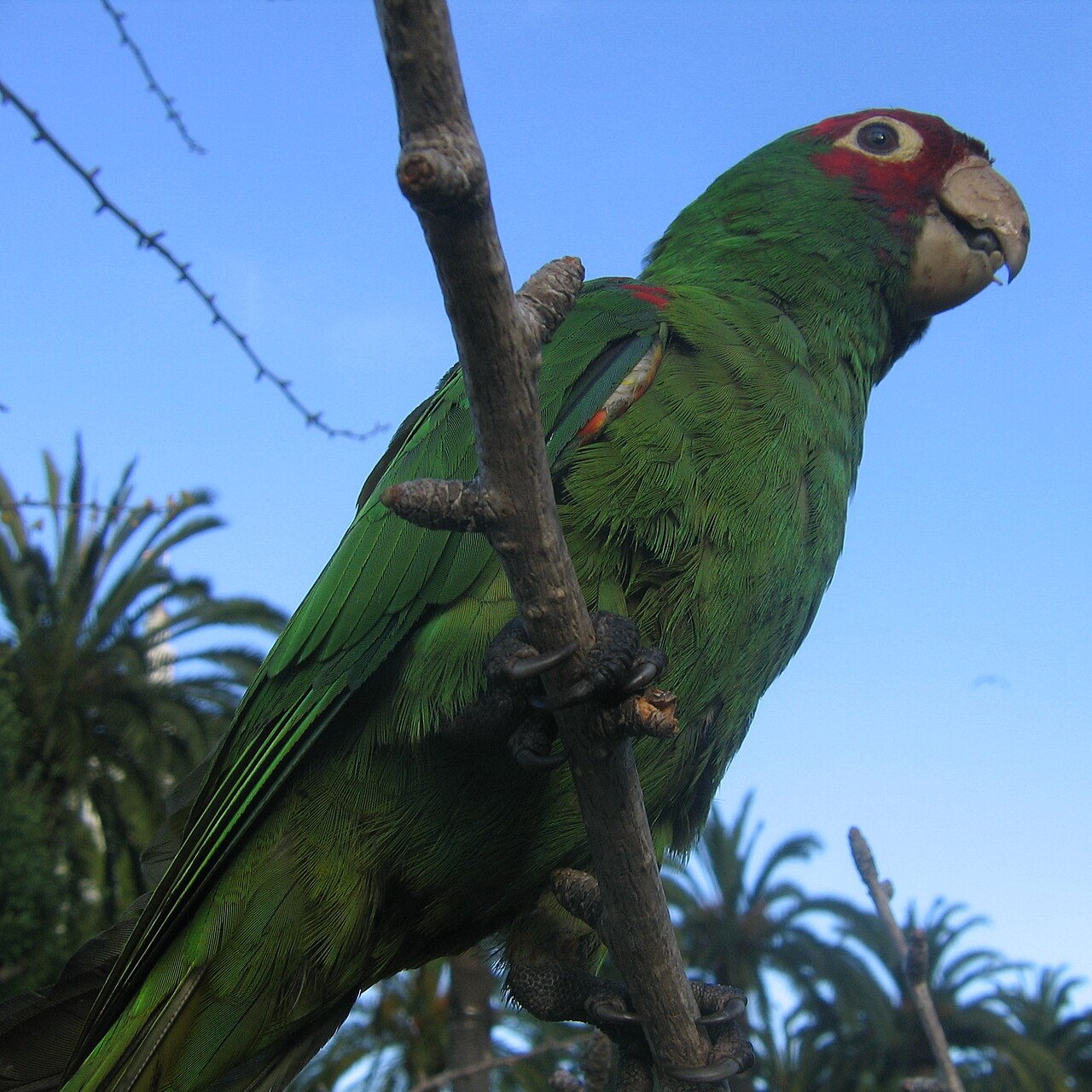
The Red-masked Parakeet is a large green parakeet with an almost entirely red head and neck, about half its length made up by the tail. Native to southwestern Ecuador and northwestern Peru, it is naturalised in a string of California cities, descended from escaped and released cage birds.
Voice
A loud, two-syllable screech, harsh and far-carrying, given mostly in flight. Perched in a tree the species is far quieter, with only shorter, softer calls between bouts of feeding.
Recording: Leonardo Ordóñez-Delgado — CC BY-NC-SA 4.0 · Reserva Ecológica Arenillas, El Oro, Ecuador · xeno-canto
Identification
Mostly green, with an almost entirely red head running from forehead into the neck — in this species not confined to a mask around the eye. Red also shows under the wing, on the neck and thighs, and along the leading edge of the wing. The pale, elongated eye-ring stands out against the red. Young birds remain entirely green until about four months old.
Confusion species
Mitred Parakeet (Psittacara mitratus), also found in California, has a green rather than red neck and a variable, often much smaller amount of red around the eye. Nanday Parakeet has a black facial mask and a black bill, with no red. Young, still all-green birds of this species can only be told from other green parakeets by the pale eye-ring and the long tail.
Habitat
Originally jungle and deciduous forest, adapted to semi-arid country and suburbs below 1,500 metres. In this region mainly California cities with tall trees and palms providing fruit and blossom.
Where the bird is most often found, arranged by the USNVC — the vegetation classification of the United States and Canada — and CMECS for sea and coast.


Range and movements
Its original range lies in southwestern Ecuador and northwestern Peru; that falls outside the guide area. In North America it is naturalised from escaped cage birds, with breeding groups in San Francisco, San Diego County, Los Angeles, the San Gabriel Valley, Sunnyvale, Orange County, Palo Alto and Long Beach, among others; smaller groups have also been reported from Hawaii. It does not migrate: the birds stay in the same area all year.
- Resident
- Passage
- dark = core range, pale = thinly spread
Where and when to look
Check the neck: in this species red runs from the head into the neck, while the related Mitred Parakeet stays green there. The long pale eye-ring is already visible even on young, still-green birds.
Conservation
The species is classed as Near Threatened (NT) worldwide: the population is declining because of the cage-bird trade and the loss and fragmentation of habitat in Ecuador and Peru. The naturalised populations in California fall outside that assessment and are growing there.
Scientific name
Psittacara erythrogenys | Lesson, 1844
Lesson described the species in 1844; because it was later moved to another genus, author and year stand in parentheses. The genus Psittacara was introduced by Vigors in 1825, a compound of Latin psittacus, 'parrot', and the Tupi word ara, 'macaw'. erythrogenys is Greek for 'red-cheeked', after the colour of the head.