All species › Waders, gulls and terns › Skimmers, noddies, terns and gulls › Red-legged Kittiwake
Red-legged Kittiwake | Rissa brevirostris
Roodpootdrieteenmeeuw | Gaviota piquicorta
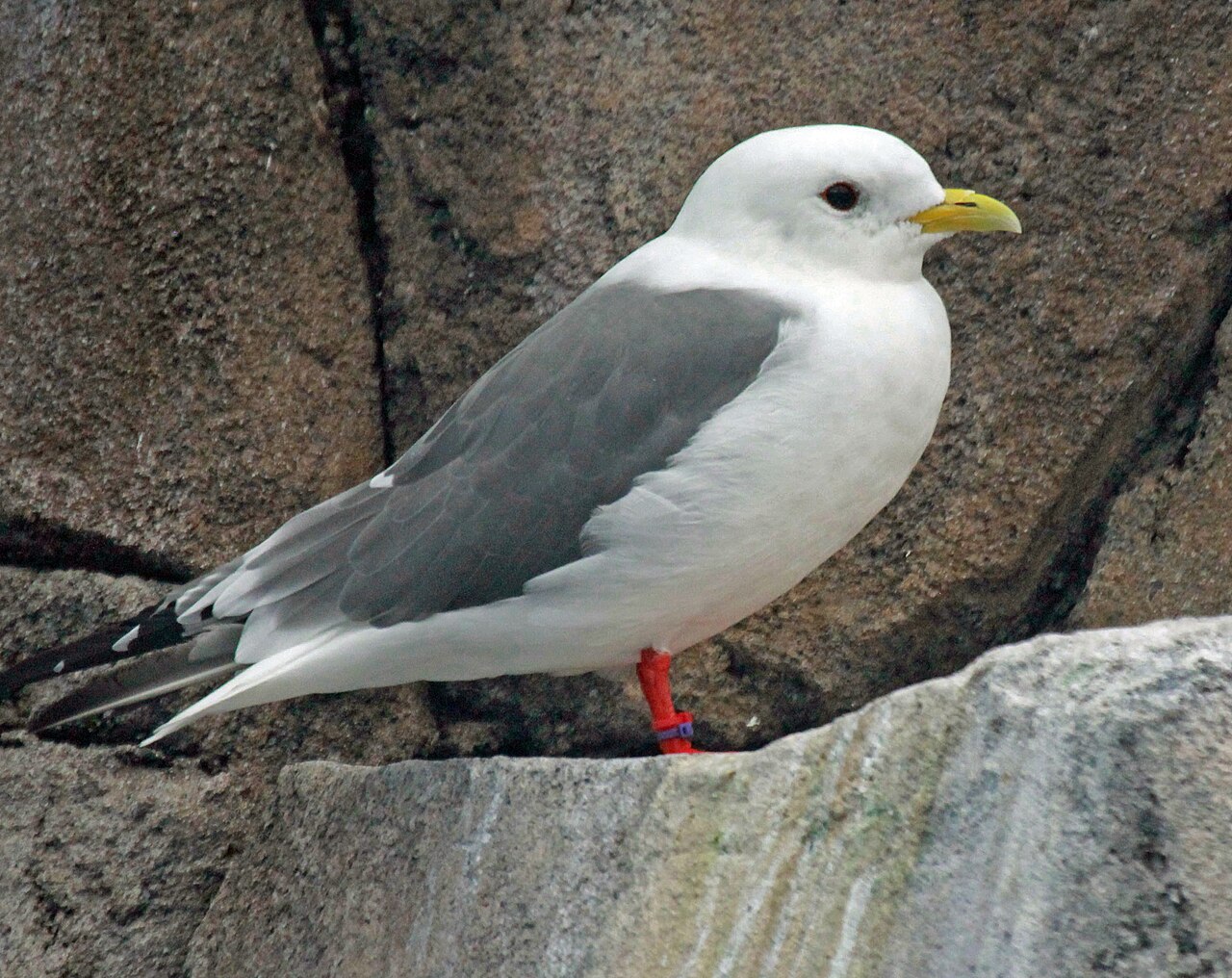
The Red-legged Kittiwake breeds on a handful of islands in the Bering Sea and nowhere else on earth. By far the greater part of the species sits on the cliffs of the Pribilof Islands, where the birds build their nests on ledges barely a hand's breadth wide. Short, bright red legs, a short yellow bill and a large dark eye are distinctive at close range.
Voice
At the colony it is noisy: a loud, repeated kee-ya, usually in series of three or four, higher and shriller than the familiar kitti-wake of the Black-legged Kittiwake. Alongside it comes a fast, high laughing series and a long drawn-out wail as a bird leaves the nest. At sea it is almost always silent. Anyone standing on the cliffs of Saint Paul or Saint George hears the two species mixed together and soon learns the difference in pitch.
Recording: Christoph Zockler — CC BY-NC-SA 4.0 · Kamchatka Krai, Russian Federation · xeno-canto
Identification
A small, short-legged gull with a round head, a large dark eye and a short yellow bill. The sexes are alike. The legs are short and bright coral red — the mark it is named for, but often precisely what cannot be seen on a bird sitting on a ledge. The mantle is a clearly darker slate grey than the Black-legged Kittiwake's, and the underwing is grey rather than white, which is the best mark on a bird overhead. The wingtip is plain black without white, and the wings project well beyond the short tail at rest. Juveniles lack the black W and the black tail band of young Black-legged Kittiwakes: they show only a dark ear spot and a grey neck collar, and so already look much like an adult.
Confusion species
Black-legged Kittiwake (Rissa tridactyla) is the only real confusion species, and breeds on the same cliffs: it is larger, paler grey on the mantle, with black legs, a longer yellow bill and a white underwing. Seen from below in flight the difference is large — grey against white — and it works at a distance too. Young birds differ most clearly: the black zigzag across the wings and the black tail band of a young Black-legged Kittiwake are entirely absent here. Beyond that, the Red-legged Kittiwake is shorter-billed and larger-eyed, which gives it a softer, dove-like face.
Compare gulls: legs, head, bill and wing tip side by side
Habitat
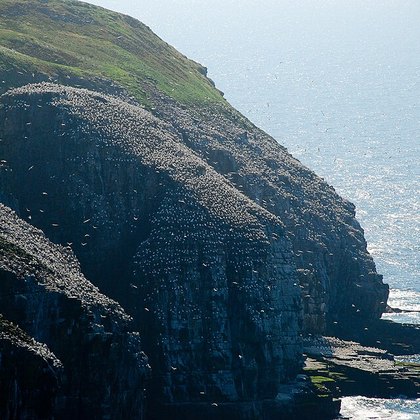
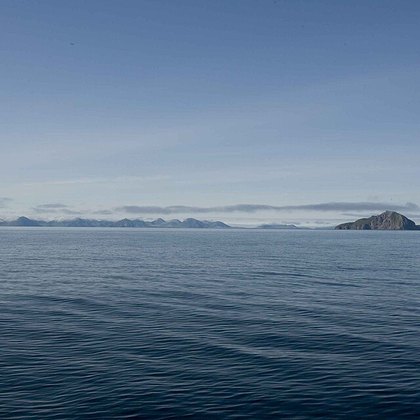
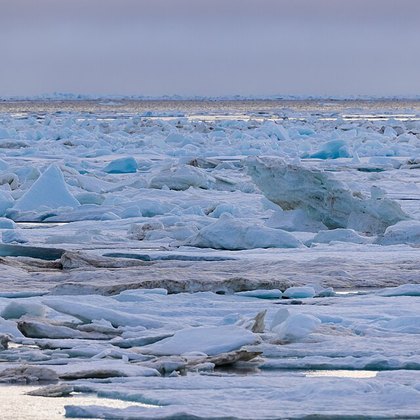
Breeds only on steep sea cliffs of islands in the Bering Sea, on narrower ledges than the Black-legged Kittiwake uses and usually somewhat higher. Outside the breeding season it lives on the open sea, mostly over deep water beyond the shelf edge and along the rim of the pack ice. It eats mainly lanternfish, which come to the surface at night, and so does much of its feeding in the dark. It hardly uses coastal waters, bays or harbours.
Where the bird is most often found, arranged by the USNVC — the vegetation classification of the United States and Canada — and CMECS for sea and coast.
Range and movements
The entire world range consists of the Pribilof Islands, Bogoslof, Buldir in the western Aleutians and Saint Matthew Island in Alaska, plus the Commander Islands on the Russian side. The great bulk of the species breeds on Saint George Island alone. In September the birds leave the cliffs and spread over the Bering Sea, the northwestern Pacific and the Gulf of Alaska; beyond those seas it is rarely seen. Within the guide area Alaska is therefore the only unit, and there it is present all year.
- Breeding (summer)
- Passage
- dark = core range, pale = thinly spread
Where and when to look
There is one practical way to see it: the flight to Saint Paul or Saint George in the Pribilof Islands, between mid-May and the end of August, and then looking down from the cliff edge. Search the narrowest ledges for the birds with the darkest backs, and wait until one sails past along the cliff: the grey underwing decides it. Outside that season the species is at sea and effectively out of reach.
Conservation
The world population is estimated at some 337,000 to 377,000 mature birds and has fallen by roughly a third since the mid-1970s, though the decline appears to have levelled off in recent years. The IUCN therefore lists the species as Vulnerable (VU). The cause is sought in the food supply: the availability of lanternfish depends on temperature and currents in the Bering Sea, and both are changing. A species confined to so few islands is also vulnerable to a single accident — an oil spill, or rats coming ashore.
Scientific name
Rissa brevirostris | (Bruch, 1855)
Carl Friedrich Bruch described the species in 1855 as Larus (Rissa) brevirostris; because Rissa has since become a genus of its own, author and year stand in parentheses. Rissa is taken from the Icelandic rita, the name for the kittiwake. brevirostris is Latin for short-billed, from brevis for short and rostrum for bill, and that is exactly what separates it from its sister species. The type locality is given no more precisely than northwestern North America.