All species › Gamebirds › Partridges, pheasants, grouse and allies › Red Junglefowl
Red Junglefowl | Gallus gallus
Bankivahoen | Gallo Bankiva
The Red Junglefowl is the wild ancestral form of the domestic chicken, by nature a shy forest bird of South and Southeast Asia; feral populations have lived in Hawaii for centuries, descended from birds the first Polynesian settlers brought with them. This page covers those free-living birds, not the ordinary chicken of a farmyard: the purest form survives in the deep forest of Kauaʻi, while elsewhere in the islands generations of crossing with escaped domestic chickens have given the birds a far more varied appearance.
Voice
The male crows the familiar 'cock-a-doodle-doo', but shorter and higher-pitched than in most domestic roosters, and at any time of day or night — feral roosters keep no fixed schedule of dawn calling. The female gives a soft, repeated clucking while walking with chicks, and in alarm a sharp, piercing call that sends the whole group flying for the forest. Under the rainforest canopy of Kauaʻi, that crowing, from unseen birds deep in the vegetation, is one of the most frequently heard sounds.
Recording: Aku Kalliomäki — CC BY-NC-SA 4.0 · Virrat, Finland · xeno-canto
Identification
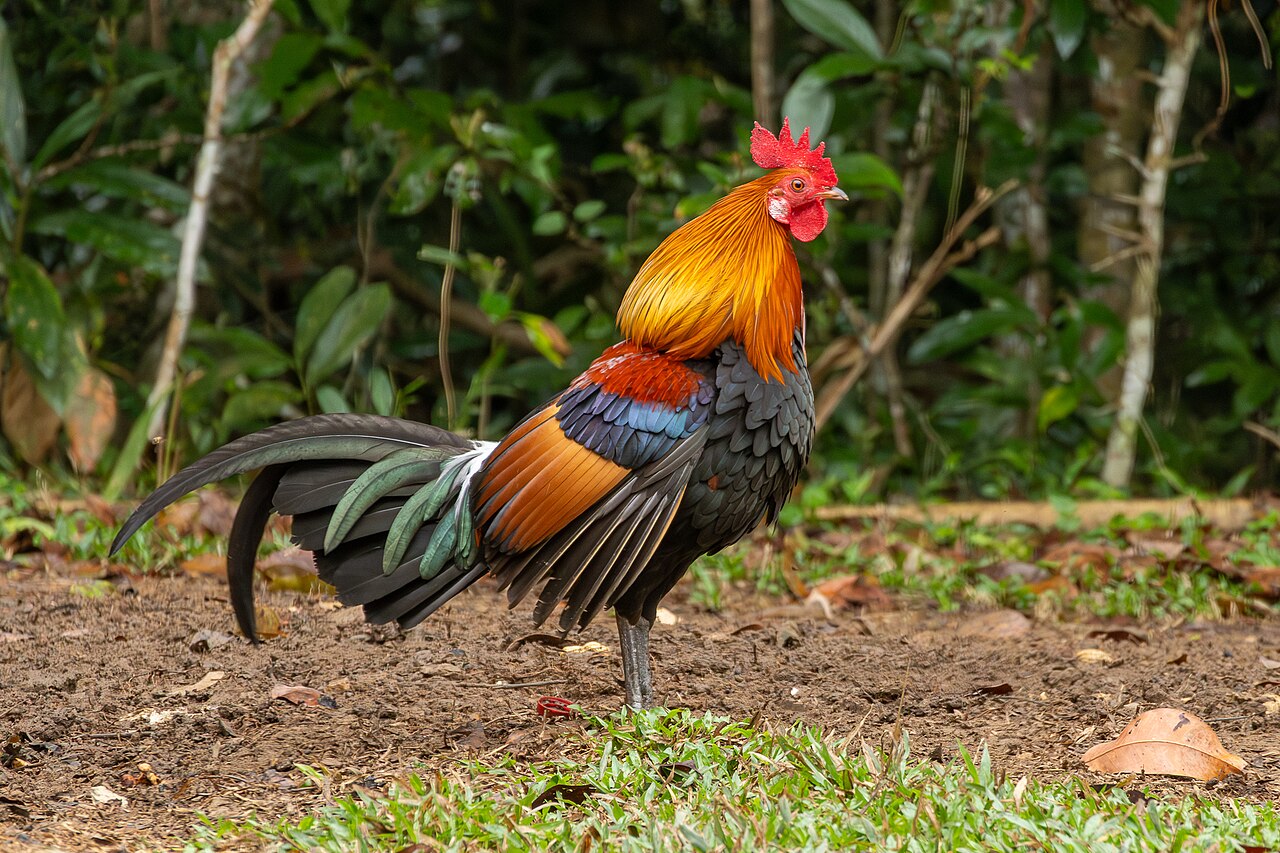
The male has orange-red neck and back hackles, a glossy black-and-green tail with long, curved sickle feathers, a red comb and wattles, and — the best mark for recognising a pure bird — grey rather than yellow legs. The female is dull brown with fine dark streaking, smaller, with a short tail, and likewise grey legs in pure birds. Feral roosters of mixed ancestry vary in colour, from almost white to black and barred, and often have yellow rather than grey legs, a trace of their domestic forebears. The silhouette stays that of an ordinary chicken, with the head held upright and the tail carried high.
Confusion species
Telling it from the ordinary domestic chicken rests in practice on few features: only leg colour and, to a lesser extent, the pitch of the crow give any guide, and most birds outside Kauaʻi's deep forest are already generations mixed. Small ornamental breeds with plumage resembling that of the wild male are often mistaken for Red Junglefowl, when in fact it is the reverse: those breeds were bred to resemble the junglefowl. The female Kalij Pheasant is greyer and lacks the orange neck hackles; the female Ring-necked Pheasant is much larger, with a long, pointed tail.
Habitat
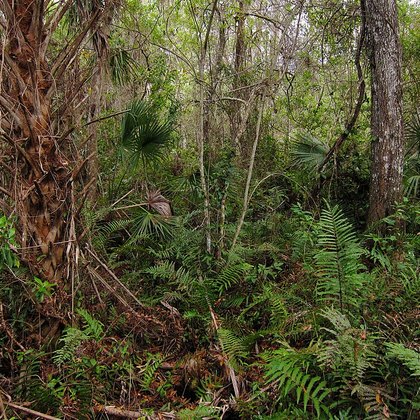
The purest population lives in the humid, densely vegetated interior forest of Kauaʻi, in ravines and along streams where few people go. Feral birds of mixed ancestry are far more widespread and range across all the islands, in gardens, along beaches, in parking lots and at hotels, wherever food can be found. Both forms avoid high, cold mountain country.
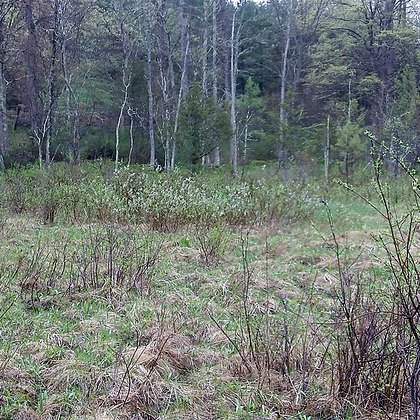
Where the bird is most often found, arranged by the USNVC — the vegetation classification of the United States and Canada — and CMECS for sea and coast.


Range and movements
Polynesian settlers carried the Red Junglefowl to Hawaii centuries ago as a food source; the birds went feral and, especially on Kauaʻi, long maintained a relatively pure population. On the other islands, later escapes of domestic chickens kept up a steady mixing. On Kauaʻi itself that mixing increased sharply after Hurricane Iniki in 1992, which broke open thousands of coops of domestic chickens; genetic studies show that even Kauaʻi's population has since become mixed, though it remains the population on the island closest to the wild form. Elsewhere in North America the species does not occur in the wild.
- Resident
Where and when to look
Walk an early-morning trail in Kokee State Park or Waimea Canyon on Kauaʻi: the farther from the road and buildings, the greater the chance of birds close to the wild form. Watch the leg colour — grey points to a less mixed bird, yellow to a stronger link with the domestic chicken.
Conservation
Not threatened worldwide (LC); as a domestic animal the species is the most numerous bird on Earth. Hawaii's feral population is abundant and growing, and in towns is regarded as a nuisance for its noise and the traffic hazard it poses, while the less-mixed birds of Kauaʻi's interior are of scientific interest as the last link to the original introduction.
Scientific name
Gallus gallus | (Linnaeus, 1758)
Linnaeus described the species in 1758 as Phasianus Gallus; it has since been moved to another genus, so author and year stand in parentheses. Brisson introduced the genus Gallus in 1760, the Latin word for 'cock'. The type locality was later restricted to the island of Con Dao (formerly Pulo Condor), off the coast of Vietnam near the mouths of the Mekong.