All species › Passerines › Shrike-babblers, Erpornis and vireos › Red-eyed Vireo
Red-eyed Vireo | Vireo olivaceus
Roodoogvireo | Vireo ojirrojo
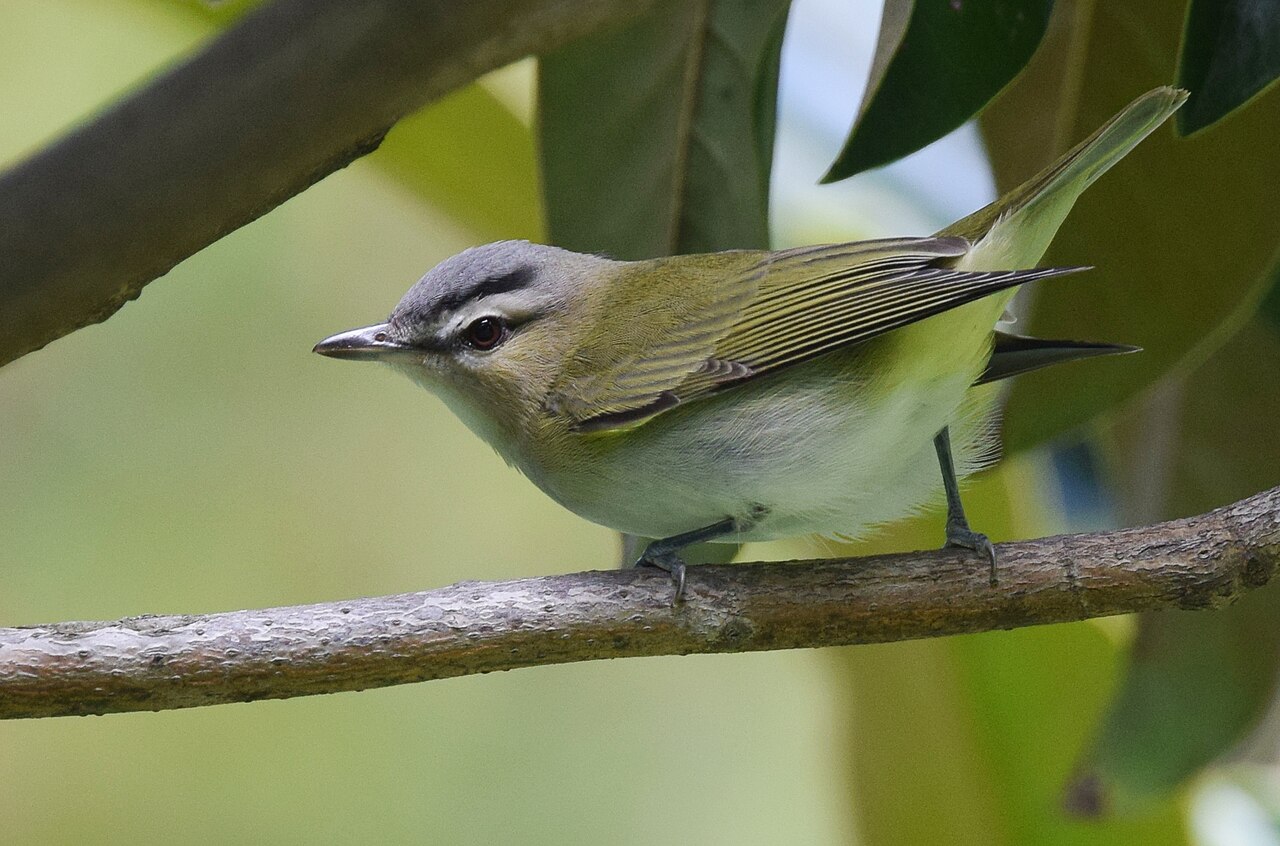
The Red-eyed Vireo is the voice of the eastern summer woods: invisible high in the canopy, yet audible all day long, even at noon when everything else has fallen quiet. One male can push out more than twenty thousand short phrases in a day. Seen close, the singer turns out to be a crisply marked olive-green bird with a white eyebrow and a deep red iris.
Voice
The phrases sound like a question and an answer given by turns: a rising chir-wee, a pause, then a falling chee-wyoo, endlessly in shifting order. Each male commands a few dozen such motifs and never repeats one twice in a row. The sound nearly always comes from high in the leaves and moves slowly, because the bird works onward as it sings. It is often confused with American Robin, whose song is fuller and richer and comes in runs of several phrases together.
Recording: Stanislas Wroza — CC BY-NC-SA 4.0 · Le Fjord-du-Saguenay Regional County Municipality (near Saint-Fulgence), Saguenay–Lac-Saint-Jean, Quebec, Canada · xeno-canto
Identification
Olive-green above, white below, without wingbars and without a mark anywhere: simplicity itself. The head carries the identification: a blue-grey crown, a white eyebrow with a black border above and below it, and a dark line through the eye. In adults the iris is deep red, which shows only at close range and in good light; birds in their first autumn have a brown eye and are yellower on the flanks. Male and female cannot be told apart. Flying from tree to tree it is a small green-grey streak with nothing to hold on to — everything is in the head.
Confusion species
Warbling Vireo (Vireo gilvus) is greyer and plainer, lacks the black borders to the eyebrow and has a paler, brown eye. Philadelphia Vireo (V. philadelphicus) is smaller, yellow on throat and breast and shorter-billed, and usually keeps lower down. Tennessee Warbler (Leiothlypis peregrina) resembles it in autumn, but has a thin, sharply pointed bill and moves far faster and more restlessly. In doubt: the sharp black border above the white eyebrow belongs to the Red-eyed Vireo alone.
Habitat
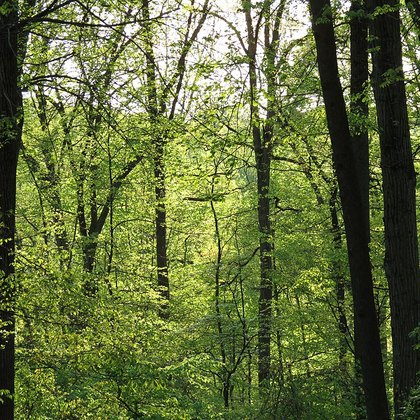
It breeds in deciduous and mixed woodland with a closed canopy and a shrub layer beneath it, from swamp forest and streamside woods to maple and oak on the hills; northwards this passes into aspen and birch among the conifers. Large unbroken tracts are preferred to scattered woodlots. On migration it is far less particular and turns up in parks, gardens, hedgerows and coastal scrub. Clear-cut and young regrowth are avoided until the canopy has closed again.
Where the bird is most often found, arranged by the USNVC — the vegetation classification of the United States and Canada — and CMECS for sea and coast.




Range and movements
It breeds from British Columbia and the southern Northwest Territories east to Newfoundland and south to Texas and Florida, which makes it one of the most numerous forest birds of the continent. In August and September it leaves across the Gulf of Mexico and through Central America, with smaller numbers over Cuba and the Bahamas. The winter is spent in the Amazon basin, far south of the guide area; the map alongside therefore shows only what can be seen of it here. Unlike many forest birds its numbers are rising, by roughly half a per cent a year, as abandoned farmland in the east has turned back into woodland.
- Resident
- Breeding (summer)
- Winter
- Passage
- dark = core range, pale = thinly spread
Where and when to look
Walk into a deciduous wood on a warm afternoon in June and stand still: if anything is still singing at one o'clock, this is almost certainly it. Follow the song slowly and look not at the ground but at the underside of the leaves, seven to fifteen metres up. The best moment comes when the song falters: then the bird stops moving, and only then does the white eyebrow stand out among the leaves.
Conservation
The breeding population is put at some 130 million birds and rose slightly between 1966 and 2019; the Red List lists the species as Least Concern (LC). It is, however, among the most frequently chosen hosts of the Brown-headed Cowbird, which lays its egg in the nest; in fragmented woodland that runs high, in unbroken forest much less so. As a long-distance night migrant it is also vulnerable to collisions with lit buildings and masts.
Scientific name
Vireo olivaceus | (Linnaeus, 1766)
Linnaeus described the species in 1766 as Muscicapa olivacea, among the flycatchers; since it was placed in Vireo, author and year stand in parentheses. The genus was introduced by Vieillot in 1808 and goes back to vireo, in Pliny the name of a small green bird, from the Latin virere, 'to be green'. olivaceus means 'olive-coloured'. The type locality is North America, later restricted to South Carolina.