All species › Tubenoses › Petrels, shearwaters and diving petrels › Pink-footed Shearwater
Pink-footed Shearwater | Ardenna creatopus
Chileense grote pijlstormvogel | Pardela patas rosadas
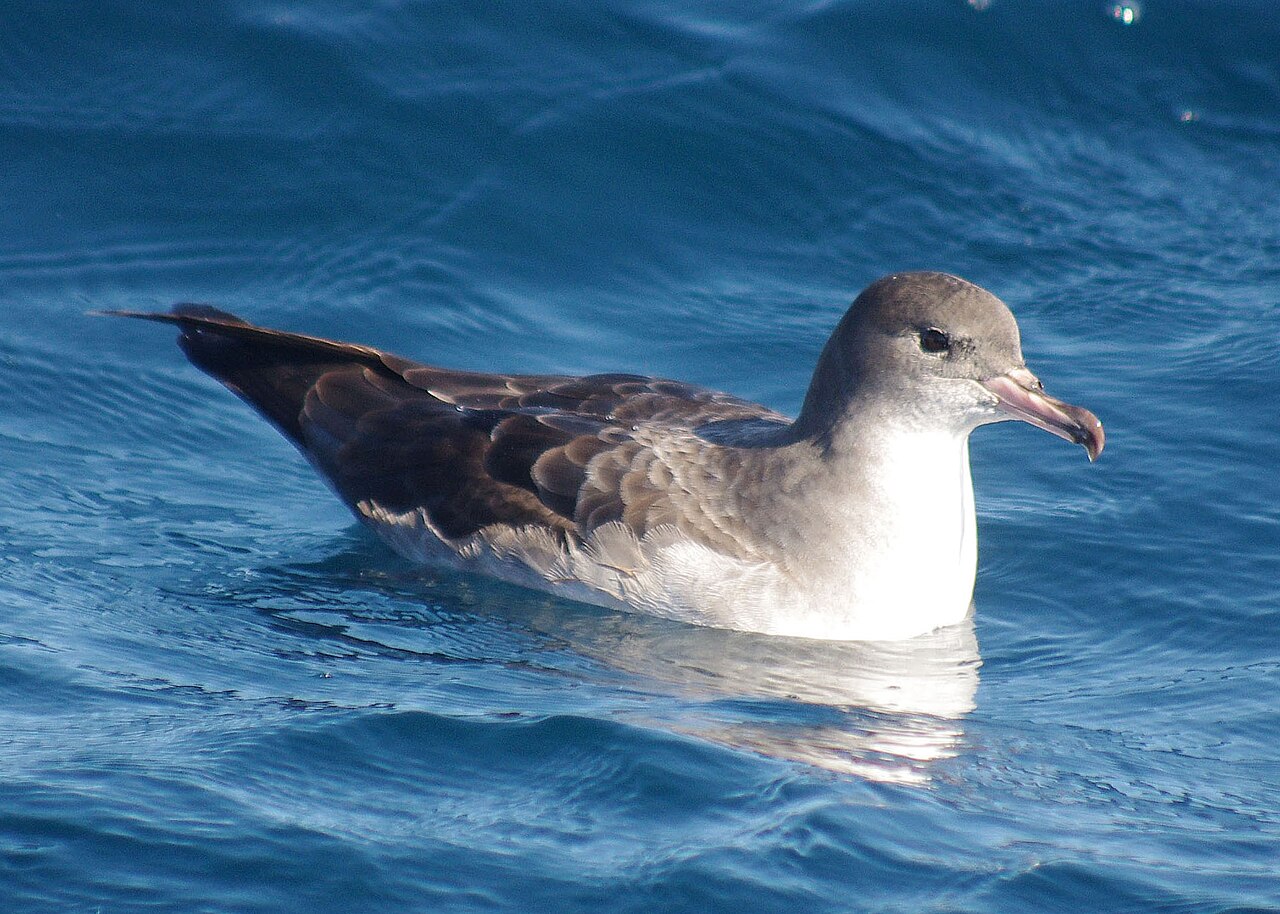
Pink-footed Shearwater is a large, grey-brown shearwater with a pale belly that passes along the entire American west coast in substantial numbers every northern summer. It breeds only on a handful of islands off Chile, where bycatch and introduced predators have made it Vulnerable (VU).
Voice
At sea the species is mostly silent; while feeding it sometimes gives a whinnying call. At the breeding colony, far outside the guide area, partners alternate soft duets in the burrow with mutual head and neck preening; none of that can be heard from the sea off North America.
Recording: Ignacio Escobar — CC BY-NC-SA 4.0 · 8 km off of Valparaiso, V Region, Chile · xeno-canto
Identification
Grey-brown above, with a pale underside variably marked with grey, especially on the throat, flanks and underwing; the bill is pink with a dark tip, the legs pink. The species is larger and heavier than most other pale-bellied shearwaters off this coast, with slower, stiffer wingbeats. Males average slightly larger than females, but that difference is not usable in the field.
Confusion species
Flesh-footed Shearwater, its closest relative, is entirely dark and lacks the pale belly, though young birds of that species always stay darker below than this one. Buller's Shearwater has a sharply defined dark cap and a bold dark M-pattern across the upperwing that this species lacks. Black-vented Shearwater is distinctly smaller, with white largely confined to the face and more grey on the flanks.
Habitat
Within the guide area the species is a true ocean bird, but with a clear preference for water closer to the mainland coast than most other tubenoses, especially over the continental shelf in warm-temperate water of roughly 14 to 18 degrees. It snatches fish, squid and crustaceans from the surface, with anchovy and sardine as important prey, and regularly follows fishing vessels. Breeding colonies lie on forested island slopes, far outside the guide area.
Where the bird is most often found, arranged by the USNVC — the vegetation classification of the United States and Canada — and CMECS for sea and coast.
Range and movements
The species breeds almost entirely on the Juan Fernández Islands and Isla Mocha off Chile. After breeding the birds move thousands of kilometres north to the waters off the American west coast, where they are common from April to November from California to British Columbia, with most birds in September; the species is occasionally seen further north as well, into the Gulf of Alaska.
- Resident
- Breeding (summer)
- Winter
- Passage
- dark = core range, pale = thinly spread
Where and when to look
On a pelagic boat trip off California, Oregon or Washington between May and October this is usually the most numerous pale-bellied shearwater; the pink base of the bill often catches the eye before the pink legs do.
Conservation
The species is listed as Vulnerable (VU). Bycatch in the Chilean purse-seine fishery for anchovy and sardine is estimated to kill more than a thousand adults a year, illegal chick harvesting on Isla Mocha has continued since the 1930s, and introduced rats, cats, rabbits and dogs threaten the breeding colonies.
Scientific name
Ardenna creatopus | (Coues, 1864)
American physician and ornithologist Elliott Coues described the species in 1864 as Puffinus creatopus, based on a specimen from San Nicolas Island off California — the type locality thus lies in the United States, even though the species breeds only in Chile. It has since been placed in the genus Ardenna, hence the parentheses around author and year. The species name creatopus comes from Greek kreas, kreatos ('flesh') and pous ('foot'), so 'flesh-footed' just like Flesh-footed Shearwater, but through Greek rather than Latin roots. The genus Ardenna was introduced in 1853 by Reichenbach, after Artenna, a term Aldrovandi used for a seabird in 1603.