All species › Waders, gulls and terns › Auks, puffins and murres › Pigeon Guillemot
Pigeon Guillemot | Cepphus columba
Duifzeekoet | Arao colombino
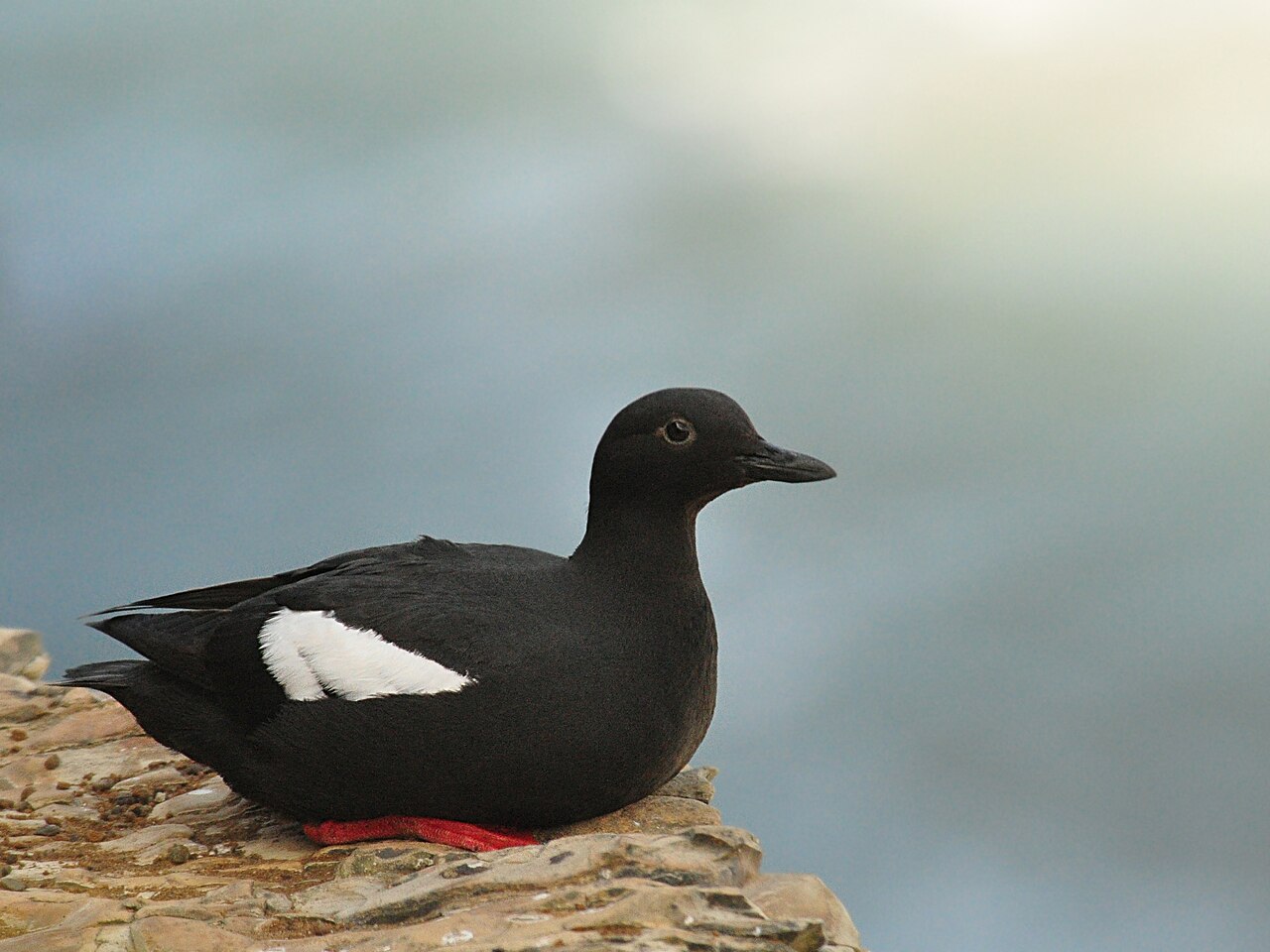
The Pigeon Guillemot is the auk of the Pacific rocky shore: sooty black with a white wing panel cut in two by a dark wedge, and with feet and mouth lining of a shouting scarlet. It fishes just off the shore, along the bottom between the stones, and breeds wherever there is a crevice — in a cliff, under a boulder, and without hesitation in the gap of a pier or a breakwater in the middle of a city. That makes it the most frequently seen of all Pacific auks.
Voice
One of the most talkative auks. Over the colony and on the water comes a thin, high whistle that slides up and down in pitch, usually in long series and often in duet: two birds answering one another in a trilling, hissing psee-see-see-seew. Unpaired males give a lower, drawn-out whistle, and alarm brings a shrill scream. In calling the bill is opened wide, so that the red throat shows at a distance — the sound and the red belong together.
Recording: Rachel Hudson — CC BY-NC-SA 4.0 · Budd Inlet, Thurston County, Washington, United States · xeno-canto
Identification
In breeding plumage dark sooty brown to black with a greenish gloss, and with a large white panel on the upperwing notched at the front by a blackish-brown wedge. Legs and webs are scarlet, and so is the inside of the mouth; the bill is black, straight and pointed. Male and female look alike. In winter plumage head, neck and underparts turn white and the upperparts grey with black-and-white marbling, while the white wing panel with its dark wedge remains. Juveniles have a grey-streaked head and neck and a smaller wing panel shot through with dark. The flight is low and whirring, the red feet showing as two spots beyond the tail.
Confusion species
Black Guillemot (Cepphus grylle) is the sister species on the Atlantic side and matches it in everything but one thing: its white wing panel is undivided. The two meet only at the Bering Strait and share no other coast, so this is not a real field problem but a likeness on paper. Within the Pacific the wedge in the white panel is the deciding mark. Common Murre (Uria aalge) and Thick-billed Murre (Uria lomvia) are much larger, longer-necked and show no white on the wing. Winter birds are confused with Marbled and Kittlitz's Murrelets, which are far smaller and shorter-billed and lack both the big white panel and the red feet.
Habitat
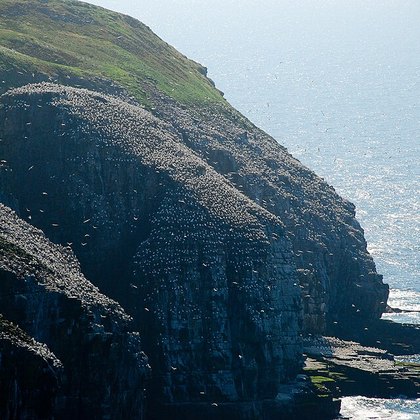
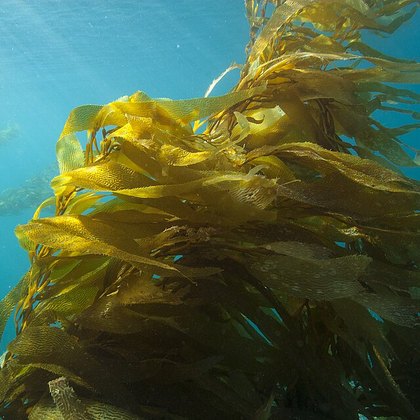
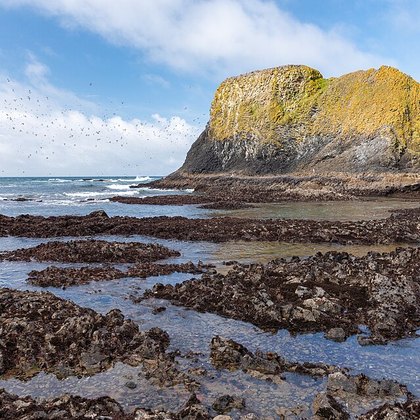
Rocky shores, cliff edges, cobble beaches and low rocky islands with a crevice, a cavity under a slab or a hole among tree roots above the tideline; breakwaters, piers and concrete jetties serve just as well. It feeds close to the nest, in water no more than about thirty metres deep, over rock, kelp beds and tide rips, hanging above the bottom and probing head-first between the stones for fish and shrimp — a way of hunting no other auk uses in the same way. It avoids deep water beyond the shelf and rarely goes more than a few kilometres offshore.
Where the bird is most often found, arranged by the USNVC — the vegetation classification of the United States and Canada — and CMECS for sea and coast.

Range and movements
From the Kuril Islands and Kamchatka across the Bering Sea and the Aleutians and south along the whole American west coast, through Alaska, British Columbia, Washington and Oregon to the Channel Islands of southern California. Most birds stay in the same stretch of coast all year; only the northernmost, where the sea freezes, withdraw to open water around the Aleutians and the Gulf of Alaska. In the southern half of the range they are less visible in winter because they scatter into sheltered inland waters and bays, not because they have gone. It reaches Baja California only exceptionally.
- Resident
- Breeding (summer)
- Winter
- Passage
- dark = core range, pale = thinly spread
Where and when to look
Look for it from shore between April and July in the sheltered waters of the Salish Sea, Puget Sound or Prince William Sound: early in the morning pairs sit off the bank and chase each other across the water with the red feet held high. Watch where a cliff or a sandstone bank is crumbling, or under an old wooden pier — the nest crevice is often at eye level there. On a bird that flies off it comes down to the wedge: if the white panel is cut across, it is a Pigeon and not the Atlantic species.
Conservation
The world population is estimated at a little under half a million birds and the trend is stable; the species is listed as Least Concern (LC). Because it fishes just off the shore, oil is its greatest danger: after the Exxon Valdez disaster in Prince William Sound numbers there never returned to their former level. On islands introduced foxes and raccoons are a second cause, and inshore gill nets a third. Where sea otters have gone and sea urchins have grazed the kelp forests bare, its hunting ground disappears with the weed.
Scientific name
Cepphus columba | Pallas, 1811
Pallas described the species in 1811 in his Zoographia Rosso-Asiatica as Cepphus columba; because it has never changed genus, author and year stand without parentheses. Cepphus goes back to Greek kepphos, the name of a pale seabird in the ancient authors. columba is Latin for 'dove', after the stocky shape and the fast, clattering wingbeats; others see in it Icelandic klumba for an auk. The type locality is Kamchatka and the Bering Strait, the region where Pallas's Russian collectors worked.