All species › Waders, gulls and terns › Auks, puffins and murres › Parakeet Auklet
Parakeet Auklet | Aethia psittacula
Papegaai-alk | Mérgulo lorito
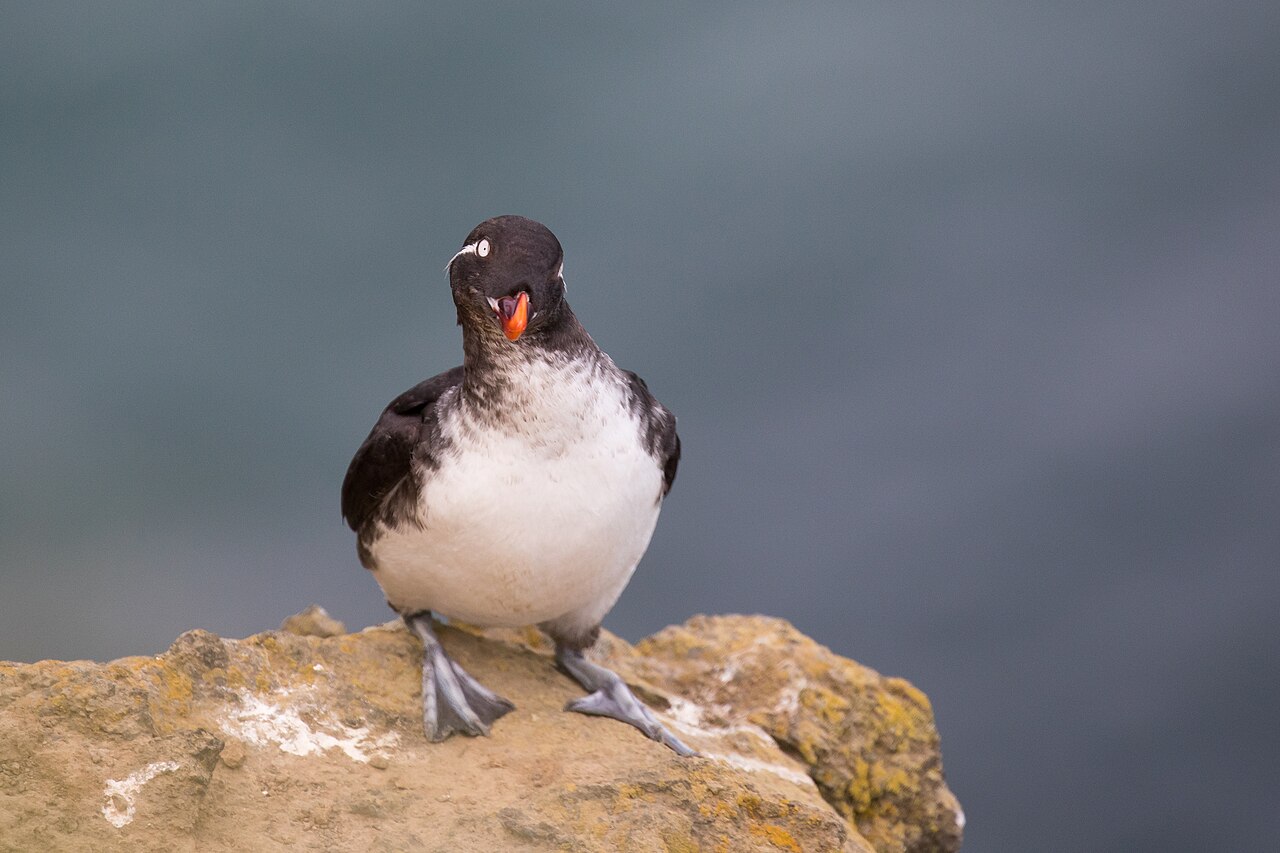
The Parakeet Auklet owes its name to the short, thick orange bill, which tilts up at the tip and gives the bird a permanently astonished look. It is the only auklet of its genus with a white belly, breeds in loose parties rather than dense masses, and is the only auk that takes jellyfish in quantity.
Voice
At the colony a rhythmic, hoarse call that sounds like a plaintive, quavering whinny: oo-weee-er, rising slowly and then falling away. Two birds often give it together while sitting upright side by side on a boulder. There are also short rasping barks on landing and in disputes over a crevice. Outside the breeding season it is rarely heard.
Recording: Sue Riffe — CC BY-NC-SA 4.0 · Gambell, Alaska, United States · xeno-canto
Identification
Blackish grey above, chin and breast mottled grey, belly and flanks white — that white underside separates it at once from the other auklets of its genus. In breeding plumage the bill is bright orange and strongly upturned, and a single narrow white plume runs back from the pale eye. In winter the bill turns dull orange, throat and breast become whiter, and the plume is shorter. Juveniles have a darker, less upturned bill and no plume. In all plumages the white belly stands out against the dark upperparts in flight, and on the water the bird sits high and upright.
Confusion species
Crested Auklet (Aethia cristatella) is the same size but wholly dark below and carries a crest. Cassin's Auklet (Ptychoramphus aleuticus) is smaller and drabber, with a dark bill bearing a pale spot at the base and a dingy grey rather than white belly. Ancient Murrelet (Synthliboramphus antiquus) has a grey back, a bluish-white bill and a sharply bordered black cap. Least Auklet (Aethia pusilla) is also white below in winter, but weighs less than a third as much and has a tiny dark bill.
Habitat
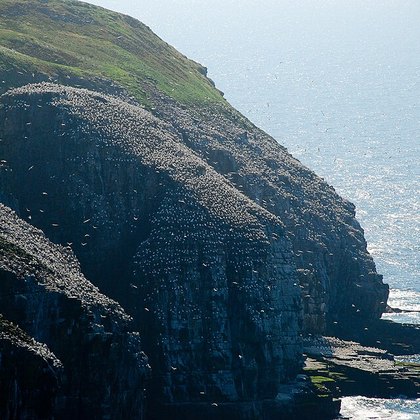
Breeds on islands in crevices in cliffs, among boulders and in talus slopes, usually in loose parties of at most a few dozen pairs and often scattered among other seabirds. It feeds far offshore in deep, open water, diving to some thirty metres; jellyfish and other gelatinous plankton make up a larger share of its diet than in any other auk. Outside the breeding season it does not come ashore at all.
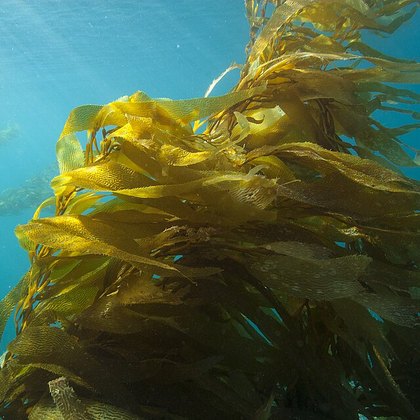
Where the bird is most often found, arranged by the USNVC — the vegetation classification of the United States and Canada — and CMECS for sea and coast.


Range and movements
Breeds patchily from eastern Chukotka, Sakhalin, the Kurils and the Commander Islands across the Bering Sea and the Aleutians into the Gulf of Alaska. In winter it spreads far over the northern Pacific, reaching the northern Sea of Japan. Along the North American coast it then occurs off British Columbia and irregularly to California, but always well offshore and in small numbers; British Columbia treats it as a rarity, and it was seen there more often in the past than it is now.
- Resident
- Breeding (summer)
- Winter
- Passage
- dark = core range, pale = thinly spread
Where and when to look
Do not look for it in the rafts of other auklets but on its own: Parakeet Auklets usually float in twos and threes, calm and high on the water, far from the colony. At a colony on the Pribilofs or St. Lawrence Island they perch upright on projecting boulders by day in June and July, and then the upturned orange bill is visible through a telescope at long range.
Conservation
The population is put at over a million birds, with its centre of gravity in Alaska, and there is no sign of a recent decline; the species is listed as Least Concern (LC). Because the species breeds in small, widely scattered parties, it is less vulnerable to the failure of any one colony than its more tightly packed neighbours. Introduced rats and arctic foxes on breeding islands, and oil at sea, remain the main threats.
Scientific name
Aethia psittacula | (Pallas, 1769)
Pallas described the species in 1769 as Alca psittacula, among the auks; because it was later moved to another genus, author and year stand in parentheses. The genus Aethia was introduced by Merrem in 1788, after aithuia, the name of a seabird in the classical Greek authors. psittacula is Latin for 'little parrot', from psittacus, 'parrot', after the short, thick, upturned bill. Pallas gave the type locality as Kamchatka and the islands towards Japan and North America.