All species › Passerines › Wrens › Pacific Wren
Pacific Wren | Troglodytes pacificus
Pacifische winterkoning | Chochín del Pacífico
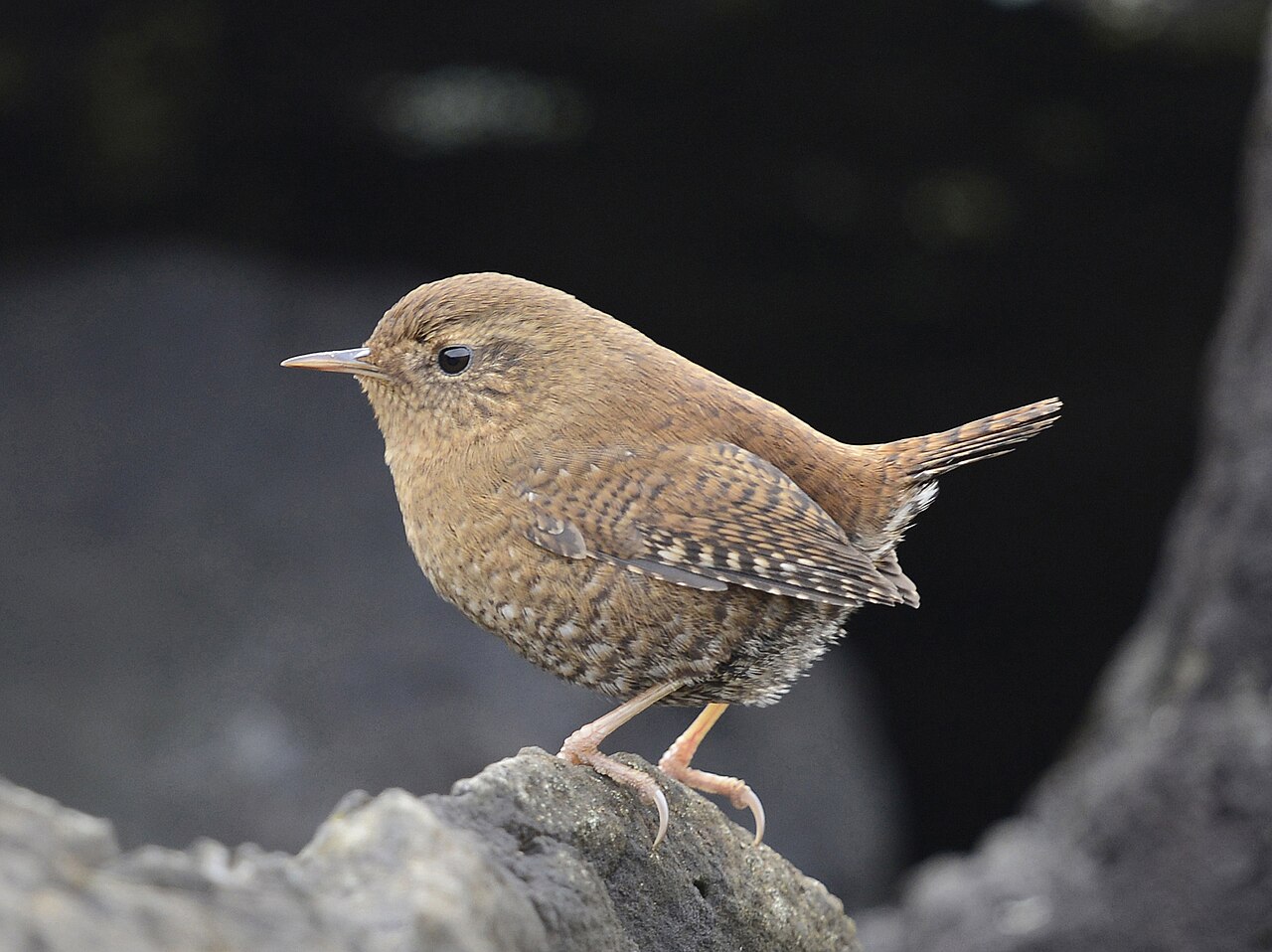
The Pacific Wren is one of the smallest songbirds in North America: a dark brown ball with a stub of a tail held up, sliding mouselike through fallen logs and ferns. It belongs to the damp conifer forest of the west coast, from the Aleutians to central California.
Voice
The song is a long, fast cascade of high trills and ticking notes, often five to ten seconds long and delivered at tens of notes per second — for its body weight one of the loudest songs of the forest. The singing bird trembles visibly over its whole body while the tail stays cocked. The call is a hard, dry chet or timp, usually single or in short pairs, sharper and drier than that of related species.
Recording: Andrew McCafferty — CC BY-NC-SA 4.0 · Hemer Provincial Park, Nanaimo, British Columbia, Canada · xeno-canto
Identification
Small and round, dark rufous-brown above with fine dark barring on wings, tail and belly. The eyebrow is pale and narrow, the throat slightly lighter than the rest of the underparts but without sharp contrast. The tail is short and carried upright almost continuously; the bill is thin and straight. The legs are long for so small a bird. Birds of the Aleutians and the islands of southern Alaska are larger, longer-billed and greyer than mainland birds.
Confusion species
Winter Wren is nearly identical and was treated as the same species until 2010; it is slightly paler and greyer brown, with a lighter throat standing out more clearly against the belly, while Pacific Wren is darker and more evenly rufous. Voice is more reliable: the call of Pacific Wren is a hard single chet, that of Winter Wren a doubled chimp-chimp recalling a Song Sparrow. The two meet in a narrow band in British Columbia, Alberta and Montana. Northern House Wren is larger, paler and longer-tailed, and sits in open scrub rather than closed forest.
Habitat
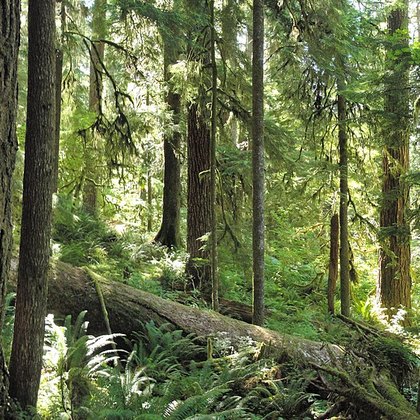
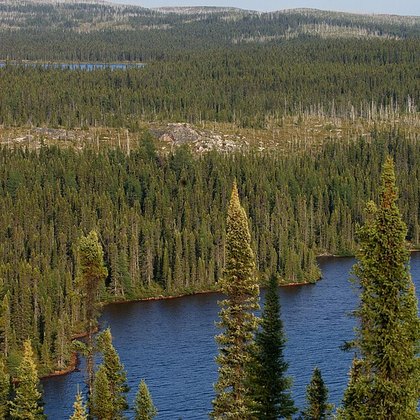
Damp conifer forest, above all old spruce and hemlock stands with abundant dead wood, fallen trunks, upturned root plates and a dense understorey of moss and ferns, usually close to streams. Mixed forest and streamside deciduous woodland are taken as well. On the Aleutians and other treeless islands of Alaska it lives among rocks, driftwood and coastal herb vegetation.
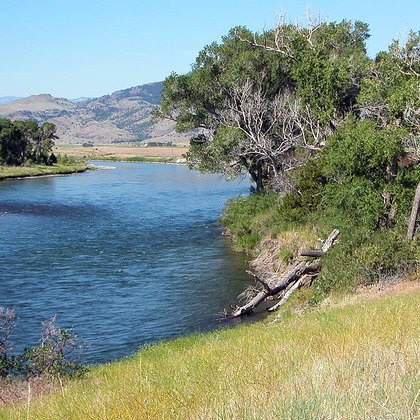
Where the bird is most often found, arranged by the USNVC — the vegetation classification of the United States and Canada — and CMECS for sea and coast.

Range and movements
It breeds along the Pacific coast from the Aleutians and southern Alaska to central California, and inland to the mountains of British Columbia, Idaho, western Montana, Wyoming and the Black Hills of South Dakota. Along the coast it is resident; inland and northern breeders move in winter to lower elevations and to the southwest, reaching Nevada, Utah and Arizona. The Aleutian populations stay on their islands all year.
- Resident
- Breeding (summer)
- Winter
- Passage
- dark = core range, pale = thinly spread
Where and when to look
Look for it in March and April along a stream in old conifer forest: it then sings from a low stump and stays in view for minutes at a time. Outside the song period the call is the handle — stand still by a root plate or a pile of dead wood and wait for the ball to reappear on the other side.
Conservation
The species is listed as Least Concern (LC) and is numerous throughout its range. It is, however, tightly bound to old forest rich in dead wood: clearcutting and short rotations lower densities considerably, and in developing urban areas breeding success is lower than in continuous forest. Retaining fallen trunks and the streamside forest belt is decisive there.
Scientific name
Troglodytes pacificus | Baird, 1864
Spencer Fullerton Baird described the form in 1864 as Troglodytes hiemalis var. pacificus, from material at Semiahmoo on Puget Sound in Washington; only in 2010 was it recognised as a separate species on genetic and acoustic evidence. Because the original description already stood in Troglodytes, author and year carry no parentheses. The genus name Troglodytes is Greek for 'cave-dweller', from trogle 'hole' and dyein 'to creep into', after its habit of disappearing into crevices and cavities. The species name pacificus means 'of the Pacific'.