All species › Birds of prey › Ospreys › Osprey
Osprey | Pandion haliaetus
Visarend | Águila pescadora
The Osprey is the only bird of prey on the continent that lives almost entirely on live fish, and it is so white below that over open water it suggests a large gull rather than an eagle. By the 1960s it had gone from much of the east, because DDT thinned its eggshells past bearing; today it breeds along virtually every coast, river and reservoir, and a large share of those nests stand on poles that people put up for it.
Voice
Come too near an occupied nest and you get a series of short, shrill whistles that quicken and sharpen as the bird circles lower overhead: cheep cheep cheep, with a squeaking note between the series. The female begs from the male with a drawn-out, plaintive tsyoooo-eep that carries across a whole bay and is often the first sign that there is a nest further along. When the male is carrying a fish, a slower, high series of whistles goes with it, delivered at the top of each rise in his undulating flight. Outside the breeding season the species is all but silent: a migrating or wintering Osprey is seen, not heard.
Recording: David Darrell-Lambert — CC BY-NC-SA 4.0 · Silah main island, Duba, Tabuk Province, Saudi Arabia · xeno-canto
Identification
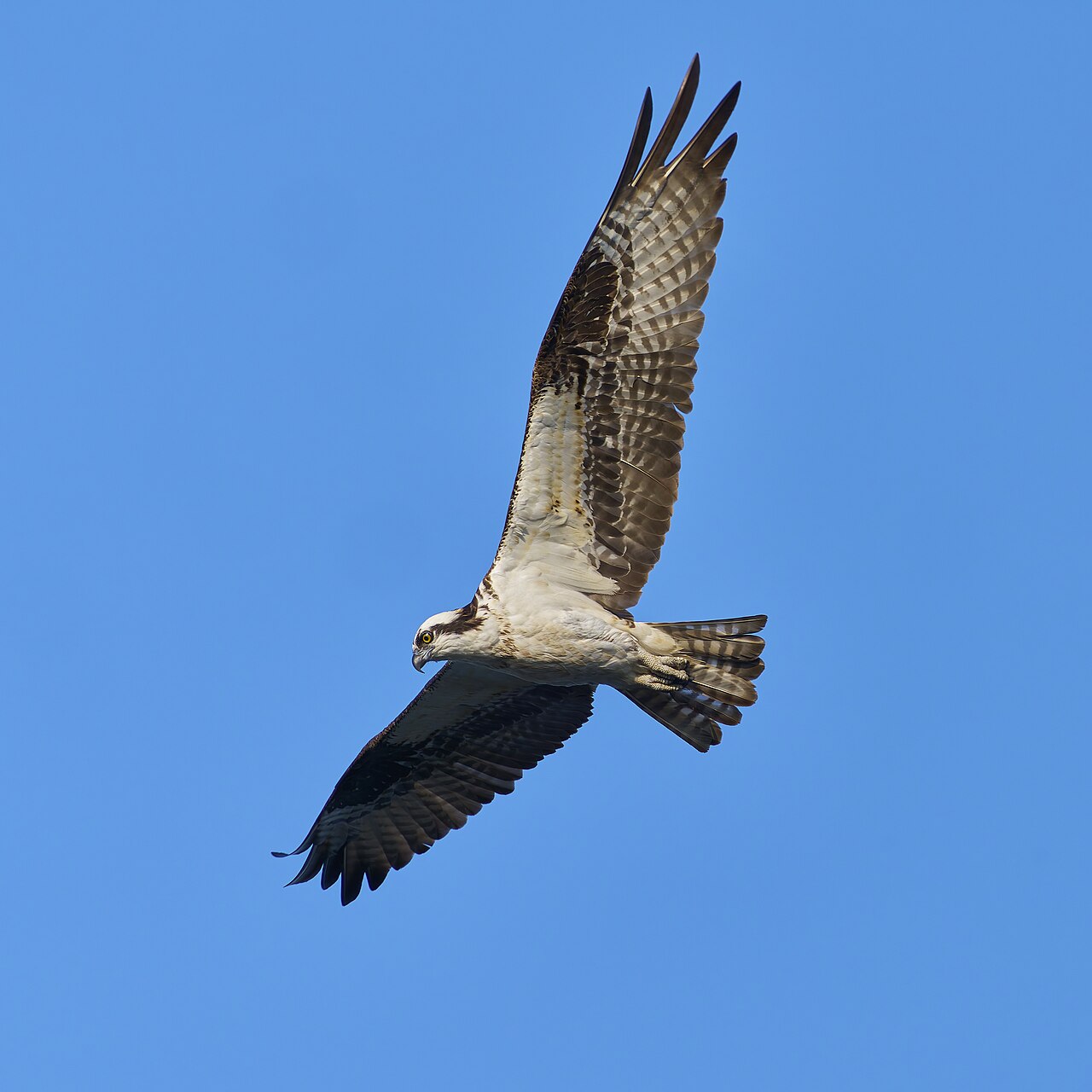
White below: white belly, white leading edge to the wing, and at the bend of the wing a sharply bounded blackish-brown patch that shows at any height. The upperparts are plain dark brown, the head white with a broad black stripe running from the bill through the eye to the nape, and the eye itself bright yellow. The female averages larger and usually carries a brown band across the breast; on the male it is faint or absent. Juveniles have pale feather edges, which give the upperparts a scaled look, and orange rather than yellow eyes; that plumage wears away during the first year. The wing is long, narrow and split into four or five fingers at the tip, the tail short and finely barred.
Confusion species
A young Bald Eagle (Haliaeetus leucocephalus) is the same size but much broader-winged, blotched dark below instead of white with a neat carpal patch, and has a heavy bill that makes the head look big. Large gulls at a distance are the commonest answer of all: they lack the carpal patch and the black eyestripe, and their wingbeat is faster and flatter. The Red-tailed Hawk is shorter and far broader in the wing, with a streaked belly band and a rusty tail, and it does not hover over open water. Over a reservoir the outline settles it: no other large raptor is this narrow-winged and this white underneath.
Habitat
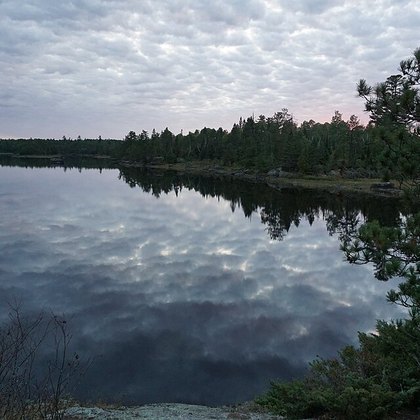
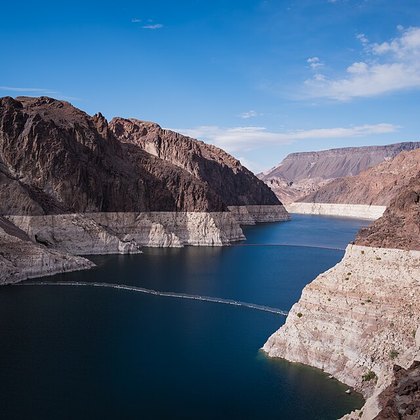
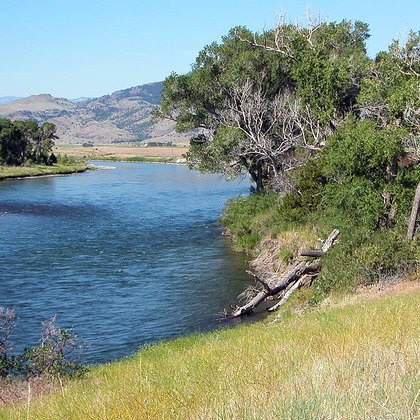
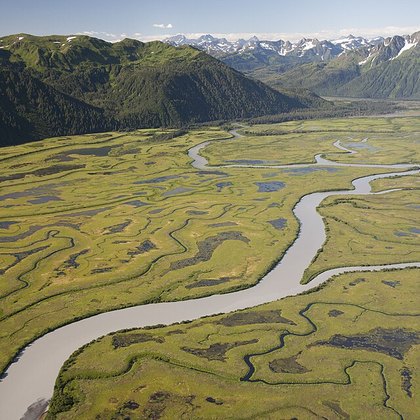
Shallow, clear water in which fish can be seen from above: lakes, reservoirs, slow rivers, estuaries and lagoons, and in winter the mangrove coasts of Mexico and the Caribbean. It needs two things at once — fishing water and a safe, free-standing nest site within ten kilometres or so of it — and that combination is scarce in a natural landscape. Deep, turbid or heavily overgrown water is of no use to it, however much fish it holds. Woodland it uses only for the dead, projecting top it builds in; a pole standing in the water does just as well.
Where the bird is most often found, arranged by the USNVC — the vegetation classification of the United States and Canada — and CMECS for sea and coast.

Range and movements
It breeds from Alaska and boreal Canada to the Gulf Coast, Baja California and the Yucatán peninsula, with settled populations in the Bahamas, Cuba and on the cays off Belize that stay put all year. Northern birds move south along coasts and ridges in September and October and winter in Mexico, Central America, the Antilles and far into South America, to Brazil and northern Argentina — that last region falls outside the guide area and so cannot be shown on the map. Satellite tracking reveals journeys of four to five thousand kilometres, year after year along the same route and with the same stopovers. Young birds spend their first summer in the wintering area and only return to breed in their second or third year.
- Resident
- Breeding (summer)
- Winter
- Passage
- dark = core range, pale = thinly spread
Where and when to look
Follow the poles. Along motorway bridges, harbours, marinas and reservoirs stand nest platforms where the same pair returns each March and stays visible into August; binoculars from the car park are enough. Early morning gives the flattest water and the most fishing; on a windy afternoon the bird sits still on a pole and little happens. On autumn migration in September a headland or a ridge is the best place: it travels by day, usually alone, and low enough for the black carpal patch to show.
Conservation
Least Concern (LC), and one of the clearest recovery stories on the continent. In the 1950s and 1960s eggs collapsed under the incubating birds because DDT reached them through their fish and thinned the shells; after the American ban of 1972 numbers grew again by about 1.9 per cent a year, measured from 1966 to 2019, and Partners in Flight puts the world population at some 1.2 million birds. Much of that recovery was built on erected poles and platforms. The most persistent threat now is discarded fishing tackle: monofilament line woven in with the nest material, in which the young become entangled.
Scientific name
Pandion haliaetus | (Linnaeus, 1758)
Linnaeus described the species in 1758 as Falco haliaetus, among the falcons and eagles; because it was later placed in a genus of its own, author and year stand in parentheses. The genus Pandion was introduced by Savigny in 1809 and is named after Pandion, a king of Athens in Greek tradition; the name has nothing to do with fish or with birds. haliaetus goes back to Greek haliaietos, 'sea eagle', from hals, 'sea', and aetos, 'eagle'. Linnaeus gave the whole of Europe as the type locality; in 1761 he narrowed it himself to Sweden.