All species › Waterfowl › Ducks, swans and geese › Mute Swan
Mute Swan | Cygnus olor
Knobbelzwaan | Cisne vulgar
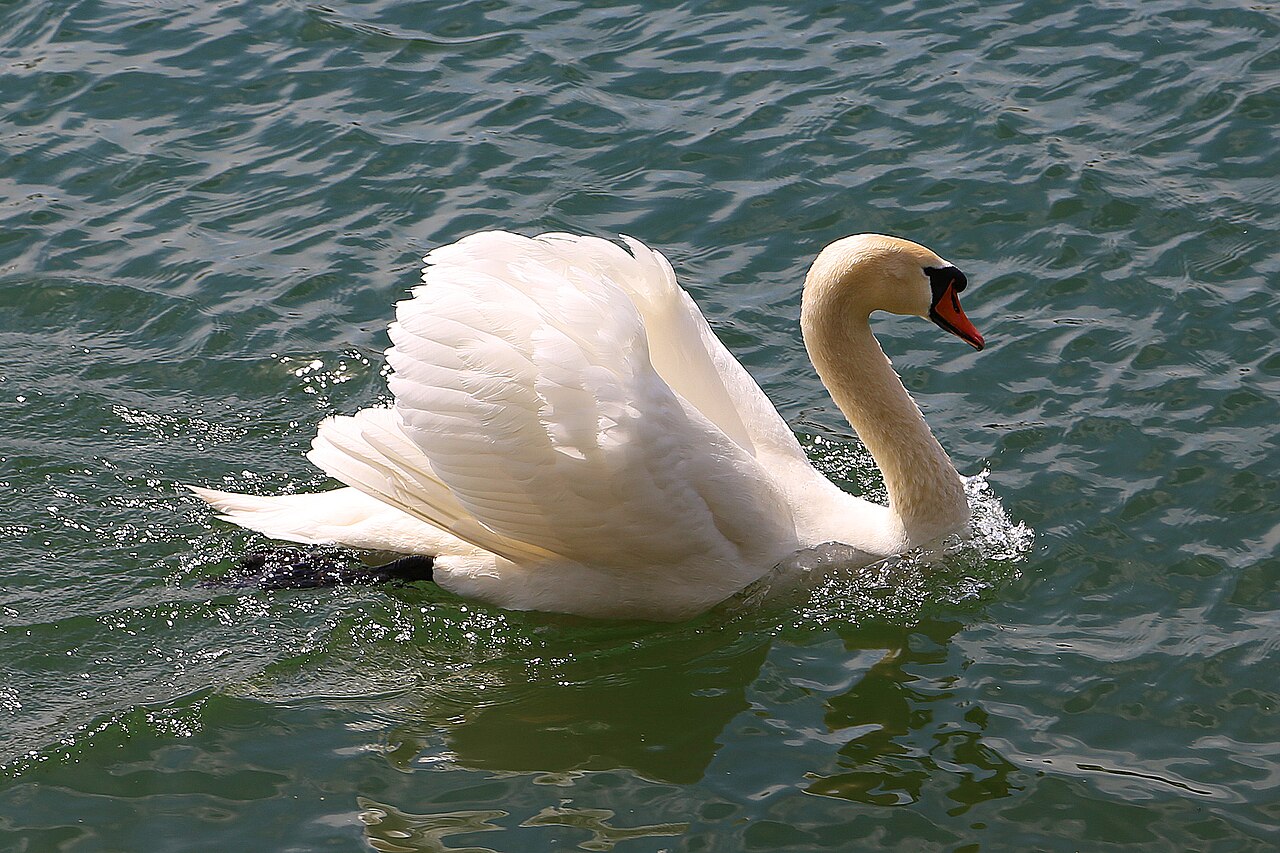
In North America the Mute Swan is not a native bird but an import: brought over from Europe in the late nineteenth century as an ornamental waterfowl for estates and city parks, the first escaped birds went feral and the species established itself along the entire Atlantic coast. The orange bill with the black knob at its base and the neck carried in a curve set it apart at once from the other swans in this guide: the two native species have a black bill, Whooper Swan a yellow-and-black one. In parts of its new range it now counts as invasive and is being actively controlled.
Voice
Despite its name the Mute Swan is not silent, but it is the quietest of the four swans in this guide: none of the far-carrying, bugling calls of the native species, only a low grunting, a hissing hshhh when threatened, and a short barking hoerd between partners. Far more noticeable than the voice is the sound of the wings: on every beat the shape of the primaries produces a rhythmic, singing hum, whoo-whoo-whoo, that gives away a passing flock hundreds of metres off before you see it. When disturbed it hisses with raised feathers and a drawn-back neck, a threat that recalls a hissing goose more than any other swan.
Recording: Stanislas Wroza — CC BY-NC-SA 4.0 · Arrondissement d'Istres (near Port-Saint-Louis-du-Rhône), Bouches-du-Rhone, Provence-Alpes-Côte d'Azur, France · xeno-canto
Identification
Adults are entirely white with an orange bill, a black knob at the base of the bill, and black skin between bill and eye. The knob is larger in the male than the female and swells further during the breeding season. It carries the neck in a characteristic S-curve, and when threatening or displaying it arches the wings high over the back while swimming, a posture shown by none of the other swans. The cygnet is greyish-brown with a grey-pink bill and no knob, and only reaches adult plumage in its second year; some populations also carry a white colour morph that is already white with a grey bill as a chick. The steeply rising forehead line with the knob is also useful in silhouette, against the straight head profiles of the other swans.
Confusion species
Trumpeter Swan and Tundra Swan both have an entirely black bill with no knob, and Whooper Swan carries yellow at the base of the bill; none of the three swims with the wings arched or holds the neck in a curve the way Mute Swan does. A young Mute Swan lacks the orange bill and can suggest a young Tundra Swan at a distance, but the flat, grey-pink bill without a yellow patch and the heavier, more angular head shape remain distinctive. Range is often a quicker clue than plumage: where Mute Swan occurs it is almost always the only swan on park ponds and urban water.
Habitat
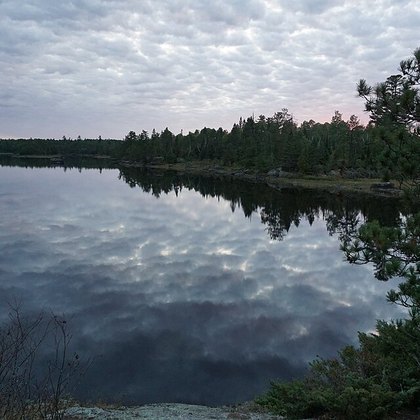
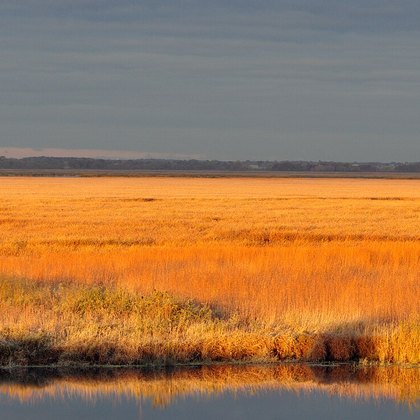
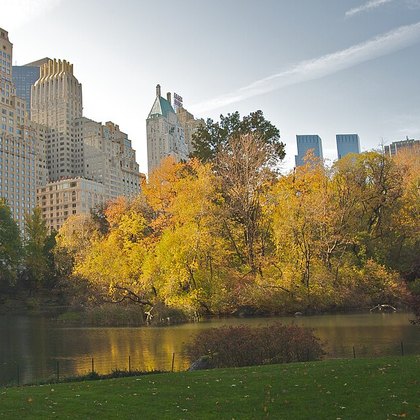
It seeks shallow, nutrient-rich fresh and slightly brackish water thick with aquatic plants: park ponds, lakes, slow rivers and sheltered bays, with its strongholds on Long Island, in the Hudson Valley and around the Great Lakes. It avoids fast-flowing water and the open sea almost entirely. As a plant eater it grazes submerged vegetation so heavily that it can strip the bottom bare in places, one of the reasons it is regarded as harmful. Urban greenery with open water, from a golf-course pond to a city park, it uses without hesitation.
Where the bird is most often found, arranged by the USNVC — the vegetation classification of the United States and Canada — and CMECS for sea and coast.


Range and movements
The first birds escaped in 1916 in New Jersey and in 1919 on Long Island, New York, from private collections; within a century the species had spread into a continuous range along the Atlantic Flyway, from southern Ontario to North Carolina, with the heaviest concentrations on Long Island and in the Hudson Valley. Independently of that, a second large population became established around the Great Lakes, above all in Michigan, where numbers climbed to well over ten thousand birds in the 2000s and the state has since intervened actively. True migration is almost unknown in the species in North America: birds stay in the same area all year and shift only locally when water freezes over.
- Resident
- Breeding (summer)
- Winter
- Passage
- dark = core range, pale = thinly spread
Where and when to look
Look for it on almost any pond or lake with public access in the Northeast or around the Great Lakes; where it occurs it is rarely missed. If a bird approaches with the neck drawn back and the wings raised high, keep your distance: that is a territorial threat display, especially near the nest in spring.
Conservation
Worldwide the species is listed as Least Concern (LC), but across much of its North American range the Mute Swan is classed as invasive and unprotected: states such as New York, Michigan and Maryland run management programmes that involve addling eggs or shooting birds, because the species displaces native waterfowl from nest sites and strips out aquatic vegetation. Despite that intervention, local populations, especially around the Great Lakes, still run into the thousands.
Scientific name
Cygnus olor | (Gmelin, 1789)
Gmelin described the species in 1789 as Anas olor, among the ducks; because it was later placed in another genus, author and year stand in parentheses. The genus Cygnus was introduced by Bechstein in 1803. The species name olor is itself classical Latin for 'swan', alongside the Greek-derived cygnus; the scientific name therefore says 'swan' twice over. The type locality lies in Russia, in Siberia and on the Persian shore of the Caspian Sea.