All species › Gannets and cormorants › Frigatebirds › Magnificent Frigatebird
Magnificent Frigatebird | Fregata magnificens
Amerikaanse fregatvogel | Fragata magnífica
The Magnificent Frigatebird hangs over a tropical coast on more than two metres of wing without a single beat, and is recognisable from kilometres away by its deeply forked tail and sharply angled wings. In display the male inflates a fiery red throat pouch into a balloon as big as his own head. It is the largest and by far the most numerous frigatebird of the Americas, and the only one that breeds in the United States.
Voice
Over the sea it is silent; even during a chase you hear nothing. At the colony it is otherwise: displaying males, pouch inflated, give a fast, hollow drumming, a rattling rrrrr-rrrrr amplified by the stretched skin, and clatter the bill along with it. Females give a short, hoarse croak. The young beg with a piercing, complaining screaming that carries over the mangrove for months on end.
Recording: Leonardo Ordóñez-Delgado — CC BY-NC-SA 4.0 · Isla de los Pájaros, El Morro, Guayas, Ecuador · xeno-canto
Identification
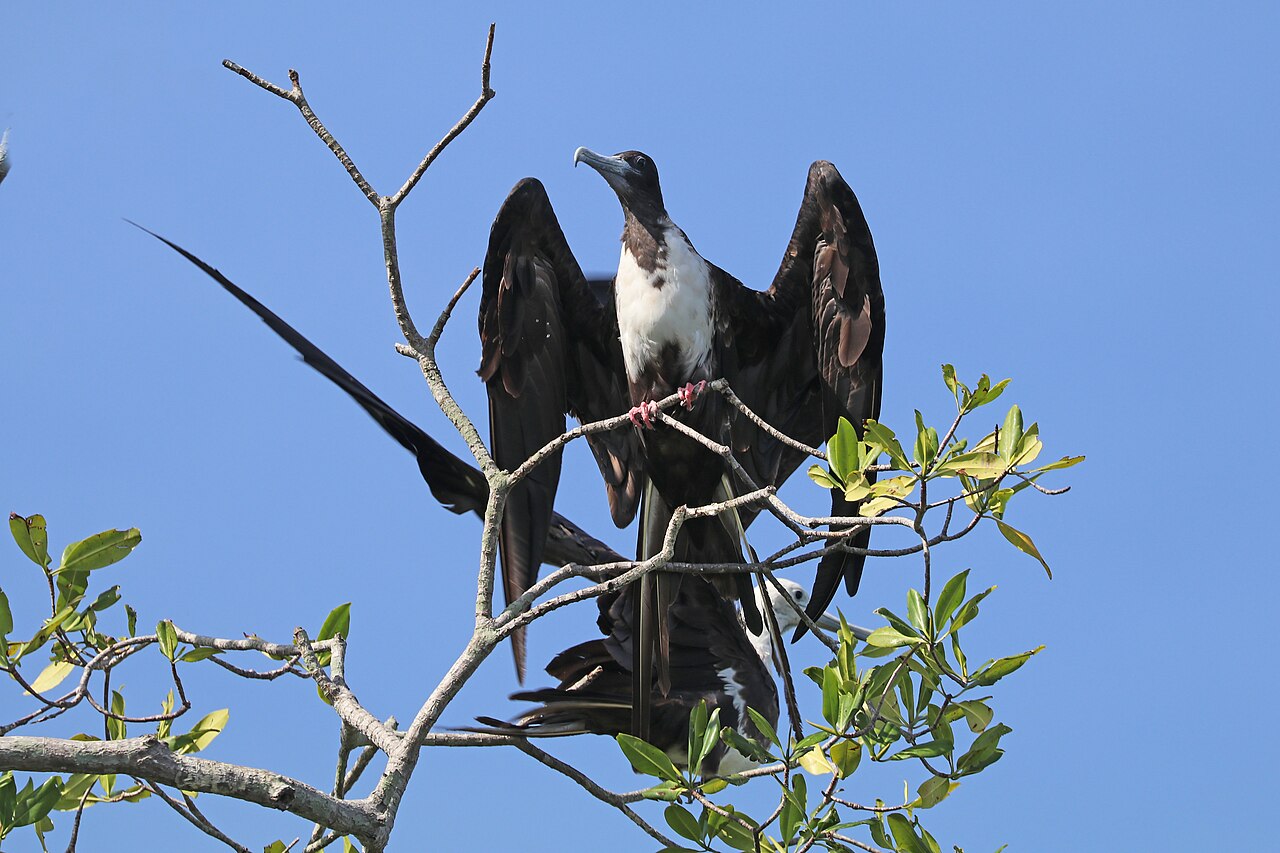
A large, wholly dark seabird with long narrow wings sharply angled back at the wrist, a long hooked bill and a deeply forked tail usually held closed while soaring, so that it looks like a single point. The male is black with a purple gloss and carries a red throat pouch that outside display hangs as a slack flap beneath the bill. The female is larger, with a white breast set sharply against the black head, and has a blue eye ring. Young birds have a wholly white head and breast and take four to six years to reach adult plumage. On that wingspan the body weighs barely a kilo and a half, and it shows in the soaring: the bird turns on the smallest bubble of warm air.
Confusion species
Within the area confusion with another frigatebird is rare but not impossible: Great Frigatebird (Fregata minor) and Lesser Frigatebird (F. ariel) turn up in the Caribbean and off California in the rarest of cases. In the female the difference lies in the throat and the eye: in Magnificent the throat is black and the eye ring blue, in Great the throat is grey and the eye ring red. Adult male Great Frigatebirds show a pale band across the upperwing, which Magnificent lacks. At a distance a soaring frigatebird is taken for a Turkey Vulture, but that has broad wings with upturned tips and an unforked tail.
Habitat
Warm coastal water and the air above it: it soars over reefs, lagoons, river mouths and the edge of the surf, where tuna and dolphins drive flying fish to the surface. It can stay at sea for days on end and sleep there on the wing, but it avoids cold water and rarely crosses the open ocean outright. To breed and to roost it needs low bushes or mangrove on an uninhabited islet, where it can step off a branch straight into the wind. Fishing harbours and places where fish waste is dumped are visited readily.
Where the bird is most often found, arranged by the USNVC — the vegetation classification of the United States and Canada — and CMECS for sea and coast.





Range and movements
Breeds on islands off both coasts of Middle America: from Baja California and the Gulf of California south along the Pacific, and from the Gulf of Mexico through the whole Caribbean to north-eastern Brazil; in the United States only on a few islets at the Marquesas Keys and the Dry Tortugas in Florida. On the far side of the Atlantic there is still an all but extinct colony in the Cape Verde Islands. Young and non-breeding birds wander north in summer along the Gulf and Atlantic coasts as far as the Carolinas, and on the Pacific into southern California. For much of the year they hang over the open sea, outside every map unit; that part of their year is therefore not on the map.
- Resident
- Breeding (summer)
- Winter
- Passage
- dark = core range, pale = thinly spread
Where and when to look
From a pier or a ferry in the Caribbean, look up rather than at the water: frigatebirds often hang so high that they show only as a small black anchor against the sky. At a colony, February to April is the time to see displaying males sitting in the bushes with the pouch inflated; from a boat they can be watched at tens of metres without disturbance. With every bird, look at the underside first: all black is a male, white on the breast a female, white up into the head a young bird.
Conservation
The world population is put at more than a hundred thousand breeding birds and counts as stable; the species stands as not threatened (LC). It is nonetheless vulnerable, because it breeds in few places and a pair raises at most one chick every other year: if a colony goes, it takes a long time to make good. In the Caribbean colonies have been lost to hotel and harbour building, to rats and cats on the breeding islets, and to hurricanes. The colony in the Cape Verde Islands, the only one on the eastern side of the Atlantic, has fallen to a handful of pairs.
Scientific name
Fregata magnificens | Mathews, 1914
Mathews described the form in 1914 as Fregata minor magnificens, that is, as a subspecies of the Great Frigatebird; it was later raised to a species of its own, but because the genus did not change with it, author and year stand without parentheses. The genus Fregata was introduced by Lacépède in 1799, after French frégate, the fast sailing ship after which sailors already named these birds. magnificens is Latin for 'splendid'. The described specimen came from Barrington, now Santa Fe, in the Galápagos Islands.