All species › Passerines › New World sparrows › LeConte's Sparrow
LeConte's Sparrow | Ammospiza leconteii
Lecontes gors | Gorrión de Le Conte
LeConte's Sparrow is a small, orange-buff sparrow of wet sedge meadows and peatland in interior Canada and the northern prairie states. It moves almost entirely through the lowest layer of the vegetation and rarely comes into the open; most records begin with a singing male that has to be located by ear.
Voice
The song is a short, insect-like sequence of at most two seconds: a thin introductory squeak, then a dry buzz and a short closing note, often written tika-zzzzzzz-tik. Volume is low and pitch high, so the song fades out against grasshoppers and wind at any distance. Singing happens mainly at dusk and at night, usually from cover and sometimes from a sedge stem. The call is a short tsip.
Recording: Peter Ward and Ken Hall — CC BY-NC-SA 4.0 · Fraser-Fort George H (near Tête Jaune Cache), Fraser-Fort George, British Columbia, Canada · xeno-canto
Identification
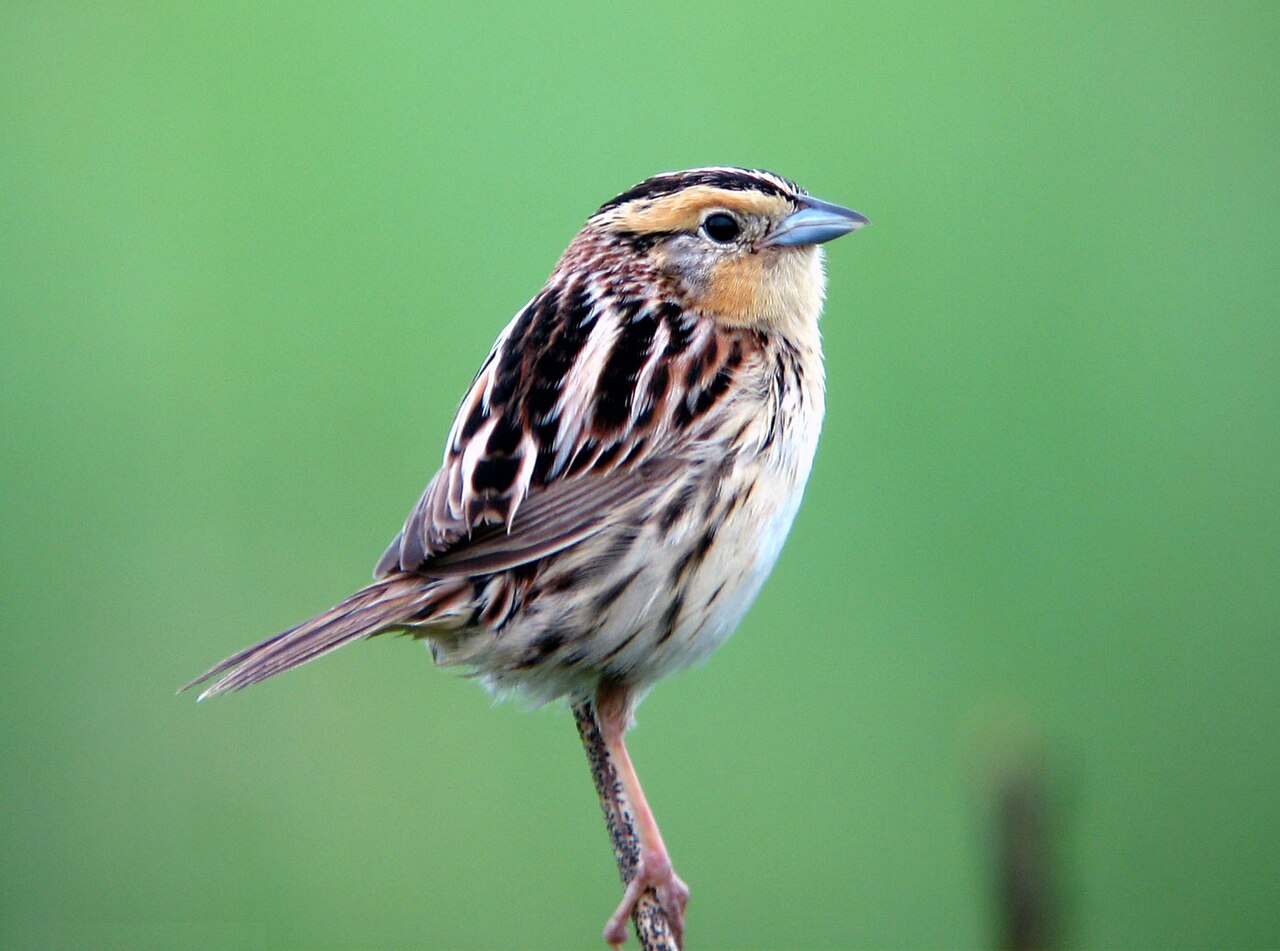
The head carries the identification: an orange-buff face with a grey ear patch, a dark crown with a narrow white central stripe, and a lilac to pearl-grey nape finely streaked with chestnut. Breast and flanks are orange-buff with short dark streaks, the belly off-white. The back is brown with pale beige mantle stripes. The tail is short and pointed, the bill small and grey. The sexes look alike.
Confusion species
Grasshopper Sparrow has a paler, less orange face without a grey nape and lacks the fine chestnut nape streaks. Nelson's Sparrow is greyer above, has a more evenly orange face triangle and lives in brackish or salt marsh rather than sedge meadow. Baird's Sparrow has a buff-yellow head but a heavier, short bill and a necklace of fine streaks on an otherwise white breast. In LeConte's Sparrow the grey chestnut-streaked nape and the buff breast band always occur together.
Habitat
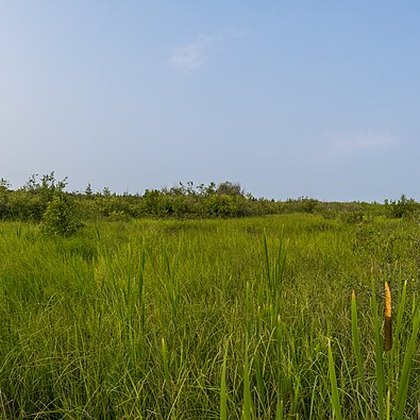
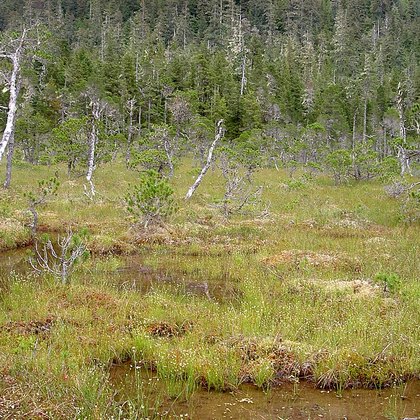
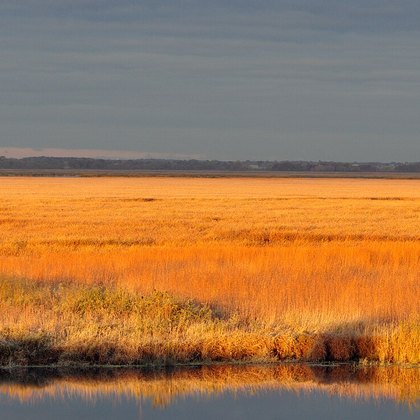
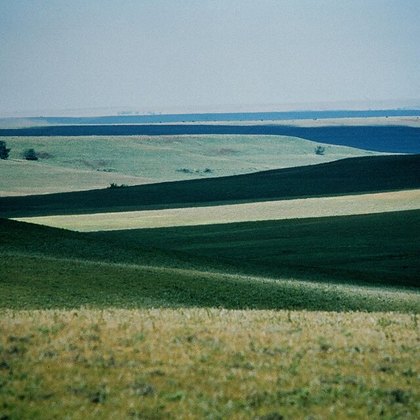
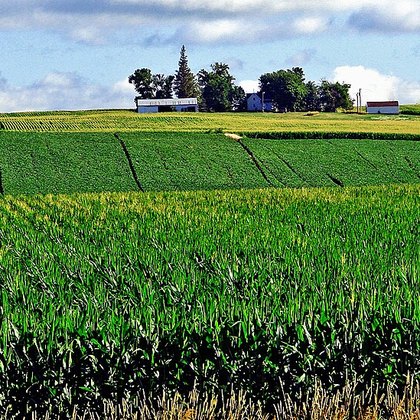
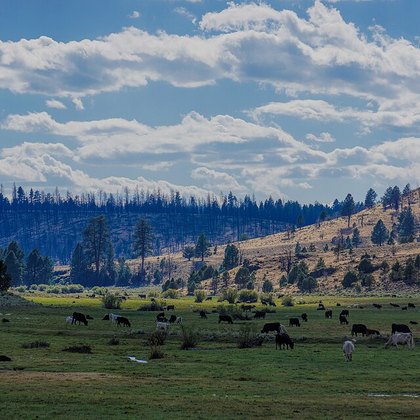
Wet sedge meadows, peatland and muskeg (boggy spruce peatland typical of boreal Canada) with dense grasses and sedges and little woody growth. It breeds where the water table is high but the ground is not standing in water, along the edges of bog pools and lake shores. Management decides much: without fire, mowing or periodic flooding the ground closes over with shrubs within a few years and the species goes. In winter it uses rank damp grassland, mown rice fields, stubble and the dry margin of coastal marsh.
Where the bird is most often found, arranged by the USNVC — the vegetation classification of the United States and Canada — and CMECS for sea and coast.
Range and movements
The breeding range runs from northeastern British Columbia and Alberta east through Saskatchewan and Manitoba to central Ontario and western Quebec, and south to Montana, North Dakota, Minnesota and northern Michigan. Migration goes through the Great Plains and the Mississippi valley. It winters in the southern United States, from central Texas and Oklahoma east to Georgia, the Carolinas and northern Florida, with the concentration in the coastal plain of Louisiana, Mississippi and Alabama.
- Breeding (summer)
- Winter
- Passage
- dark = core range, pale = thinly spread
Where and when to look
Walk a wet sedge field early in the morning or late in the evening in May or June and listen for the buzz; sightings usually come when a male climbs a stem for a few seconds. In winter, walking a damp grass field through works better than waiting: the bird flushes briefly and low and drops back into the grass after a few metres.
Conservation
The Red List keeps the species at Least Concern (LC), but the Breeding Bird Survey indicates a decline of about 1.7 per cent per year and a cumulative loss of around 64 per cent between 1966 and 2023. Partners in Flight puts the breeding population at about 5.1 million birds and places the species on its tipping-point list. Drainage of peat and sedge land, conversion to arable farming and succession on unmanaged ground are the main causes.
Scientific name
Ammospiza leconteii | (Audubon, 1844)
Audubon described the species in 1844 as Emberiza le conteii, from specimens taken on the prairies of the upper Missouri River; because it was later moved to another genus, author and year stand in parentheses. The species name honours the American naturalist John Lawrence LeConte. The genus Ammospiza comes from Greek ammos 'sand' and spiza 'finch', so 'sand finch', after the sandy and marshy ground the species of this genus live on.