All species › Tubenoses › Albatrosses › Laysan Albatross
Laysan Albatross | Phoebastria immutabilis
Laysanalbatros | Albatros de Laysan
Laysan Albatross is the most numerous albatross of the Pacific Ocean and the species most likely to be seen from the west coast of North America. It breeds almost entirely on the western Hawaiian Islands, far from the American west coast, and ranges thousands of kilometres over the open ocean the rest of the year.
Voice
At the breeding colony the species is noisy, with a mix of whining, squeaking and moaning calls during courtship, interspersed with sharp bill-clapping when pairs and rivals greet one another. At sea, away from the colony, it is essentially silent.
Recording: Percy Ulsamer — CC BY-NC-SA 4.0 · Sand Island Midway Atoll, United States · xeno-canto
Identification
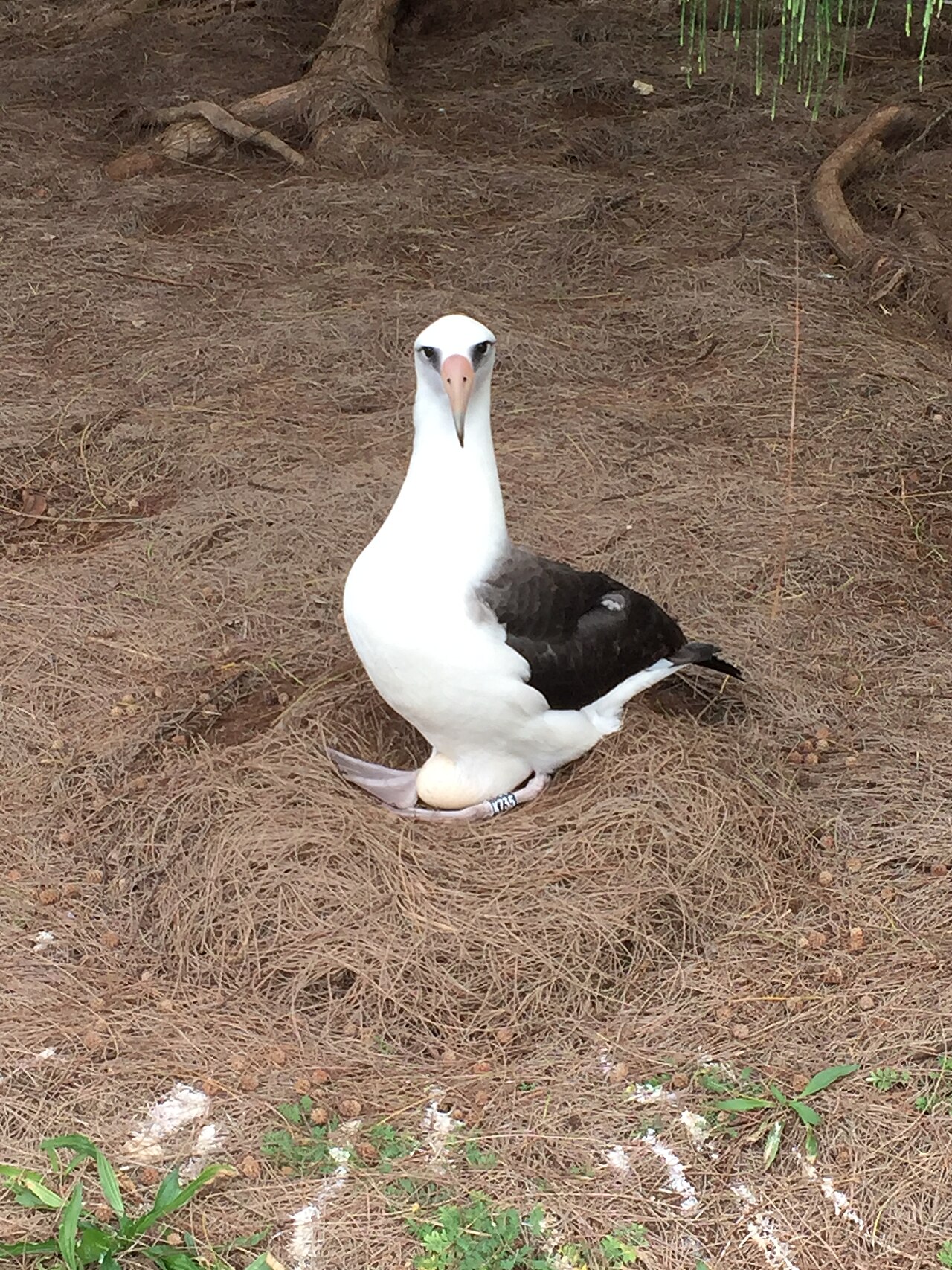
Adults are white with dark grey-brown upperwings, a pale underwing with a narrow dark trailing edge, and a dark patch around the eye. The back is brown, the rump white and the tail dark. Chicks are downy grey-brown; fledged young already resemble the adult but have a darker bill. In flight the long, narrow, stiff wing stands out, allowing the bird to glide for hours without a wingbeat.
Confusion species
Black-footed Albatross, the species most often seen alongside it off the American west coast, is almost entirely dark brown and lacks the white body. Short-tailed Albatross is larger and heavier with a thick, pink bill; young Short-tailed Albatrosses are indeed entirely dark like young Black-footed Albatrosses, but have a far heavier bill than Laysan Albatross.
Habitat
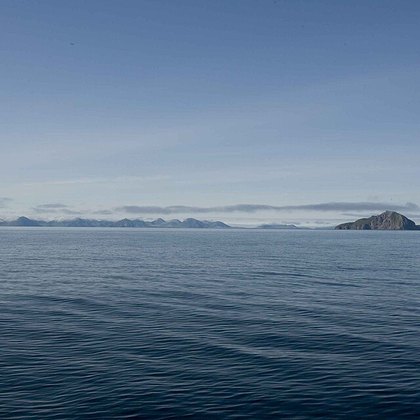
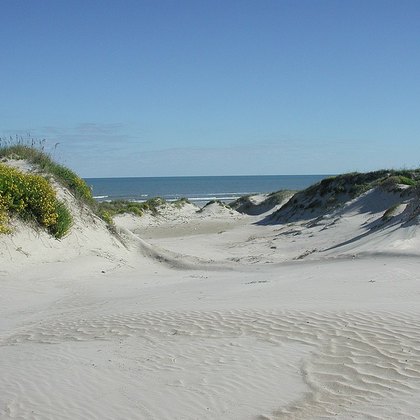
It breeds on open, vegetated or sandy flats of low-lying islands, with Midway Atoll and Laysan Island together holding most of the world population; a small, growing colony also exists on Mexico's Revillagigedo Islands. Outside the breeding season it lives entirely on open, cold-to-temperate ocean water, where it snatches squid from the surface. It does not use land away from the breeding colonies.
Where the bird is most often found, arranged by the USNVC — the vegetation classification of the United States and Canada — and CMECS for sea and coast.
Range and movements
The main population breeds on the western Hawaiian Islands, with a small colony on the Revillagigedo Islands off Mexico's west coast. From the colonies the birds fan out across almost the entire North Pacific, north to the Bering Sea and the Aleutians and east to the American west coast, where it is seen mainly in winter and early spring. After being nearly wiped out by feather hunters around 1900, the world population has recovered strongly, though it remains below pre-hunting levels.
- Resident
- Breeding (summer)
- Winter
- Passage
- dark = core range, pale = thinly spread
Where and when to look
Join a pelagic boat trip from California in winter or early spring, for instance from Monterey Bay or San Diego; Laysan Albatross is the albatross you are most likely to encounter there, often alongside the more numerous Black-footed Albatross.
Conservation
The species is listed as Near Threatened (NT); the world population numbers over a million birds and is growing, a recovery from barely eighteen thousand pairs in the 1920s after feather hunting ceased. Rising sea levels are the greatest long-term threat to the low-lying breeding islands, while bycatch in longline fisheries and plastic ingestion add further risk.
Scientific name
Phoebastria immutabilis | (Rothschild, 1893)
British zoologist Walter Rothschild described the species in 1893 as Diomedea immutabilis; it has since been placed in the genus Phoebastria, hence the parentheses around author and year. The species name immutabilis is Latin for 'unchangeable', referring to the unvarying plumage of the adult bird. The type locality is Laysan Island, one of the western Hawaiian Islands where the species breeds in the greatest numbers.