All species › Tubenoses › Petrels, shearwaters and diving petrels › Juan Fernandez Petrel
Juan Fernandez Petrel | Pterodroma externa
Juan-Fernandezstormvogel | Fardela de Juan Fernández
Juan Fernandez Petrel is a large, powerfully built petrel that spends nearly its entire life over the open Pacific and now breeds in only one place on Earth: the mountain ridges of Alejandro Selkirk Island, the most remote island of the Juan Fernández archipelago off the coast of Chile. Outside the breeding season it ranges far north, into the waters around Hawaii, where it is most often seen within this the guide area.
Voice
At the breeding colony, high on the island's bare ridges, a sighing whistle sounds, sometimes followed by a hoarse bark or a short wowk, along with a booming, repeated boo-boo-boo. As with most relatives, that sound is tied to the colony; in the waters around Hawaii, where the species does not breed, it is seen only silently.
Recording: David Boyle — CC BY-NC-SA 4.0 · Rangatira (below the summit), Chatham Islands, New Zealand, New Zealand · xeno-canto
Identification
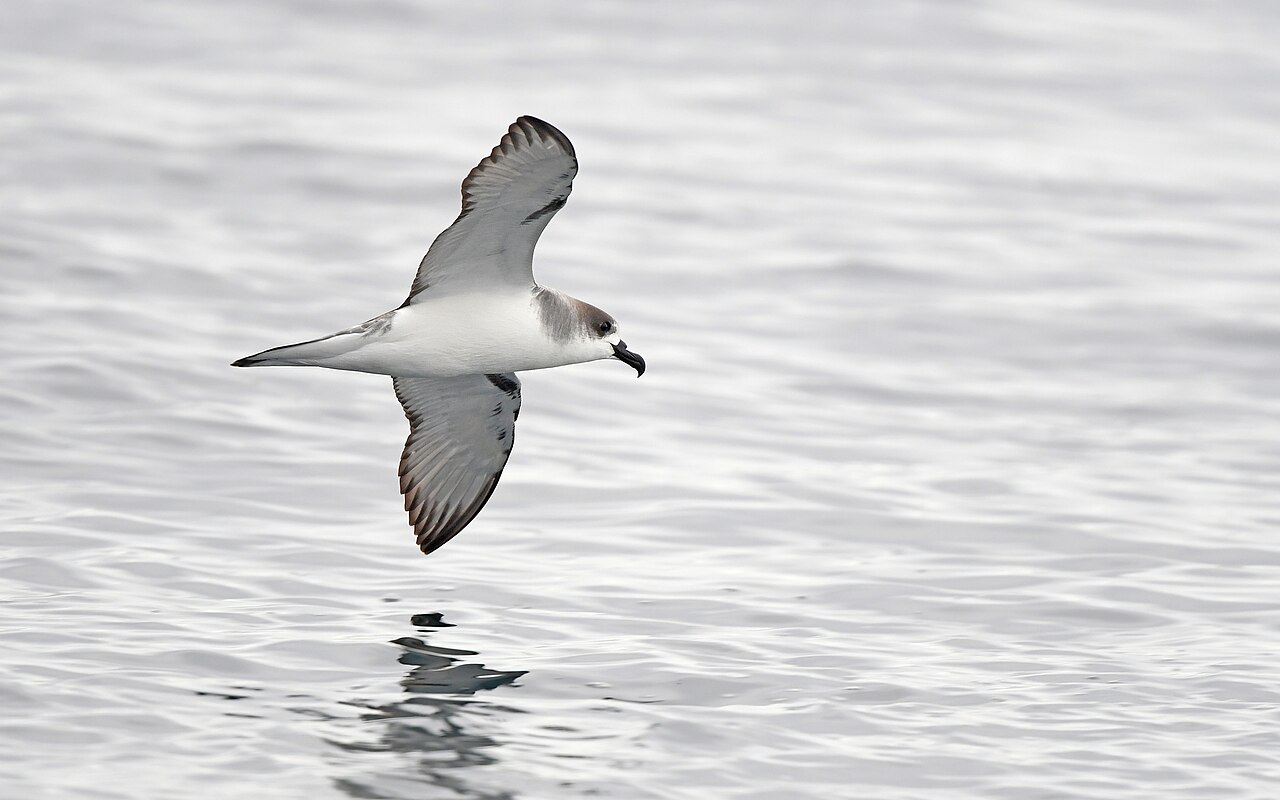
Above, Juan Fernandez Petrel is dark brownish-grey, with a black 'M' pattern across the outstretched wings. The underparts are white, with a black trailing edge to the underwing and a small, variably developed black patch at the wing bend that does not reach the centre of the wing. The face is white with a black cap extending below the eye, without a pale collar; the bill is black and strongly hooked, the legs yellow with dark brown tips. Male, female and juvenile are coloured alike, and at over forty centimetres it is one of the larger petrels of its genus.
Confusion species
It is most often confused with White-necked Petrel (Pterodroma cervicalis), seen in the same waters and closely similar: that species has a clear white band across the hindneck separating the black cap from the back, a feature Juan Fernandez Petrel entirely lacks. Committees that assess rare sightings note that, especially in worn plumage, the two species can only be told apart with certainty from good photographs. From the much more uniform Murphy's Petrel (P. ultima), which is entirely grey-brown without any white on the underparts, Juan Fernandez Petrel is instantly told apart by its white belly under any conditions.
Habitat
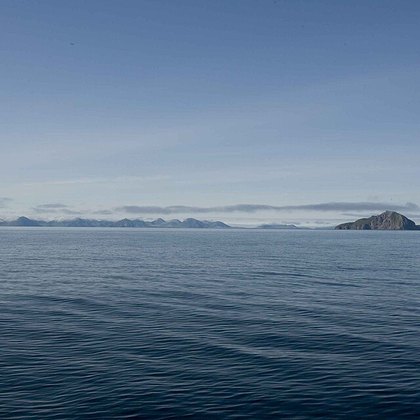
For breeding, Juan Fernandez Petrel seeks bare, windswept ridges above seven hundred and fifty metres, where it digs a tunnel two to three metres long. The rest of the year it lives entirely at sea, foraging in the convergence zones between equatorial currents and countercurrents, far from any coast. It never uses land within this the guide area; it also does not occur along the American coast itself.
Where the bird is most often found, arranged by the USNVC — the vegetation classification of the United States and Canada — and CMECS for sea and coast.
Range and movements
The species breeds exclusively on Alejandro Selkirk, the outermost island of the Juan Fernández group off Chile. After the breeding season, which ends in May when the young fledge, the birds move north into the tropical and subtropical Pacific as far as the waters around Hawaii, where they are fairly common from April to October, especially southeast of the islands and in greatest numbers some three hundred kilometres from Hawaii Island. In the northwestern Hawaiian Islands, beyond the inhabited islands, it is by contrast rare. One bird, carried by the remnants of a hurricane, even ended up far inland, as far as Arizona.
Where and when to look
The best chance within this area is a pelagic boat trip off the west coast of Hawaii Island between April and October; watch for the combination of the powerful build, the white underparts without a collar, and the black cap extending below the eye.
Conservation
The species is listed as Vulnerable (VU) because its entire world population breeds on a single island. Feral cats and rats kill eggs, chicks and incubating adults, and introduced goats have degraded parts of the breeding habitat through overgrazing. The colony is estimated at around a million breeding pairs, but the lack of a second breeding site leaves the species vulnerable to a single disaster or a new introduction of predators.
Scientific name
Pterodroma externa | (Salvin, 1875)
British ornithologist Osbert Salvin described the species in 1875 as Oestrelata externa; because it has since been placed in another genus, author and year stand in parentheses. The genus Pterodroma was introduced in 1856 by Bonaparte, from the Greek for 'wing' and 'runner'. externa is Latin for 'outer, foreign' and refers to Alejandro Selkirk, long known in Spanish as Más Afuera — literally 'further out' — as the most remote island of the Juan Fernández group. The type locality accordingly covers both islands of that group, Más Afuera and Juan Fernández itself.