All species › Waders, gulls and terns › Sandpipers and allies › Hudsonian Godwit
Hudsonian Godwit | Limosa haemastica
Rode Grutto | Aguja Café
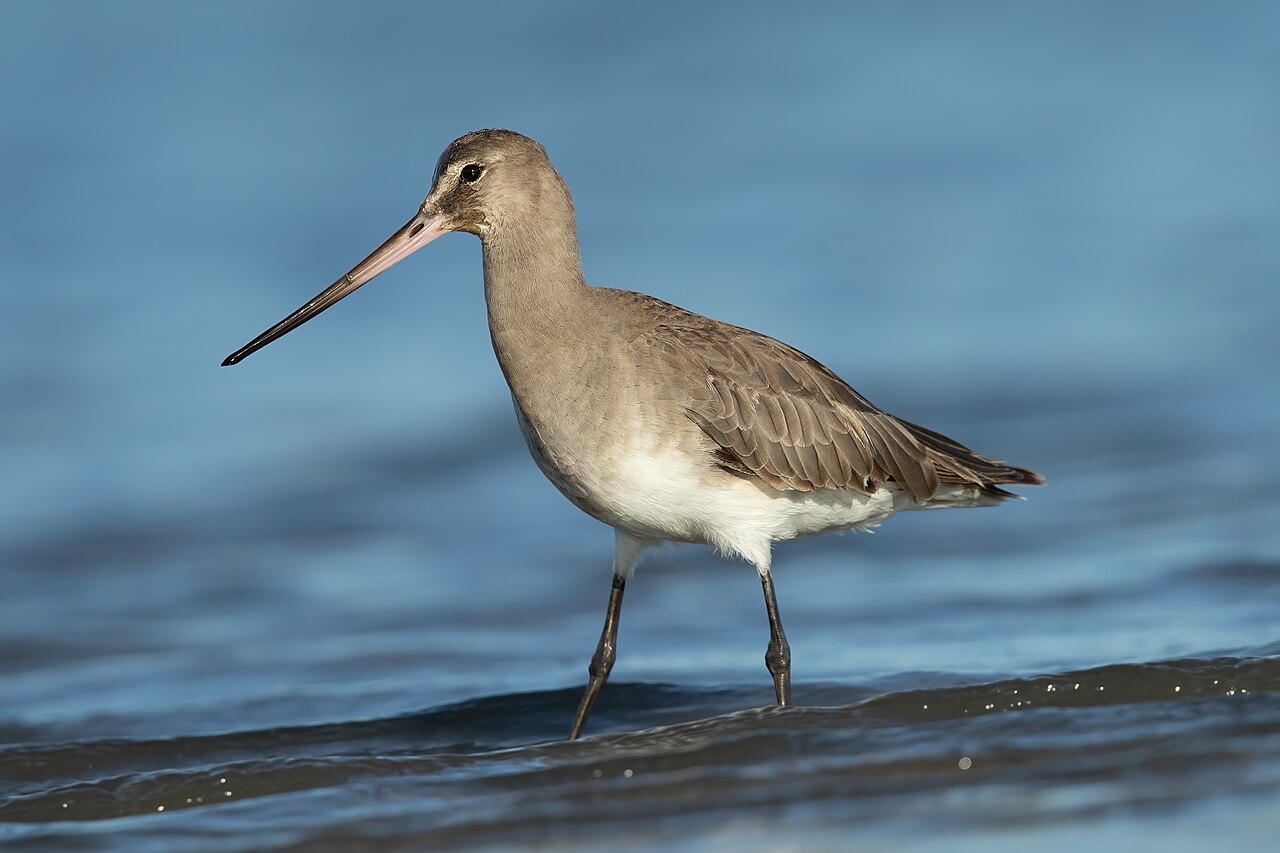
A godwit of the far north that in North America is nearly only seen on passage: brick red below in spring, grey-brown in autumn. It breeds in a few widely separated areas at the treeline and in autumn flies from James Bay in one go across the ocean to southern South America. In flight the underwing is black and the white rump carries a broad black tail band.
Voice
Away from the breeding grounds it is a silent bird; what is heard is a soft, high toe-wit from a rising flock, two syllables with the stress at the end. Over the breeding ground the male climbs on shivering wings and repeats that same motif dozens of times over, faster and louder as he gains height. At the nest and with chicks there is a sharp, hard keh-keh-keh, kept up as long as a jaeger or a fox is about. A feeding flock on migration is all but silent, and the call comes only at the moment the birds lift.
Recording: Avery Bartels — CC BY-NC-SA 4.0 · Old Crow, Yukon, Canada · xeno-canto
Identification
In breeding plumage the male is deep red-brown below with fine dark barring and blackish brown above with golden feather edges; the female is larger, duller and far less red. The bill is long, straight to slightly upturned, with a pink to orange base and a dark tip. In flight the pattern decides it: a narrow white wingbar, a white rump, a broad black tail band and a black underwing. In winter plumage the bird is plain grey-brown above and paler grey-brown below, with a pale supercilium and little other marking. Juveniles resemble the winter bird but have pale feather edges that make the upperparts look scaly. The legs are dark and project well beyond the tail in flight.
Confusion species
Marbled Godwit (Limosa fedoa) is clearly larger, cinnamon in every plumage, and has a cinnamon underwing with no white rump or black tail band. Bar-tailed Godwit (L. lapponica) has a white wedge running up the back and a finely barred tail instead of a solid black band. Black-tailed Godwit (L. limosa), a vagrant in North America, has a broad white wingbar and white underwings — the exact opposite of the black armpit of Hudsonian Godwit. A flock in winter plumage passes at a distance for Greater Yellowlegs, which have yellow legs, a pale streaked rump without a black tail band, and a three-note call.
Compare sandpipers, snipes and allies: bill, legs, wing bar and rump
Habitat
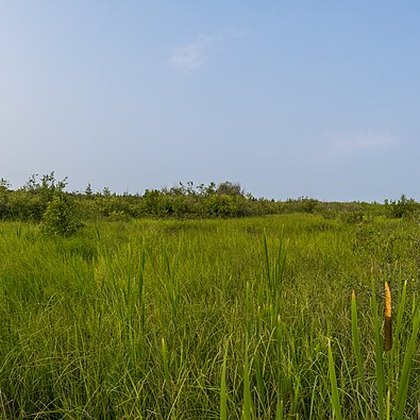
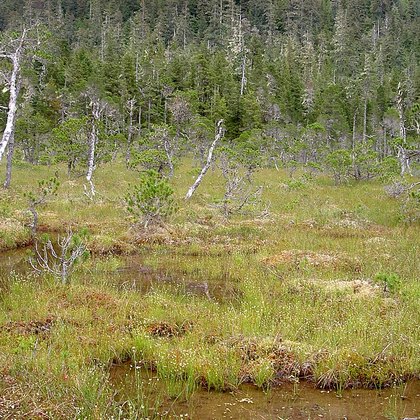
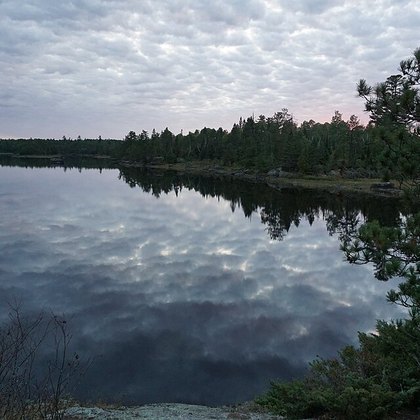
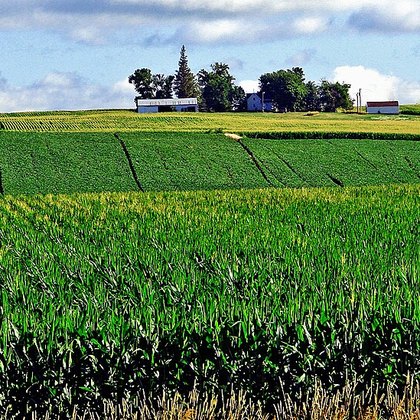
It breeds on the wet transition from boreal forest to tundra: sphagnum hummock and sedge marsh with open water, usually within a few kilometres of the treeline. On spring passage through the interior it uses shallow prairie pools, soggy meadows and flooded fields, standing belly-deep in the water to probe. In autumn nearly the whole population sits on the wide mudflats of James Bay and the south coast of Hudson Bay. Deep water and closed forest it avoids; what it looks for is a soft bottom with a thin sheet of water over it.
Where the bird is most often found, arranged by the USNVC — the vegetation classification of the United States and Canada — and CMECS for sea and coast.

Range and movements
There are a few separate breeding areas: southwestern and south-central Alaska, the Mackenzie Delta in the Northwest Territories, and the southwestern side of Hudson Bay in Manitoba. Spring migration runs almost entirely overland, by way of the Texas coast and the Great Plains, in a narrow and short wave in May. In autumn the species gathers at James Bay and flies from there in a single flight across the Atlantic to the south, so that on the east coast of the United States it is seen only in small numbers. It winters on the tidal flats of Chiloé in Chile, of Tierra del Fuego and of Bahía Samborombón in Argentina; that area falls outside this map. Around 1900 the species was held to have all but gone after hunting, until in the middle of the twentieth century thousands were found still gathering at James Bay.
- Resident
- Breeding (summer)
- Winter
- Passage
- dark = core range, pale = thinly spread
Where and when to look
Early May on the coastal prairie of Texas and northward through Kansas, Nebraska and the Dakotas, at a flooded pasture or a prairie pool: the males are then brick red and recognisable from far off. Put the flock up and look at the armpit — jet black under the wing, white rump, broad black tail band, and nothing else is left. In August and September James Bay is the place, and there they stand in their thousands.
Conservation
The Red List holds the species as Vulnerable (VU), and in the 2025 North American state of the birds it stands in the heaviest category: more than half the birds have gone in fifty years. The breeding population is put at about 77,000 birds. The weakness lies in the concentration: nearly all the birds use the same mudflats in autumn and a handful of bays in winter. To that come hunting in South America, the draining of wetlands along the migration route, oil and gas work near the breeding grounds, and the shifting of the treeline.
Scientific name
Limosa haemastica | (Linnaeus, 1758)
Linnaeus described the species in 1758 as Scolopax Haemastica, among the snipes; since it was placed in the genus Limosa, author and year stand in parentheses. Limosa comes from the Latin limosus, 'muddy', and was introduced by Brisson in 1760. haemastica goes back to the Greek haimastikos, 'blood red', after the colour of the underside in breeding plumage. The described specimen came from North America; the type locality was later fixed on Hudson Bay, after the plate in Edwards that Linnaeus used.