All species › Waders, gulls and terns › Skimmers, noddies, terns and gulls › Heermann's Gull
Heermann's Gull | Larus heermanni
Heermanns meeuw | Gaviota mexicana
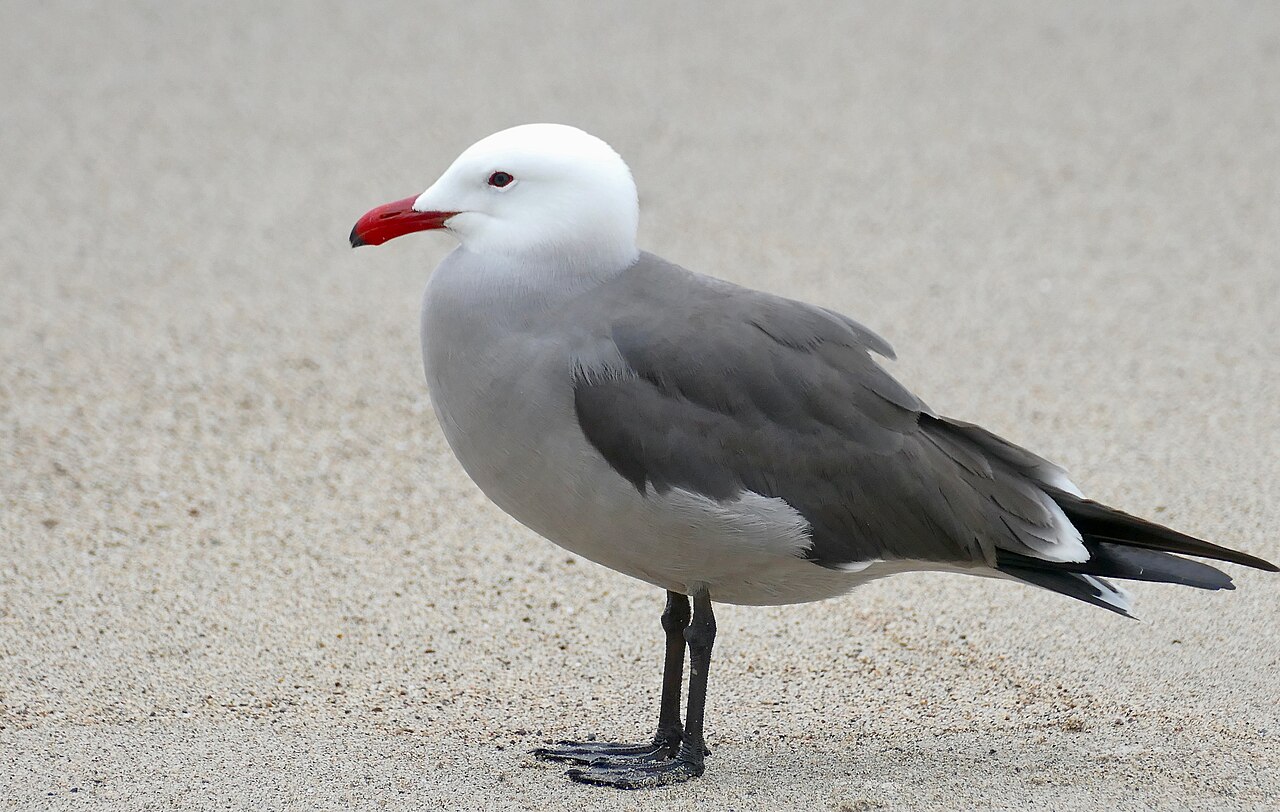
Heermann's Gull is the only gull in North America with a grey body: dark grey above and below, with a snow-white head and a deep red bill tipped black. Nearly the whole world population breeds on one small island in the Gulf of California. After breeding it moves not south but north, up the Pacific coast as far as British Columbia.
Voice
The voice is deeper and more nasal than that of other gulls and is recognisable at once as different. Commonest is a low ow or ow-ak, given in all kinds of circumstances, and a high, reedy cry when birds squabble over food at sea. Displaying males give a rapid series of ah notes that sounds like laughter; females answer with squeaky notes resembling the begging of young. On a Californian pier in August the low ow cutting through the ordinary gull voices is the first sign that it is there.
Recording: Isain Contreras Rodríguez — CC BY-NC-SA 4.0 · Topolobampo, Ahome, Sinaloa, Mexico · xeno-canto
Identification
A medium-large gull, long-winged in proportion and slim-headed. The adult is dark slate grey on back, wings, breast and belly, with a white head, black legs and a deep red bill with a sharp black tip; the tail is black with a narrow white terminal edge, and the trailing edge of the wing is white. Outside the breeding season the white head becomes streaked grey-brown. Juveniles are dark sooty brown all over, with a two-toned flesh-coloured bill and a dark tip, and over three years grow gradually smoother brown and then grey. Because the grey of the body and the grey of the wing are so nearly equal, it looks uniform in flight — unlike any other gull on this coast.
Confusion species
In adult plumage confusion is hardly possible: no other gull in North America has a grey body with a white head and a red bill. The dark young birds are the real problem: a young Western Gull (Larus occidentalis) is as dark but larger, heavier-billed and paler on the rump, and always shows some pale patterning in the wing. A young Black-tailed Gull (Larus crassirostris) is as evenly dark but has a pale face and a sharply cut black bill tip. At a distance, chasing a pelican, it suggests a Parasitic Jaeger (Stercorarius parasiticus), but it lacks the pointed elongated central tail feathers and the flash of white at the base of the wing.
Compare gulls: legs, head, bill and wing tip side by side
Habitat
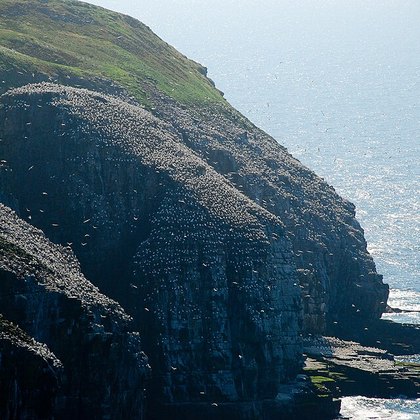
Breeds on bare, rocky desert islets in the Gulf of California, where the nest is no more than a scrape lined with feathers, grass and beach debris. Outside the breeding season it stays close inshore, usually within some fifteen kilometres of land, over shallows holding sardine and anchovy. It rests and roosts on beaches, rocks, piers, pilings, breakwaters and coastal rooftops, and does not avoid seaside towns. Far offshore it is scarce, and inland it hardly occurs at all.
Where the bird is most often found, arranged by the USNVC — the vegetation classification of the United States and Canada — and CMECS for sea and coast.




Range and movements
About ninety per cent of the world population breeds on Isla Rasa, an islet of less than a square kilometre in the Gulf of California; the rest is spread over a few dozen other islets along the Mexican coast. What it does next is unusual for a gull: instead of going south, the birds move north up the Pacific coast from June, reaching California in July and August and Oregon, Washington and British Columbia in autumn, then drifting back in winter. A smaller share travels the other way, as far as Guatemala. Since Isla Rasa was protected in 1964 the breeding population has grown strongly, from an estimated fifty-five thousand pairs in 1975 to around a hundred and fifty thousand pairs now.
- Resident
- Breeding (summer)
- Winter
- Passage
- dark = core range, pale = thinly spread
Where and when to look
The best months on the American west coast are July to October, and the best place is a pier or rocky point where Brown Pelicans are fishing: Heermann's Gulls wait for a pelican to surface and try to rob the catch from its pouch. Look for a grey gull that is not drifting with the rest but hanging over a pelican — the behaviour gives it away sooner than the plumage.
Conservation
The species is listed as Near Threatened (NT), not because the birds are few but because almost all of them breed in one place: a single failure of the anchovy, one storm, or one introduced rat on Isla Rasa reaches the whole population at once. Thousands of eggs were taken there each year in the past and guano was mined; since protection in 1964 and the removal of introduced rats and mice, breeding success has improved greatly. The lasting concerns are the sardine and anchovy fisheries and the warm years in which the food fails and the colony sometimes raises almost nothing.
Scientific name
Larus heermanni | Cassin, 1852
Cassin described the species in 1852 as Larus heermanni, and because it has stayed in that same genus ever since, author and year stand without parentheses. The specific name honours Adolphus Lewis Heermann, physician and collector on the American Pacific Railroad Surveys, who took the specimen described. Larus is the classical Latin word for a gull, borrowed from Greek laros. The type locality is San Diego, California — not the breeding range, then, but the stretch of coast the birds move to after nesting.