All species › Waders, gulls and terns › Auks, puffins and murres › Guadalupe Murrelet
Guadalupe Murrelet | Synthliboramphus hypoleucus
Xantus' alk | Mérgulo de Guadalupe
Guadalupe Murrelet breeds on just two island groups in the world — Guadalupe and the San Benito Islands off Baja California — which makes it one of the most narrowly distributed seabirds in North America. It lives further from the coast than any other auk of this shore: pairs drift alone or in twos over deep water, far out of sight of land. Since 2012 it has been counted as a species in its own right, separate from Scripps's Murrelet, with which it previously went under one name.
Voice
At sea it is almost always silent; the most anyone hears there is a short high squeak between the two birds of a pair. At the colony it is noisy after dark, with high whistles, squeaking see-see-see series and a soft rapid chatter with which partners find each other above the noise of the surf. By day the birds keep quiet in their crevice, because sound draws gulls and owls. Those very calls turned out on closer study to differ from those of Scripps's Murrelet, and that was one of the arguments for counting the two as separate species.
No recording with a suitable Creative Commons licence has been found for this species yet; what to listen for is described below.
Identification
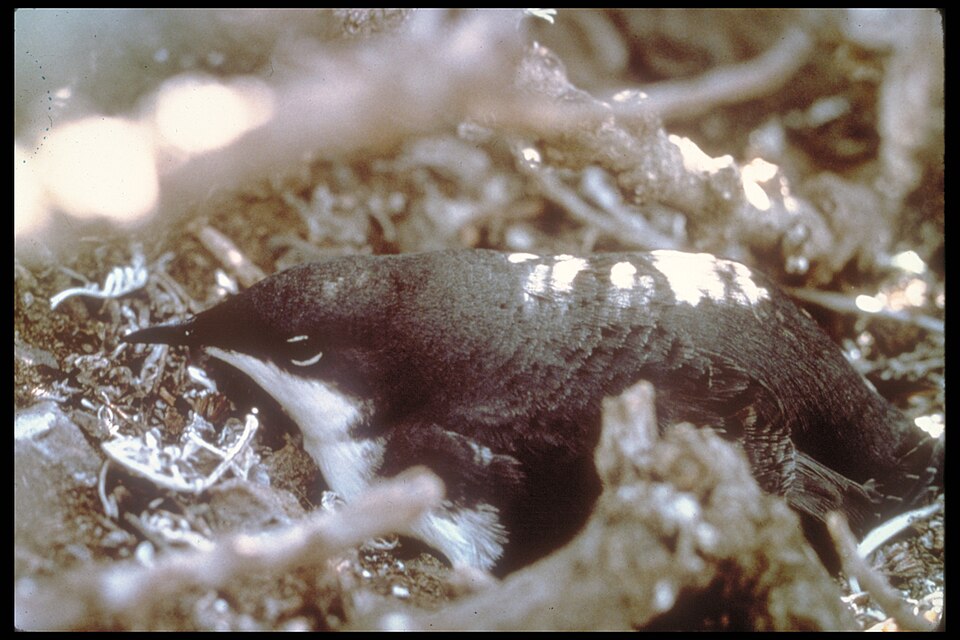
A small, neatly black-and-white auk with a small head, a thin pointed black bill and bluish-grey legs. The upperparts are black with a blue-grey bloom when the plumage is fresh; chin, throat, breast and belly are clean white, and the division runs sharply along the side of the head. The white of the face reaches in front of and above the eye, so that the dark eye sits in a white field instead of vanishing into the black cap — the mark by which it is known. The underwing is bright white, seen as a brief flash as the bird takes off. Male and female are alike and there is hardly any seasonal change; juveniles resemble the adults but have a shorter bill and some dark flecking on the flanks.
Confusion species
Scripps's Murrelet (Synthliboramphus scrippsi) is the only real pitfall: on that bird the white of the face stops below the eye, so the eye lies within the black cap, whereas on Guadalupe Murrelet it stands in a white field. Craveri's Murrelet (S. craveri) has a dusky rather than white underwing, a dark half-collar at the sides of the breast, and black running down below the eye. A winter Marbled Murrelet is black and white but has a white collar and a white scapular bar and barely occurs here. At sea it nearly always comes down to how much white lies in front of the eye; if you saw only the flight, the bird usually cannot be named.
Habitat
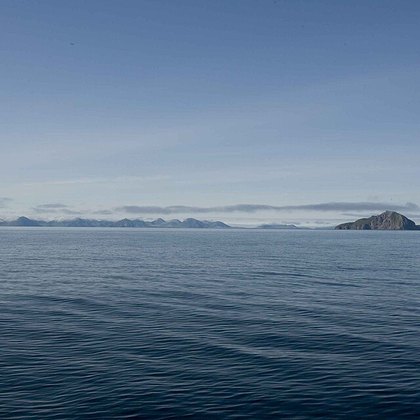
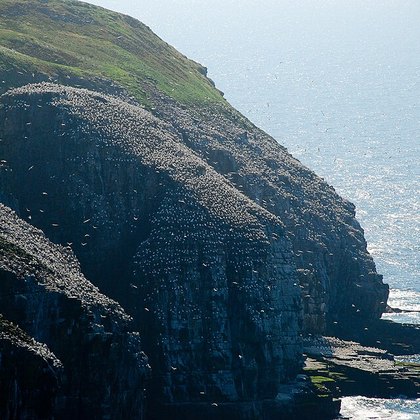
Outside the breeding season it is a bird of the open ocean, further offshore than the other auks of these waters and often beyond the edge of the continental shelf. It breeds on steep rocky islands: in crevices, holes under boulders and under dense bushes on slopes above the sea, always hidden. It avoids inshore waters, bays and harbours, and comes ashore only in darkness. Its islands are dry and treeless; the vegetation it needs is no more than a low shrub to roof a crevice.
Where the bird is most often found, arranged by the USNVC — the vegetation classification of the United States and Canada — and CMECS for sea and coast.
Range and movements
The breeding range is small: Isla Guadalupe, some two hundred kilometres off the coast of Baja California, and the San Benito Islands closer to land. After the breeding season the birds spread out at sea, north into the waters off northern California, but always well offshore. On the San Benito Islands it breeds alongside Scripps's Murrelet without appreciable interbreeding; that finding helped decide the taxonomic separation of the two forms in 2012. On Guadalupe itself colonies were lost during the years when the island carried goats and cats.
- Breeding (summer)
- Winter
- Passage
- dark = core range, pale = thinly spread
Where and when to look
It can only be seen from a boat, and best on a multi-day pelagic trip far beyond the California Channel Islands, from August to October. Sail with binoculars ready and watch for pairs that fly straight away from the boat rather than diving. Take a photograph if you can: the difference from Scripps's Murrelet lies in millimetres of white around the eye and is often judged more accurately afterwards on a screen than on a rolling deck.
Conservation
The species is listed as Endangered (EN) on the Red List: there are only a few thousand birds, almost all on two island groups, and numbers are falling. Introduced cats and rats did heavy damage on Guadalupe, and because the whole population lies so close to the busy shipping lanes to Los Angeles, a single oil spill could strike a large part of it. On the San Benito Islands the introduced predators have been removed and breeding success is recovering; on Guadalupe management is still under way.
Scientific name
Synthliboramphus hypoleucus | (Xántus, 1860)
János Xántus described the species in 1860 as Brachyrhamphus hypoleucus; because it was later placed in another genus, author and year stand in parentheses. The genus name Synthliboramphus goes back to Greek sunthlibo, 'to press together', and rhamphos, 'bill'. The epithet hypoleucus comes from hupo, 'beneath', and leukos, 'white': white below. The type specimen was collected at Cape St. Lucas, the southern tip of Baja California, where Xántus, a Hungarian exile in American service, collected birds for years. The English and Spanish names point to Isla Guadalupe, the island that holds the heart of the species.